Listen to SupChina editor-at-large and Sinica podcast host Kaiser Kuo read this article.
On January 25, 2020, as the city of Wuhan headed into the world’s first Covid-19 lockdown, the Chinese billionaire Wang Jian arrived on one of the last incoming trains. Flanked by a small entourage of younger scientists, Wang exited the station wearing a mask, a light puffy jacket and a backpack. Thousands were fleeing the river port metropolis. But Wang came ready to work.
During the SARS epidemic in 2003, the now 66-year-old geneticist had been similarly proactive, repeatedly flying to the outbreak’s epicenter in Guangdong Province to petition authorities to allow his young bioscience firm, the Beijing Genomics Institute (BGI), to sequence the deadly respiratory virus’s genome. Wang’s requests were denied until the last moment, after SARS reached Canada and scientists there became the first to sequence it — a national embarrassment for a rising China. BGI eventually sequenced the SARS genome, but the bureaucratic delay angered Wang, who built his career in the fast-moving biotech industry off ambitious, risky plays.
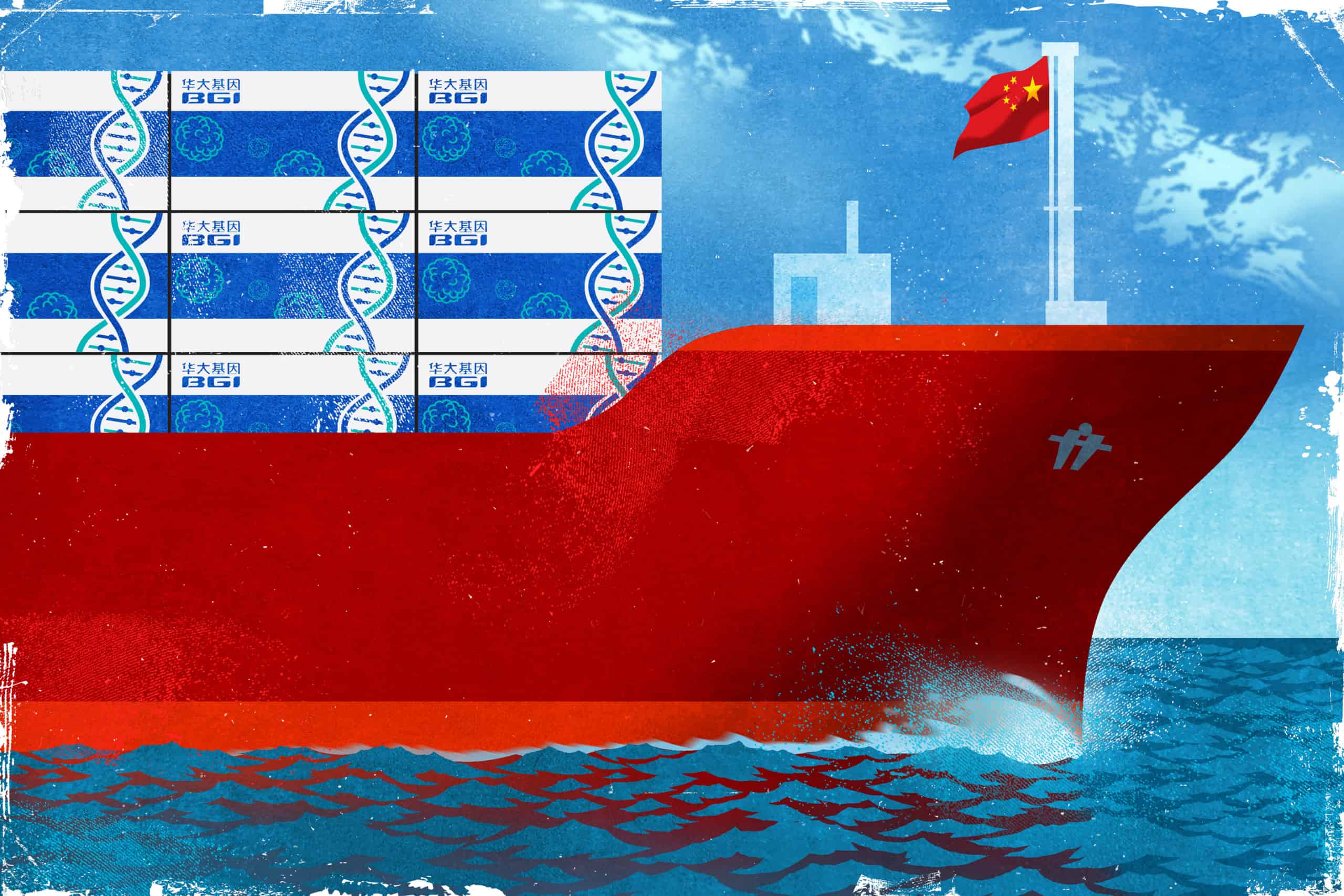
When the Covid-19 pandemic began, Wang, BGI’s chairman, wasted little time heading to the source. Experience had taught him to value action over waiting for government permission. And he was at the helm of a much heftier ship now: In just a decade, BGI has gone from a scrappy start-up working out of a shoe factory to a $7 billion biotech giant that boasts the world’s largest genetics research center and more than 6,000 employees in a dozen countries.1It’s also a company that is believed to have more gene sequencing capacity than all U.S. labs combined.
In Wuhan, Wang’s team built a field lab to collect and analyze Covid-19 samples. The virus’s genome had already been sequenced by Chinese scientists in early January. Wang’s plan was to develop a map of the outbreak. “Accurate detection and diagnosis are as important as clinical rescue to defeat this epidemic,” he said at the time. “We have in our hands a scientific toolkit to fight the outbreak.”
Wang branded their makeshift laboratory “Fire Eye,” a reference to the Taoist Monkey King, a mythical figure popular in China who can see demons in people. The lab, a large inflatable tube, was well-equipped with sequencing machines, diagnostic equipment and robots. It took five days to erect and was capable of performing 10,000 tests a day. According to BGI’s own estimates, the early detection work in Wuhan helped reduce the spread there by nearly 50 percent.

Credit: BGI, CCCC Second Harbor Engineering
Afterwards, they set up a dozen more Fire Eye labs throughout the country. In one three-week span, BGI tested 12 million Beijingers, and soon proved indispensable to China’s official pandemic response efforts. The company, which prizes itself on its renegade history, was showered with positive press coverage in the state media and promotions from China’s diplomats abroad. BGI’s share price nearly doubled over the past year on the Shenzhen Stock Exchange, and is now valued at $7 billion. Like the Monkey King’s supernatural vision, the company has been on fire.
As the rest of the world succumbed to the virus, BGI sought to offer a hand. In April, the company pledged to provide diagnostic tests and Fire Eye labs to more than 80 countries, from Sweden to Sri Lanka. BGI also introduced a website to collect open-source Covid-19 genetic data to help get ahead of virus variants. The firm’s global outreach was particularly successful in the Middle East, where it struck deals in the UAE, Israel and Saudi Arabia.
[BGI] is this merger of company, academic institution and government that blurs all the lines.
George Church, a Harvard geneticist and longtime BGI advisor
Last spring, BGI even sought to provide aid to the United States, which at the time was struggling to test for the virus. The company propositioned about a dozen states. “We propose to establish the world’s largest Covid-19 testing facility through a public-private partnership,” BGI said in a proposal to California officials. “By working with the state’s existing testing labs, this operation could be running tests in less than 2 weeks.”
But advisors in the state cautioned against accepting such an offer, warning that the company’s links to China presented privacy risks. Those concerns were partly based on an unclassified U.S. intelligence brief circulating at the time, according to The Washington Post. Dated April 10, it warned that “Chinese influence over CGI [BGI’s American subsidiary] could provide China with access to the sensitive medical data of patients who use its medical testing.” All Fire Eye proposals in the U.S. were eventually turned down.
Similar concerns emerged in Australia. In April, BGI announced a $210 million deal to distribute 10 million Covid-19 tests in the country. But just as in the U.S., critics raised concerns that the company could collect citizens’ genetic data, a hint that it could be shared with the Chinese government.
Those concerns were heightened in June, after a report published by the Australian Strategic Policy Institute (ASPI), a think tank in Canberra, linked a BGI subsidiary to a repressive surveillance campaign being carried out in China. The subsidiary, Forensic Genomics International (FGI), was accused of collaborating with public security bureaus in China to take genetic samples from men and boys and establish databases for DNA profiling, ostensibly for criminal forensics.
A month after the report’s publication, the Trump administration added two BGI subsidiaries to the Commerce Department’s Entity List, effectively sanctioning the company by restricting U.S. firms from exporting goods to the companies. The Commerce Department cited the firms for alleged abetting of repressive surveillance in the western Chinese region of Xinjiang, where up to one million Uyghur Muslims have been detained in massive detention camps.

BGI quickly disputed the allegations in a press release. But in the west, BGI seemed less like a group of brilliant scientists hoping to quell a pandemic and more like a shady behemoth in cahoots with the Chinese authorities. BGI’s core competencies, after all, dovetail nicely with many of Beijing’s ambitions — China’s latest five year plan highlighted biotech as one of seven strategic areas, as did Beijing’s Made In China 2025 initiative — and the company has longstanding ties to the state: since 2016, BGI’s opulent Shenzhen headquarters have also housed the China National Gene Bank, a state bio-repository, and government-designated “Key Laboratories” for genetic research.
BGI’s Covid assistance programs marked a new level of potential coordination. Often, announcements of BGI’s foreign deals came with exalted commentary from Chinese diplomats. BGI’s deal in Saudi Arabia was framed in a government press release as the “result of [a] phone call” between Xi Jinping and the Saudi king.
Even the company’s biggest advocates in the West acknowledge that, institutionally, BGI is a chimera.
“It is this merger of company, academic institution and government that blurs all the lines,” says George Church, a renowned Harvard geneticist and longtime BGI advisor. “They’re kind of this smoothly oiled machine that has features of all three types.”

Credit: BGI
In response to the firestorm of allegations, BGI has kept mum, releasing only a few terse rebuttals while refusing interviews, including a request from The Wire. But as BGI’s global influence expanded last year, suspicions about its relationship with Beijing paralleled a larger shift in western attitudes towards Chinese multinationals. From Huawei to ByteDance, the line between the CCP and Chinese tech firms has grown increasingly blurred. And while the potential privacy risks of social media apps like ByteDance’s TikTok are up for debate, the value of one’s genetic data, which has been called “the new gold,” is more universally agreed upon.
“This will be the locus of science, technology and economic growth in this century,” says Scott Moore, a China-focused political scientist at the University of Pennsylvania. “It’ll surely bleed over into U.S.-China relations.”
Thanks to BGI, it already has.
BUILDING BLOCKS
Despite its state ties today, BGI was founded in spite of the Chinese government, not because of it. In the late 1990s, its four, foreign-educated founders — Wang Jian, Yang Huanming, Yu Jun and Liu Siqi — struggled to find support back home, where the field of genetics wasn’t yet taken seriously. They saw a dual-edged opportunity in the Human Genome Project, an international project established in 1999 by America’s National Institute of Health to map the 3 billion base pairs of the human genome. By volunteering to tackle 1 percent of the genome, BGI would be able to slipstream itself into the global genetics field. At the same time, by representing China on the world stage as the only participant from a developing country, the company might also earn some much-needed government goodwill.
The gamble worked: A year later, when Bill Clinton singled out China for its role in the project, Beijing saw that BGI had indeed earned it some global cred. Soon after, BGI was folded into the Chinese Academy of Sciences (CAS), in Beijing.
Then-President Bill Clinton noted China’s contributions in his June 2000 announcement that the Human Genome Project had been completed.
Credit: William J. Clinton Presidential Library
But if the Human Genome Project launched BGI into existence, it was rice that catapulted the company into fame. In 2002, BGI scientists announced that they had sequenced the entire genome of one variety of rice. Others had been trying, but BGI pulled it off.
“It was as if you could hear the scientific community’s necks turn and creak,” recalls Laurie Goodman, publishing director of GigaScience, BGI’s scientific journal. “That was really when a lot of people were like, ‘Okay, they’re doing cool things.’”
BGI’s ambitions soon exceeded what CAS’s bureaucratic dictums allowed. After an ugly split, Wang Jian, Liu Siqi and Yang Huanming relocated the company to Shenzhen in 2007. They renamed it, simply, BGI, and set up shop in a former shoe factory in the seedy port district of Yantian. (Yu Jun set up a rival company within CAS called the Beijing Institute of Genomics or, BIG.)
Wang Jian described the move as the company’s “second resurrection,” and just a year after their southern relocation, BGI made global headlines again by sequencing the first genome of an Asian person. A flurry of nerdy milestones soon followed: sequencing the giant panda, a cucumber, a silkworm, intestinal microbes, even the DNA of an ancient man.2The four thousand year old man scientists named Inuk discovered in Greenland’s permafrost.
“I have a dream that we are going to sequence every living thing on earth!” declared Yang Huanming at a genetics conference in 2011. “We are going to sequence everybody in the world!”

Credit: Imaginechina via AP Images
With financial backing from heavy hitters like Softbank, the China Life Insurance Company and Jack Ma’s Yunfeng Capital, the company went on a recruitment drive, expanding its team from under 1,000 to more than 3,000 and opened offices in the U.S., Europe and other parts of Asia.
But BGI still faced one big hurdle: The company was reliant on sequencing machines from Illumina, a California firm and industry leader. In 2010, BGI had even placed a record-setting order when it purchased 128 sequencing machines from Illumina using a portion of the $1.5 billion in loans the company borrowed from the state-run China Development Bank. In order to end its dependence on Illumina and become an industry leader itself, BGI made a 2012 bid to buy Complete Genomics (CG), a fledgling but technologically advanced sequencing firm in California. Illumina, which was also vying for the firm, contested the acquisition by painting its once top-customer as an untrustworthy agent of the Chinese state. (Illumina did not respond to requests for comment. The two firms have been engaged in a series of lawsuits since 2019 regarding patents and antitrust claims.)
The deal raised both economic and national security objections from other observers as well. First, by making gains in the U.S. market, the company would have access to the country’s more diverse DNA samples, which in turn would help it develop drugs and diagnostic tests that could compete with U.S. companies. The national security concerns were harder to articulate, but a 2012 article in The Atlantic called “Hacking the President’s DNA” specifically mentioned BGI and outlined the risks of a future in which states developed “personalized bioweapons.”
Nonetheless, after a federal review, BGI’s $117.6 million bid went through, allowing the Chinese upstart to build its own sequencing machines. By the end of 2013, the company’s valuation hit $820 million, and they soon launched a subsidiary, MGI, in order to manufacture sequencing technology. The result has been a drastic decrease in the cost of sequencing. In 2001, it cost upwards of $95 million to sequence a human genome. By 2014, Illumina had reduced it to $1,000. Today, BGI can do it for $600.

Credit: Roy Kaltschmidt for Lawrence Berkeley National Lab, Creative Commons
“They can usually underbid anything you get from Illumina and produce data of at least the same quality,” says Rasmus Nielsen, a biologist at UC Berkeley who has collaborated with BGI. “They deliver on what they say they can deliver.”
What makes the U.S. apprehension about BGI testing so intriguing is that BGI has a long history of partnering and collaborating with leading American institutions and scientists. It has forged ties with Harvard, the University of Washington, Johns Hopkins, Mt. Sinai Hospital and the Bill and Melinda Gates Foundation. The firm even has labs in San Jose, Seattle and Cambridge, Mass. And 92-year-old James Watson, who with Francis Crick discovered the structure of DNA more than half a century ago, was at one time listed as a BGI advisor.3In an extraordinary move, in 2019 BGI donated $5 million to fund the current and future archives of Nobel laureates at Cold Spring Harbor Laboratory in New York.
In addition to that backing, the company has been quick to adopt and monetize new technologies. In 2010, they started clinical trials for non-invasive prenatal tests. Today, the service, called NIFTY tests, makes up the lionshare of its revenue, according to public filings, with over six million performed. The firm boasts investments in other advanced industries as well, including precision medicine, artificial intelligence for diagnostic medical use, and even agriculture, with a focus on making strategic crops like millet more resistant to climate change.
“If there’s something biotech-related, BGI is probably doing it,” says Hallam Stevens, a scientific historian at Nanyang Technological University in Singapore who is writing a book on BGI. “They’re incredibly diversified at this point, giving lots of things a go and seeing what sticks.”

Data: S&P’s CapitalIQ
Many initiatives didn’t stick, of course. A much-touted pig cloning project fizzled to nothing, and an effort to launch a BGI college was struck down by the government. The company’s most high-profile dud was the Cognitive Genomics Project, which set out to analyze the genomes of 2,000 high-IQ individuals to learn more about the origins of genius. Led by an eccentric teenage prodigy, the project produced many international headlines but few actual findings. It also raised some ethical red flags that, in the years since, BGI has had a hard time shaking.
The company has made no secret about its obsession with personal health, and Stevens says it is known to have a “fetish for youth.” Wang Jian, who often performs pushups on stage at conferences, has detailed BGI’s “100+” goal — the hope that its employees will live past the age of 100 — and the company has undertaken strict methods to help them get there, such as disconnecting elevators in order to force people to walk and tracking employees’ dining habits at the company cafeteria.
But while promoting an active lifestyle is one thing, BGI’s interest in its employees’ health often wades into uncomfortable territory. A few years ago, Wang remarked at a press conference that it would be an embarrassment if a BGI employee were to have a child with birth defects.
“That’s a very eugenics kind of mentality,” says Stevens. “But that resonates a lot with the Chinese government’s attitude towards biotechnology. They think we need to keep people healthy not just with more hospitals and doctors but through preventative means, including genetic testing.”
BAD SCIENCE
BGI is not China’s only major biotech company, nor is it the only one interested in the U.S. market. But it is by far the largest and most visible, making it a convenient target for various concerns related to China’s global healthcare ambitions. Accusations of ethical lapses, such as the so-called “CRISPR-baby” incident, large hacks of American medical companies originating from China, and concerns around weak patient privacy regulations are increasingly common and, to an extent, warranted.
“Through cyber intrusions in recent years, the PRC has already obtained the Personal Identifying Information (PII) of much of the U.S. population,” says Dean Boyd, the communications director at the U.S. government’s National Counterintelligence and Security Center. “By combining this stolen PII with personal health information and large genomic datasets collected from abroad, the PRC is afforded opportunities to precisely target individuals in foreign governments, private industries, or other sectors for potential surveillance, manipulation, or extortion.”
Much of the concern over genetic data transfer seems pulled from a futuristic spy novel. Through such data, for example, intelligence agencies might discover a person’s propensity for an addiction, which they could then exploit. Aggregated U.S. data could also reveal diseases that the country is particularly vulnerable to. And it may even be possible to target specific ethnic groups with genetically-curated bioweapons.
“It’s science fiction now but also something that’s not completely unthinkable,” says Yves Moreau, a professor of genetic engineering at the University of Leuven. “It’s a bit beyond the edge of current technology but not very far.” Rumors that Beijing is planning such bioweapons, he adds, already terrorize Uyghur communities in Xinjiang.
Science fiction or not, it is a threat that, increasingly, the United States is taking seriously. In 2019, the Committee on Foreign Investment ordered the Chinese tech firm iCarbonX, which was founded by BGI’s former CEO and is backed by Tencent, to divest from its 2017 stake in PatientsLikeMe, a U.S. health firm that helps patients identify other patients with similar conditions.
And earlier this month, a U.S. federal research panel led by Google’s Eric Schmidt released a 750-page report on the national security implications of Chinese advances in AI and biotech. BGI, it says, “may be serving, wittingly or unwittingly, as a global collection mechanism for Chinese government genetic databases, providing China with greater raw numbers and diversity of human genome samples as well as access to sensitive personal information about key individuals around the world.”
Calling it “the biotechnology equivalent of Huawei,” the report recommends Washington more aggressively highlight to consumers “concerns about the links between BGI and the Chinese government.” (BGI has stored some genetic data on Huawei servers, according to reporting by the Wall Street Journal.)
BGI insists that it does not share anything with the Chinese government. “BGI pays particular attention to complying with scientific ethics and personal privacy protection at all times, with zero tolerance for any violations of ethics and privacy, and strictly prohibits any business that violates human rights,” the company said in a statement.
Still, BGI’s privacy policy is hardly reassuring. The company does not share consumers’ genetic data with a third party, the policy states, unless when “it is directly relevant to public security” or “otherwise provided by applicable laws.”
For observers, this is a huge loophole. Nor do Wang Jian’s personal feelings towards the matter scream due diligence. “Emperors have been ruling us for thousands of years. I know the government is watching us at all times,” he said in 2014. “So what? I don’t care about my personal privacy. It just doesn’t matter.”
Particularly foreboding to some is BGI’s links to the Chinese military. In January, Reuters found that several scientists associated with BGI had worked with the military on brain science and biological enhancement programs, such as making soldiers less susceptible to altitude sickness.
This is consistent with a larger strategic interest, says Elsa Kania, an expert on Chinese military innovation. In recent years, she says, biotechnology has become a major focus of Chinese military strategists. As expressed in influential military textbooks and research journals, these interests range from brain-computer interfaces to using drugs for cognitive enhancement to developing “ethnic specific genetic weapons.”
“From a policy perspective, I’m less concerned about what BGI is doing in the U.S. or otherwise,” she says, “and more about the fact that the U.S. has failed to put into place a coherent framework for the security and management of genetic data and biomedical information, given its value and potential sensitivity across the board.”
For many, the risk of U.S. genetic data falling into China’s hands is more an economic threat than a national security one. All biotech companies desire data, after all. Vast amounts of it across diverse populations can lead to medical breakthroughs with enormous commercial value.
“From a national competitiveness angle, there would be reason not to transfer American genetic data to BGI en masse,” says Abigail Coplin, a sociologist at Vassar College who studies the Chinese biotech industry. “Not because I think that they’re going to do anything nefarious with it, but because it is a particularly diverse and unique genetic data pool that, if China suddenly had access to, would probably make them pretty difficult to compete with as we move forward with precision medicine.”
Indeed, BGI’s offer to help the United States with Covid testing, critics said, represented something of a corporate Trojan Horse — a means for the firm to get a foothold in the American healthcare market and amass biodata for eventual Chinese corporate domination.
The discourse around data privacy and regulation is at a very different place in China versus the West.
Hallam Stevens, a scientific historian at Nanyang Technological University in Singapore who is writing a book on BGI
“What happens if we realize that all of our future drugs, our future vaccines, future health care are all completely dependent upon a foreign source?” Edward You, an FBI special agent, said on the news program 60 Minutes in January. “If we don’t wake up, we’ll realize one day we’ve just become health care crack addicts and someone like China has become our pusher.”
You’s fear — that China’s ability to vacuum up data will lead to other innovations, leaving the U.S. behind — is not entirely without precedent, says Stevens, of Nanyang Technical University. The same fear has come up with Alibaba, the Chinese internet giant: Alibaba’s huge collection of data about Chinese citizens has allowed the company to develop powerful tools, such as the Zhima system, which calculates credit scores using data pulled from customer purchases — reportedly the basis for the Chinese government’s broader “social credit system.”
“The discourse around data privacy and regulation is at a very different place in China versus the West, so what they have been able to do with these data, it seems, has been less circumscribed,” says Stevens. “Also, operating in a nation that’s four to five times the population of the U.S. gives them a further advantage.”
To describe the aggregation of genetic, medical and other biological datasets and subsequent spillover commercial uses, researchers have coined a new term: the “bioeconomy.” According to a new report from the National Academies of Sciences, Engineering and Medicine, America’s bioeconomy is at risk, in part, because its tradition of data openness is being met with “constrained access to international data,” including “the strict regulations on exporting Chinese genetic data or samples.”
“There is a strong push to bring a lot of data inside China to create a large strategic asset,” explains Moreau. “Chinese companies could then establish leadership in many domains of medical and pharmaceutical technology. The question is, if this data is not shared back, will Chinese companies have a significant and unfair competitive advantage?”
BGI seems to be counting on it. In a 2016 interview, Wang Jian reflected on the importance of “the China context” in BGI’s astonishing success. Only because of the intense momentum of the Chinese economic boom and support from the state, he said, could the company become what it has.
“Not any individual has the strength or ability to bring BGI to where it is today,” Wang reflected. “Without the China context, there is no BGI.”

Brent Crane is a journalist based in San Diego. His work has been featured in The New Yorker, The New York Times, The Economist and elsewhere. @bcamcrane