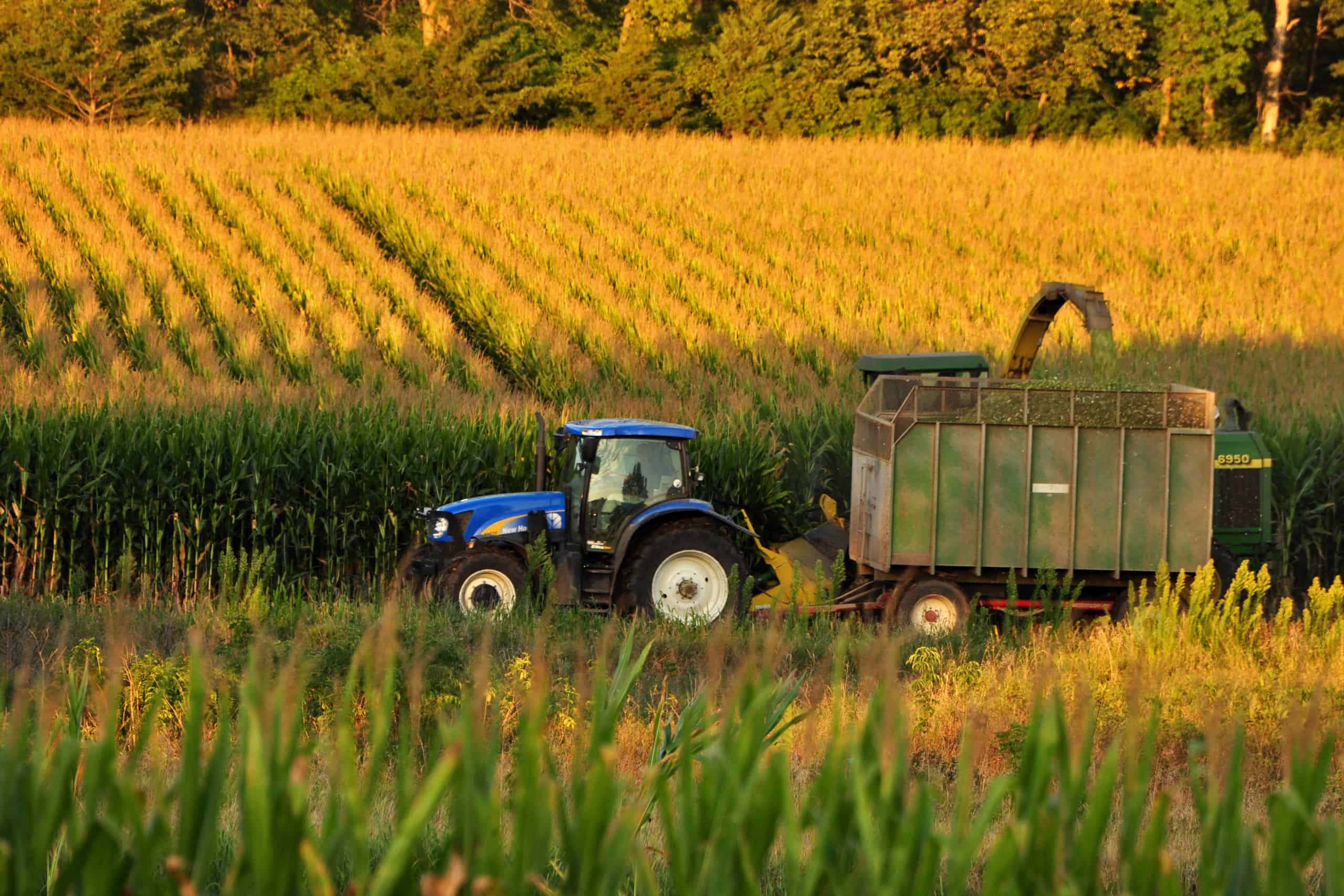
Credit: TumblingRuns, Creative Commons
In the treacherous trade relationship between the United States and China, there has been one kernel of hope: corn.
During the past year, corn exports to China have reached record levels. In the last four months of 2020 alone, the U.S. shipped 124 million bushels of corn to China, up from less than one million in the same period in 2019. And reports from the U.S. Department of Agriculture project that from last October to September 2021, American farmers could export as much as $31.5 billion worth of agricultural products to China — the highest number ever — driven partially by surging demand for corn.
“The corn exports to China have been crazy,” says Jim Putnam, a corn farmer in Worthington, Minnesota. “It is something I never saw coming. We went from zero to incredible demand.”
But what appears to be a bright spot in U.S. trade with China is not necessarily a sign that the U.S. will close its massive deficit, which totalled $310.8 billion last year.1Experts note that while corn exports are soaring, most other major exports to China have dropped in recent years. Instead, analysts say it may be a temporary surge in demand.
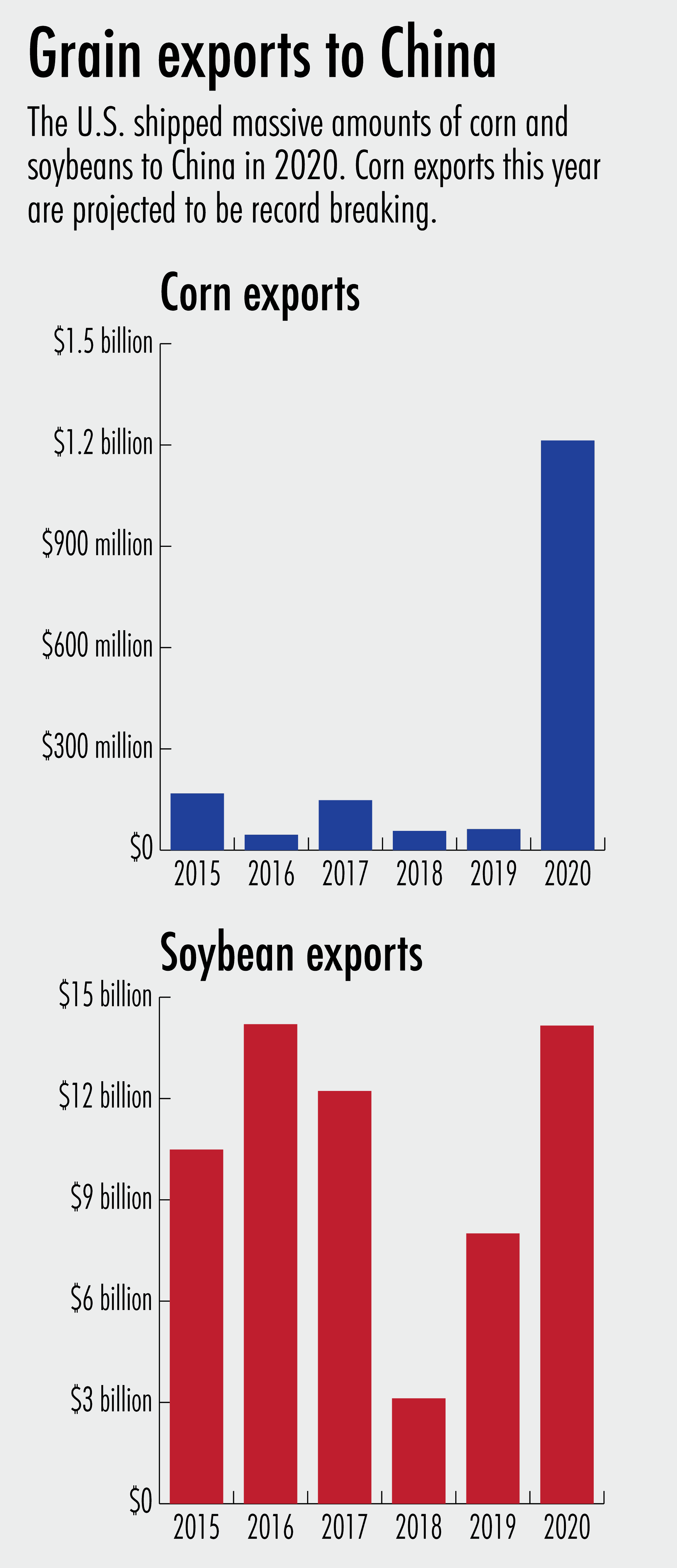
Why exactly China is buying so much corn is a mystery. Historically, soybeans and sorghum, as compared to corn, have been far more significant American grain exports to China. And while exports for all three of those grains, which are primarily used by Chinese buyers for animal feed, are doing relatively well this year, corn is a standout.
“China is by far the biggest importer of U.S. corn this year,” says Bryan Lohmar, the China director for the U.S. Grains Council, an organization that promotes the global use of American grains, including corn. “But why is demand so high? That part is less clear.”
One explanation, analysts say, could be the phase one trade deal, which was signed last year and included a pledge from China to buy $200 billion of U.S. goods over two years, including agricultural products. According to a recent study by the Peterson Institute for International Economics (PIIE), a Washington-based think tank, corn exports reached 497 percent of China’s trade deal target.
But given that China fell short of reaching its overall target by more than 40 percent, and that the country also imported large amounts of corn from other nations, including Ukraine and Brazil, many experts are skeptical that the trade deal is the sole source of the corn boom. “It might be OK right now for corn, but everywhere else it is much worse than it was four years ago,” says Chad Bown, a senior fellow at PIIE.
Instead, experts say this is driven largely by Chinese domestic demand for corn. “Some would say the phase one agreement is driving this,” says Joseph Glauber, senior research fellow at the International Food Policy Research Institute and former USDA chief economist. “But the fundamental fact here is that China needs corn to meet feed demand.”
One of the forces driving that demand, analysts say, is African swine fever, an epidemic which wiped out nearly half of the Chinese pig herds starting in 2018. With the supply of pigs now recovering, experts say China is seeking to bolster its feed supply. There is also evidence that the disease is changing the way that pigs are fed in China, as farmers move away from using food scraps and recycled food waste, which can be a disease vector, to relying on grains like corn.
There are, of course, other contributing factors, including two World Trade Organization grain disputes which the U.S. won against China in 2019 — one aimed at the government subsidies given to Chinese grain producers and another linked to tariff-rate quotas, a two-tier tariff system which the U.S. argued limited its access to the Chinese market. High domestic prices for corn, and China’s relatively quick recovery from Covid-19, which is driving up demand for meat, may have also contributed to the import surge.
It’s difficult to determine the precise factors behind the surge, analysts say, because China’s agricultural data isn’t transparent. “There is widespread distrust about Chinese official stats related to pig inventory and corn reserves,” says Wendong Zhang, an economics professor at Iowa State University. “And the domestic stats not only have implications for the domestic market, but also for global corn trade. It’s hard to really know what is going on.”
For now, corn farmers across the midwest are celebrating, but given the impermanent nature of some of the contributing factors, like African swine fever and China’s quick recovery from Covid-19, that may not last. “When is the party going to end?” asks Jon Scheve, president of grain at Minnesota-based Superior Feed Ingredients. “China’s demand has been a huge savior for the corn industry this year, but what if it stops?”
China has long insisted on food security so that the country is not too dependent on imports, but the country’s huge population and shortage of arable land makes it difficult. Though China produces most of its corn domestically, it is taking steps to be even more self-reliant, both by planting more corn and attempting to increase crop yield, which is significantly below U.S. corn yield. On top of that, analysts say China would rather import corn from countries which it has better trade relations with, like Brazil or Ukraine.
When is the party going to end? … China’s demand has been a huge savior for the corn industry this year, but what if it stops?
Jon Scheve, president of grain at Minnesota-based Superior Feed Ingredients
Even if that happens, ethanol may be a future source of corn demand. Prior to the pandemic, China was beginning to implement an ethanol mandate, which required that all gasoline contain 10 percent ethanol in an attempt to reduce pollution. That roll out was paused last January, but when it is reinstated, it could push up demand for corn imports, including from the United States. Just last month, China purchased a large amount — around 200 million gallons — of ethanol for the first half of 2021, potentially representing an early sign of increasing demand for the biofuel.
The American farm belt is also hopeful that the Biden administration, which is in the process of reviewing the trade deals with China, won’t let agricultural products get caught up in the broader acrimony. During the trade dispute with Beijing, agricultural exports to China took a beating, but farmers, who were a crucial voting bloc for Trump, received massive federal payouts.
“There are so many issues between the U.S. and China, but the agricultural relationship is maybe the only positive aspect,” says the U.S. Grains Council’s Lohmar. “We hope that continues. It is in China’s interests — their import demand for corn is growing, and we are the major supplier. It fits.”
But Putnam, the Minnesota corn farmer, isn’t holding his breath. “As a farmer, I don’t count on the Chinese purchases to stay where they are at,” he says. “It would nice if they did, but I am not counting on it.”

Katrina Northrop is a journalist based in New York. Her work has been published in The New York Times, The Atlantic, The Providence Journal, and SupChina. @NorthropKatrina