Since the release of ChatGPT, American technologists and policymakers have claimed that the U.S. and China are locked in an escalating race to artificial general intelligence, or AGI. This is a powerful, yet misleading narrative.

In its most common formulation, AGI can be understood as the theoretical point at which AI systems can match, if not, outperform humans on most cognitive tasks, thereby creating crucial strategic advantages for the country or actor that reaches it first. Whether AGI is imminent remains contested, but the goal is taken seriously by the world’s leading frontier AI companies, which are collectively investing hundreds of billions of dollars into achieving it.
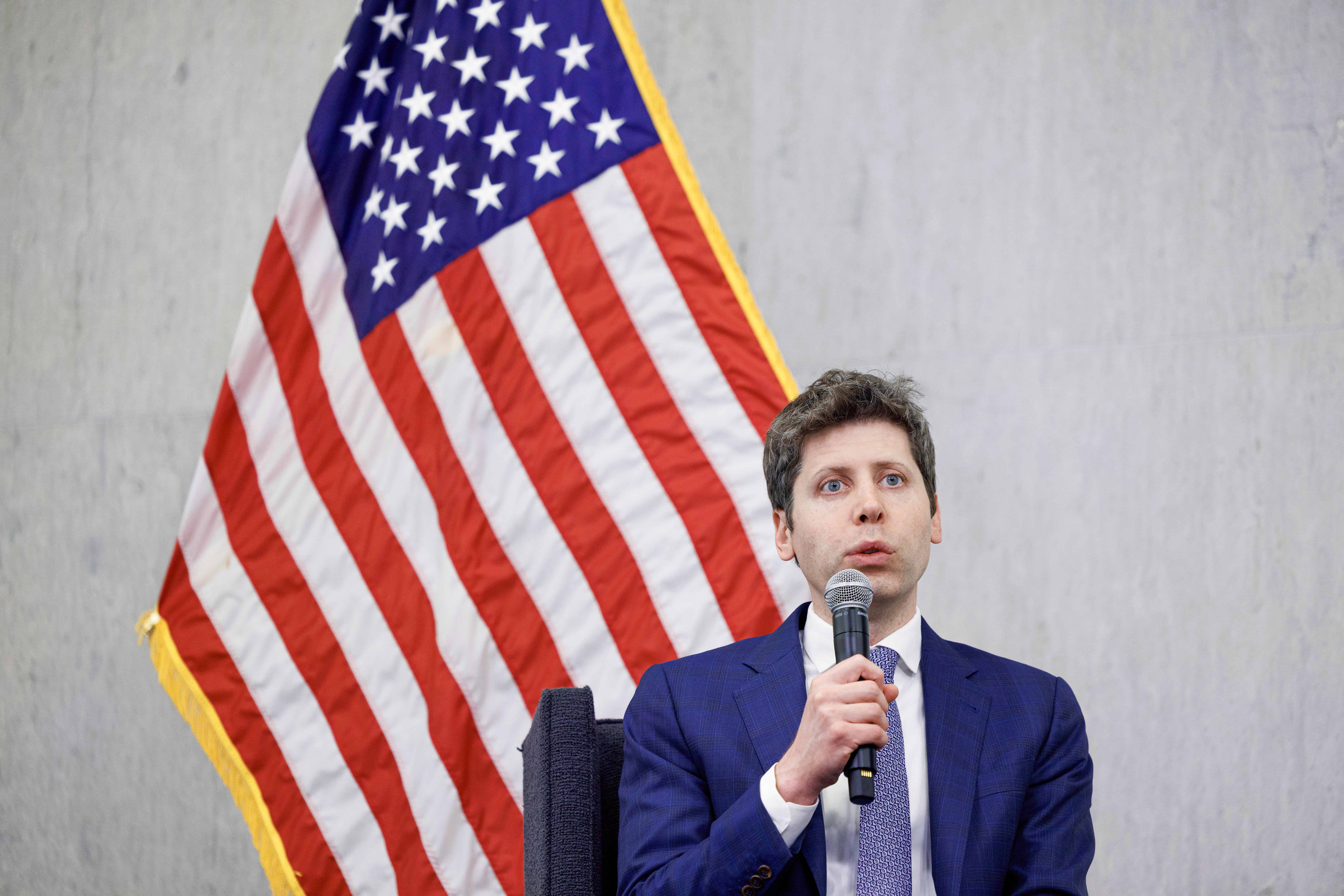
Essays by chief executives such as OpenAI’s Sam Altman predict AGI within the next few years, and paint an existential threat to the United States’s global future if it does not beat China to the AGI punch. Their companies use the same framings to call for energy infrastructure buildout, scrapping of state regulation, and access to copyright data; otherwise, in OpenAI’s words “America loses, as does the success of democratic AI”.

Beating China in AGI has been reported as a significant impetus for U.S. AI strategy under the Biden administration. Reportedly motivated in part by the goal of securing an AGI lead against China, it built expansive semiconductor export controls and introduced a diffusion rule limiting access to U.S. technology by nations worldwide. The Trump administration appears more sceptical thus far on AGI and superintelligence, and has placed a greater emphasis on protecting the global pre-eminence of the U.S.-led AI tech stack. Nonetheless the zero-sum framing of the AI race with China remains central to the administration’s rhetoric. Concerns around losing the AGI race to China remain prominent in the U.S. policy ecosystem, with commissions and prominent think tanks advocating to the Government to establish an AGI Manhattan project, and tech-funded advocacy organisations warning of the threat of Chinese superintelligence.
There’s only one small issue with all this: China does not appear to be racing towards AGI.
In spite of ChatGPT’s success, most of China’s influential policy advisors remain unconvinced that AGI is an imminent possibility. Rather, they see the current AI paradigm as a promising step towards AGI, but likely an inadequate one. It is also unclear if AGI — as it is commonly defined — is viewed as a desirable end goal by China’s top leaders, who have yet to make it a national priority or target. Instead of AGI, China’s long-term developmental goals lie at the center of its AI ambitions.

A major Chinese target has been to deliver innovation and economic successes through AI adoption which can in turn facilitate China’s economic transition away from the low-cost export-led developmental model. To support AI diffusion, the government has introduced plans and policies to increase compute and data supply for both large and small/medium sized firms. Following the release of models matching Western frontier performance such as Zhipu’s GLM-4 and DeepSeek’s V3 in early and late 2024 respectively, the Chinese government doubled down on AI adoption promotion through the AI+ Initiative. Despite U.S. policymakers’ fears, there have been no signs of a major investment in a Manhattan-type Project for AGI.
The 2024 Resolution on Reform and Modernization, drafted by President Xi Jinping and other members of the Politburo, serves as a comprehensive manifesto on what China plans to do to meet domestic social-economic developmental goals and to overcome China’s technological chokepoints. Amongst other changes, the document led to the passing of a private sector promotion law in April 2025 promising stronger business rights protection and signaling a relaxation of state control. Discussions in China’s top party journals have echoed this emphasis, often referencing the official buzzword and concept of “effective market and conditionally active government”. It is early days for these reforms. But if they are successful, they will show a salient shift from China’s state-centric model of innovation.
China is not presently racing towards AGI. It is taking meaningful steps on governance and safety, and there is a strong appetite for cooperation on risks, including with the United States. That is an opportunity the U.S. should be taking advantage of, not shutting down.
At a national level, the government has strengthened AI governance commitments and increased its focus on risks from AI. Since mid-2023, the State Council, via the support of the Ministry of Science and Technology, has been working to develop an AI Law to address China’s current lack of a broad, foundational legislation governing the technology. The 2024 Resolution further proposed an “AI security oversight system”. At the global level, in February this year, China’s leading AI policy and scientific practitioners, with the support of the government, launched China’s counterpart to the AI Safety/Security Institutes (AISIs) abroad, the China AI Safety and Development Association. At the launch event, which happened on the sidelines of the Paris AI Action Summit, the association released an AI safety cooperation framework proposing “the promotion of international cooperation to prevent substantial AI risks” and “the strengthening of global AI safety capacity-building”. At the 2025 World AI Conference, Premier Li Qiang announced China’s AI Governance Action Plan, which included a call for “global solidarity (to) fully unleash the potential of AI while ensuring its safety, reliability, controllability, and fairness” as well as the development of global technical standards.

Both nationally and internationally China has championed open-source AI platforms and models, albeit often with restrictions including censorship of sensitive political topics. Recent models released by DeepSeek, Alibaba and Moonshot AI have set the global standard for open-source model performance. This has already prompted a shift in U.S. companies’ open-source decisions, including at OpenAI. Given the ecosystem advantages from projects worldwide building on Chinese open-source AI, as well as the soft power and good will generated, it is unlikely the Chinese government’s support for open-source will wane any time soon.
China’s framing of governance and development as two sides of the same coin provides a foundation for future bilateral engagement, but challenges remain. The recent U.S. AI Action Plan voices concerns over political self-censorship within Chinese AI models to meet regulatory red lines, and the influence of Chinese companies on international standards relevant to facial recognition and surveillance. Prospects for international cooperation have also been weakened by the decision not to include Chinese institutions within the international network of AISIs, and bilateral cooperation has been further complicated by the U.S.’s addition of the Beijing Academy of Artificial Intelligence onto the U.S. Bureau of Industry and Security’s Entity List. U.S. experts have also argued that U.S.-led export controls have made collaboration with China on AI governance more difficult.
Meanwhile the race to AGI continues, but it is being run between U.S. companies, with the spectre of Chinese AGI used as justification. Policymakers are also told that there is little intention to regulate and little discussion of risk in China. Nationally these narratives are often used by these companies to lobby against stronger regulatory oversight, arguing that anything that could slow down American progress represents too great a risk given the alternative of disaster from unsafe Chinese AGI, or “enslave(ment) to PRC-mediated AI”. Internationally the winner-takes all nature of the AGI race narrative hamstrings prospects for global cooperation on AI.
We do not argue that China’s approach to AI governance is perfect, or that there are no obstacles to meaningful bilateral or global cooperation. What we do argue is that there is far more scope for cooperation than is often understood. It is inevitable for now that there will be competition and rivalry between the U.S. and China in AI, as in other domains. However a better understanding of China’s emerging strategy, and how it relates to the U.S.’s own evolving one, is essential for ensuring that this competition remains within safe bounds. China is not presently racing towards AGI. It is taking meaningful steps on governance and safety, and there is a strong appetite for cooperation on risks, including with the United States. That is an opportunity the U.S. should be taking advantage of, not shutting down.

Seán Ó hÉigeartaigh is a Professor at the University of Cambridge’s Centre for the Future of Intelligence, where his research focuses on frontier AI risk and governance.

Kristy Loke is an independent researcher focusing on China’s AI innovation and governance strategies.