University graduate unemployment has become such a problem in China that the authorities are taking a novel approach: Treat degree courses like a soccer match.

The referees — in this case the Ministry of Education — now assign academic majors a “yellow” card if too few graduates from their course land jobs; followed by a “red” if the problem persists. Courses that get a “green light” tend to include those related to robotics engineering, microelectronics, and intelligent construction, given their strong post-graduate employment prospects.
Youth unemployment and the surge in Chinese university graduates are closely linked. Among urban Chinese people aged 16–24, excluding students, unemployment hit 17.8 percent in July. That’s down from the post-Covid high of 21.3 percent, although China’s statistics bureau changed the methodology for calculating the rate in 2023.

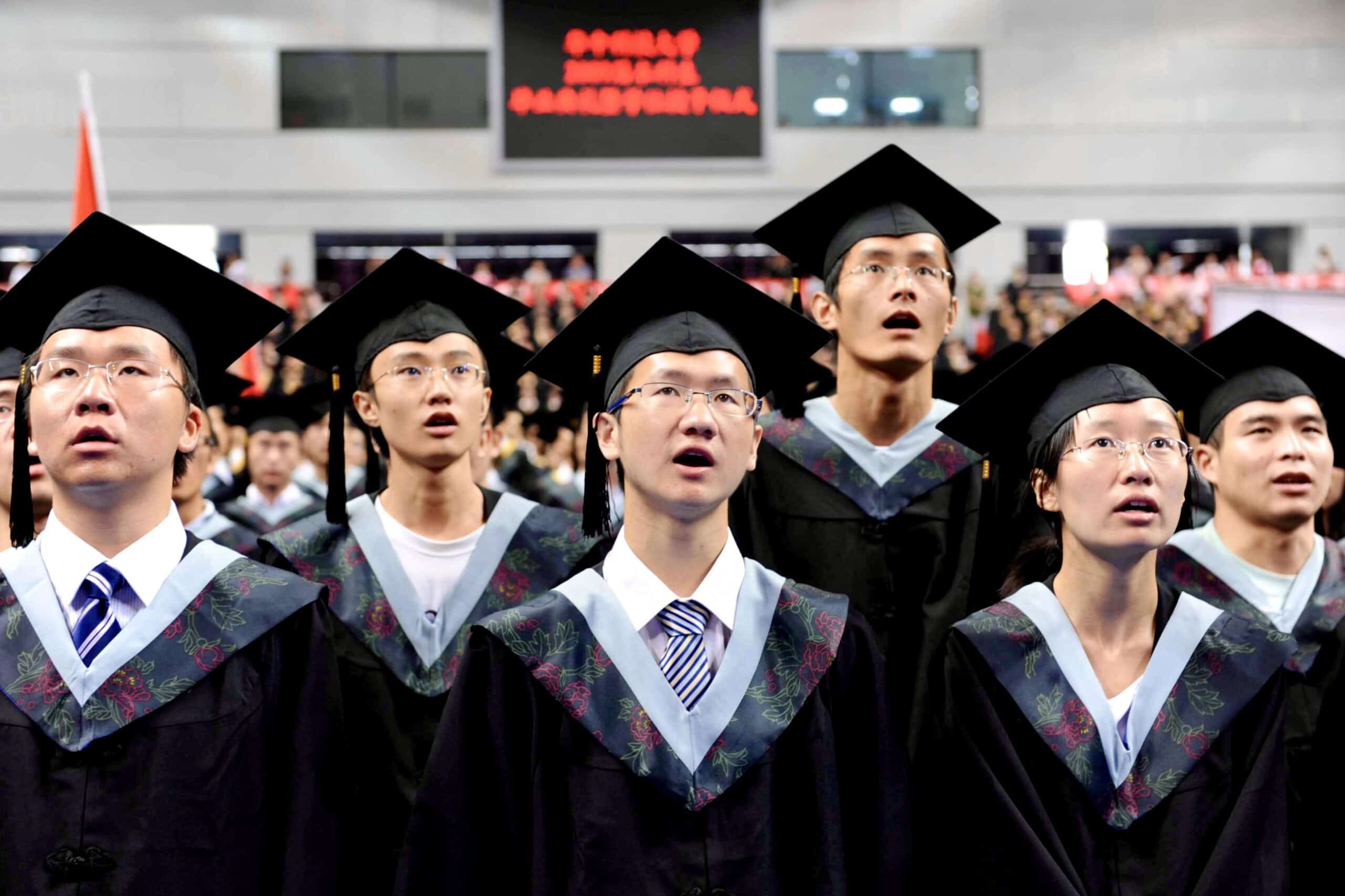
Meanwhile, this year, a record 12.22 million students graduated from China’s universities, almost double the number as recently as 2013.

Amid the youth employment crisis and record graduate numbers, the mandate for universities is clear: cut weak-performing majors and expand those whose graduates the economy most needs. Beijing has issued three major directives in the past two years. In February 2023, the Ministry of Education set a target to “optimize” 20 percent of majors by 2025. In September 2024, the CPC Central Committee and State Council introduced the red- and yellow-card warning system for majors with poor employment outcomes. And in January 2025, those bodies unveiled a broader strategy to build a “strong education nation” by 2035.
The concern of the government to reduce graduate unemployment is a strong incentive for colleges and universities to build closer cooperation with enterprises, as well as give some colleges an incentive to inflate graduate employment rates.
Gerard Postiglione, an emeritus professor in higher education at the University of Hong Kong
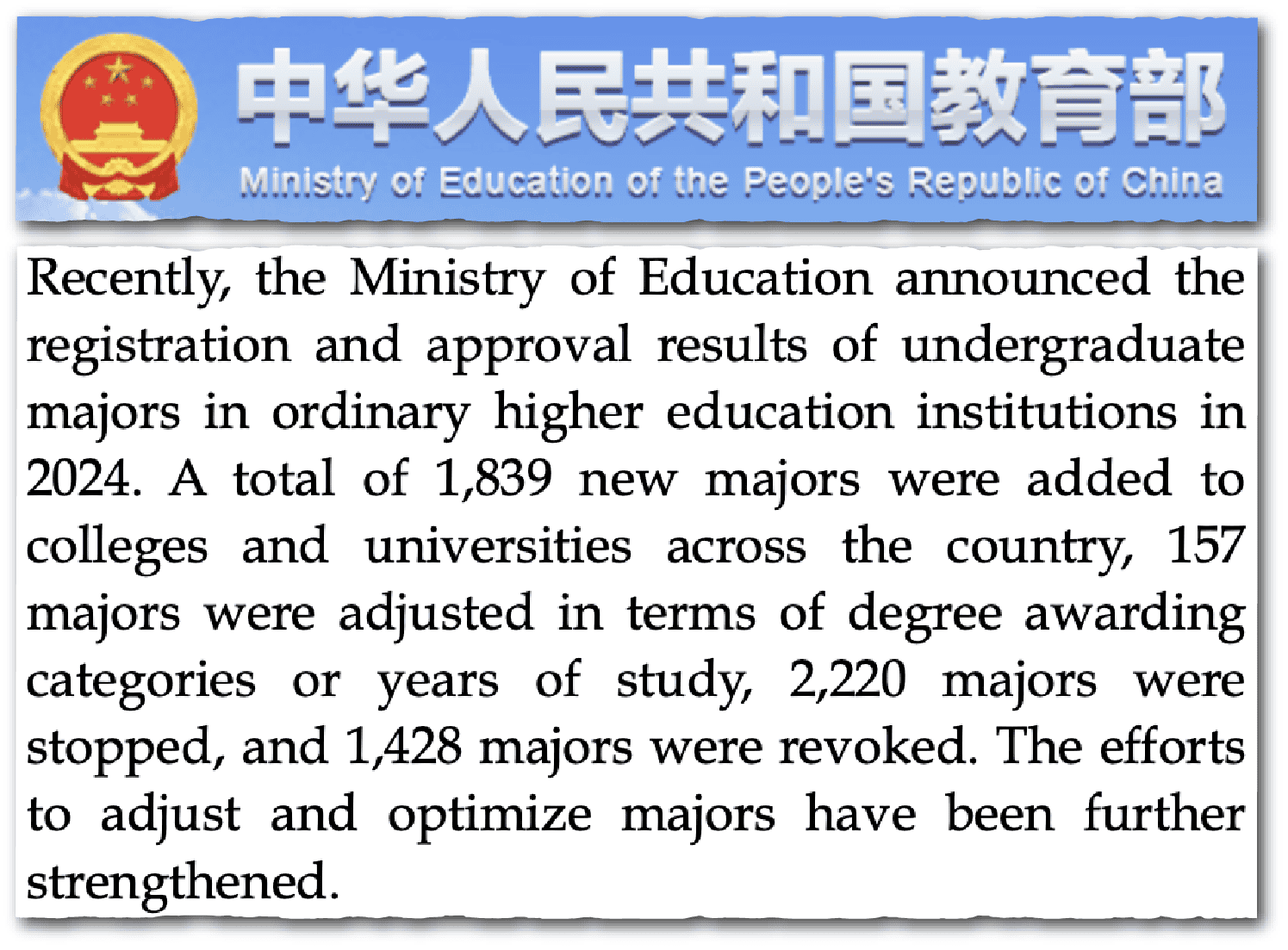
In the first full cycle after the initial directive, in 2024, universities paused or revoked more programs than they added, according to the Ministry of Education. The number of majors cut has multiplied twenty-fivefold since 2014.
“The government acted quickly to stem the mismatch between the higher education system and the needs of the labor market,” says Gerard Postiglione, an emeritus professor in higher education at the University of Hong Kong.

Amid the cull of courses, some subjects are suffering in particular. According to MyCOS, a Chinese education data platform, more than 150 universities have already proposed canceling majors in foreign languages, business administration, and design in 2025. Between 2020 and 2024, courses in information management and systems, public administration, and marketing were the most frequently cut, the data shows.
“The STEM bias in undergraduate majors has reduced programs in the humanities,” says Postiglione. “That the humanities preserve the complexity and diversity of human civilization gets short shrift in the era of AI omnipotence.”
Undergraduate ‘Red Carded’ Majors Over the Past 5 Years
| Major | 2021 | 2022 | 2023 | 2024 | 2025 |
|---|---|---|---|---|---|
| Public Utilities Management | |||||
| Music Performance | |||||
| Painting | |||||
| Legal Studies | |||||
| Fine Arts | |||||
| Applied Psychology | |||||
| Chinese International Education | |||||
| Educational Technology | |||||
| History |
The system for program offerings has also become more centralized. Universities must now submit applications for new majors a year in advance, embedded in long-term development plans. This gives the Ministry of Education greater latitude to approve disciplines that match regional development strategies. In Zhejiang, for example, universities have steered funding toward programs aligned with the province’s advanced manufacturing push.
“The concern of the government to reduce graduate unemployment is a strong incentive for colleges and universities to build closer cooperation with enterprises, as well as give some colleges an incentive to inflate graduate employment rates,” says Postiglione.
CCTV coverage of Beihang University’s low-altitude technology and engineering major. Credit: CCTV 13
Low-altitude technology and engineering — covering advanced aerial systems such as drones — has emerged as the most popular new program. A Beihang University recruitment video from June shows how prominently universities are marketing the field. According to a recent MyCOS study of 9 provinces and 508 majors, smart aircraft technology tops the list of industries facing the greatest talent shortage.
Some of the new additions in 2025 are specialized: for example, Peking University has announced a digital governance program, Shanghai Jiao Tong University an “ocean intelligence and unmanned technology” track, and Beijing University of Technology a new quantum technology program.
New Majors Proposed by China’s Ministry of Education
| Artificial Intelligence Education | Infant and Child Development and Health Management | Aviation Sports |
| Regional and Country Studies | Marine Science and Technology | Intelligent audio-visual engineering |
| Industrial Software | Spatiotemporal Information Engineering | Intelligent Molecular Engineering |
| Biomass Technology and Engineering | Smart Emergency Response | Low-altitude technology and engineering* |
| Integrated Circuit Science and Engineering* | Carbon Neutrality Science and Engineering* | Smart City and Spatial Planning* |
| Drug Economics and Management | Medical Device and Equipment Engineering | Health and Medical Insurance |
| Geriatrics and Health | Talent development and management | International Cruise Management |
| Dance therapy | Music Technology | Digital Drama |
| Digital Performance Design | Intelligent Image Art | Virtual Space Art |
| Human Settlement Design | Game Art Design |
Note: Courses marked with an asterisk are listed under “cross engineering”.
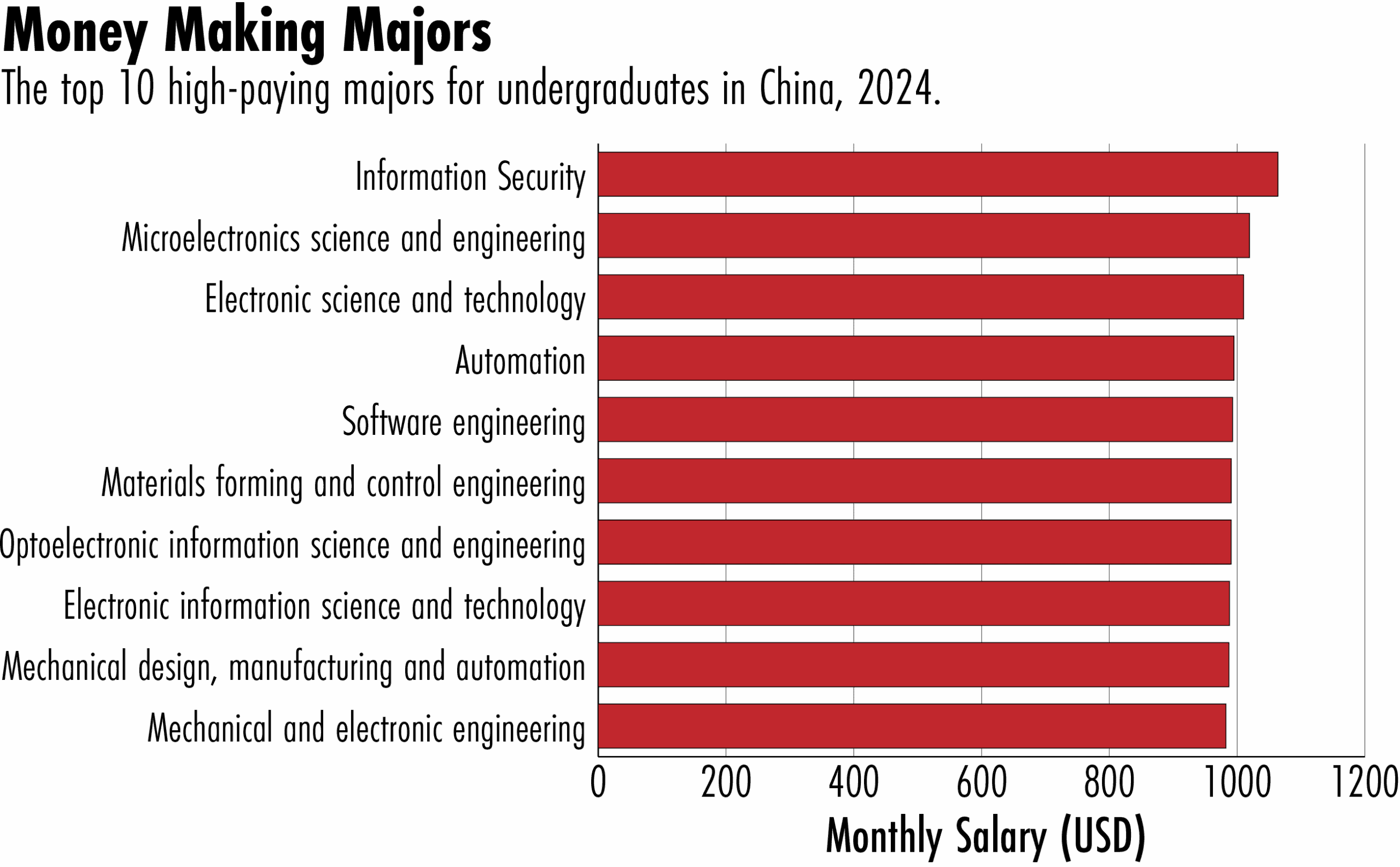
These offerings align closely with salary data. Software engineering and information security have ranked among the ten highest-paying majors for a decade, with information security consistently at the top.
The reshuffle has meant redeployment. Professors from closed or shrinking departments — especially in the liberal arts — are being shifted to general-education courses, administrative roles, or adjacent fields. Their students, meanwhile, are being nudged toward career paths in state-prioritized industries, as the range of options narrows in some areas and expands in others.

For universities, the reforms have brought tighter oversight and less room for independent planning. The major catalog itself increasingly functions as an extension of industrial policy, raising questions about what happens to disciplines that fall outside the state’s priorities.

Dean Minello was a summer staff writer for The Wire based in New York. He is a junior at Princeton University studying Public & International Affairs with a minor in East Asian Studies, and does research at Princeton’s Center for Contemporary China. Proficient in Mandarin, Dean is interested in authoritarian politics, human rights, and U.S.-China relations.