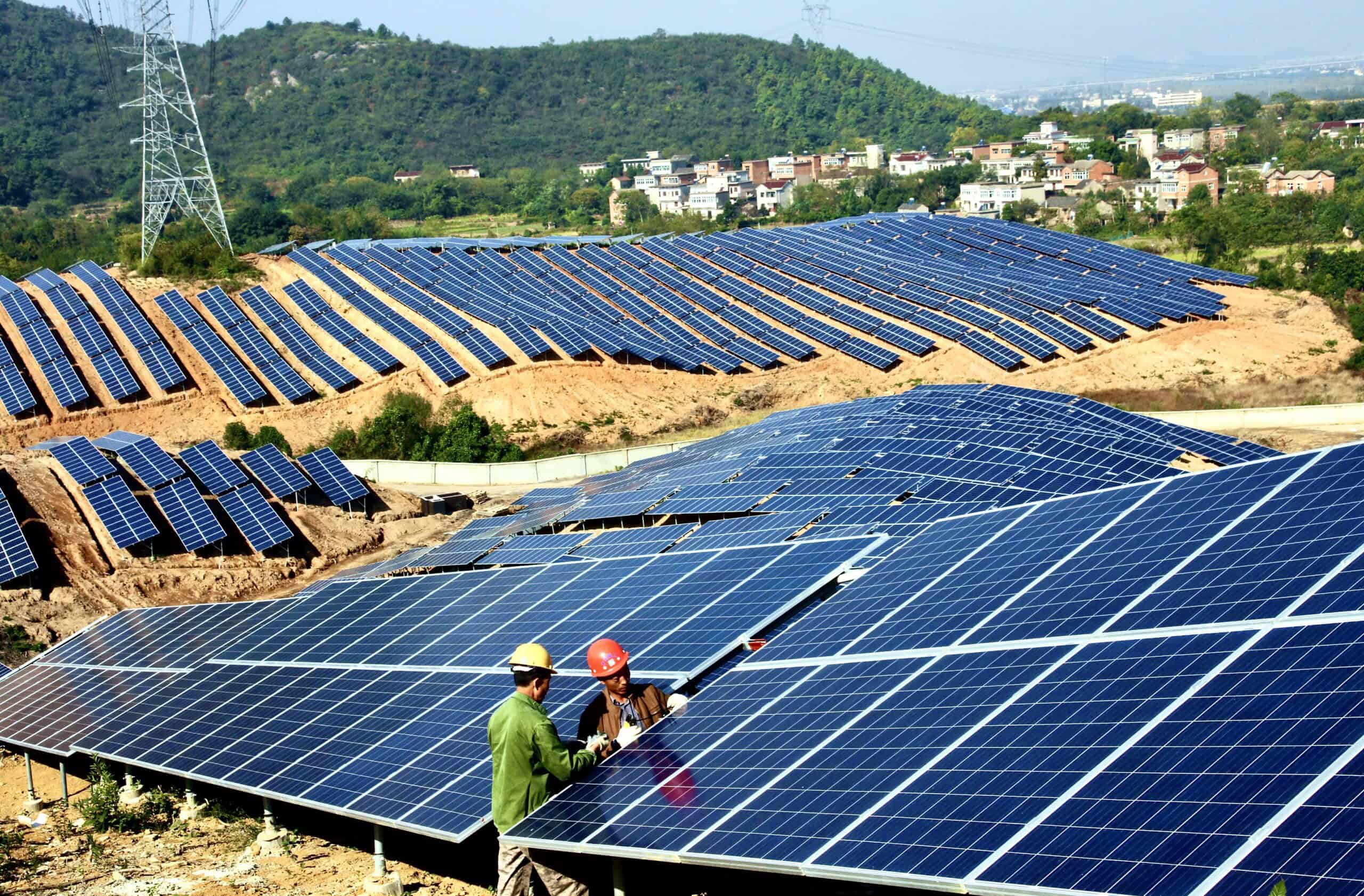
When Chinese investors began pouring into renewable energy in the early 2020s, it seemed like a perfect alignment of national ambition and global demand. Beijing’s push for carbon neutrality by 2060 coincided with Europe’s scramble to wean itself off Russian gas and the world’s broader embrace of clean energy. Factories expanded at breakneck speed, producing solar panels, wind turbines, and batteries for a market that seemed limitless. For a time, renewable energy was not just a growth story; it was the story of China’s rise as a green superpower.

But the cycle turned quickly. By 2023, overseas adoption had started to slow down, a trend that has gathered pace since the Trump administration came to power in early 2025, creating a cliff for Chinese green tech producers. As if this were not enough, China’s domestic demand for green tech has also peaked given the massive frontloading of installed capacity during the past few years, fueled by subsidies. Plummeting external and domestic demand have forced Chinese green tech companies to compete aggressively to gain market share by cutting prices. The consequences of lower prices have been slashed profit margins, which have dangerously increased financial risks for many companies. More specifically, 30 percent of China’s listed green tech companies are now zombies; in other words, they are unable to cover their interest payments with revenue generation.
This situation, which Premier Li Qiang, has coined as “involution” (内卷 nèijuǎn), is now regarded as one of the most urgent economic problems that the Chinese authorities need to solve. While there is often the impression that Li Qiang’s worries about “involution” target the U.S. and EU administrations, his main concern is probably domestic. Involution, or irrational competition as Premier Li Qiang often describes it, is a major problem at home as it fosters the misallocation of resources into unprofitable sectors with over competition. What is worse, such excessive competition has been fostered by government subsidies, especially at the local level, leading to an excessively high number of players in single sectors and in turn to excess capacity, especially given slowing domestic and external demand.

The government’s recent answer to the “involution” problem has been to force consolidation. In particular, companies are being urged to merge, acquire or be acquired, in the hope that fewer, stronger players will stabilize the market. Beijing is putting financial resources in to support the process. In the specific case of polysilicon, a RMB 50 billion restructuring fund has been created, aimed at shutting inefficient polysilicon plants, which together account for over one million metric tons of annual production. The Chinese government’s ultimate end is for Chinese companies to use their dominant position to hike prices, which will allow them to become profitable. In other words, an oligopolistic position in green tech industries is preferred rather than the current irrational competition, at least for foreign markets — since China, as a whole, dominates production so much that higher prices will hardly lead to a loss in its market share.
The question to ask is whether moving from over-competition to an oligopoly can be achieved simply through such financial incentives and the will of the Chinese leadership. If we focus on the most advanced case, that of polysilicon, prices briefly surged on news of the planned fund, offering a flicker of relief to producers. Some solar glass manufacturers and even auto firms have pledged to reduce output, echoing the government’s call for restraint. So, at first glance, it appears Beijing could have found the magic formula to solve the involution problem.

However, deeper flaws remain. Cartels are fragile, and history suggests they are prone to breakdowns when individual firms or local governments face pressure to cheat. Many provincial authorities rely heavily on green-tech firms for tax revenue and jobs; asking them to shutter plants in the name of national discipline runs against their immediate interests. Even if consolidation succeeds, it risks entrenching a handful of dominant players while sidelining smaller innovators, hollowing out the sector’s long-term dynamism. A policy meant to cure involution could just as easily pave the way for stagnation.
More critically, cutting capacity will do nothing to resolve the demand problem. Domestic installations of solar and wind have slowed, while overseas markets remain reluctant to absorb China’s glut of green tech supply. Without stronger consumption at home, the danger is that Beijing’s fund will merely rearrange the deck chairs, removing some excess but leaving the market’s underlying imbalance untouched. In the meantime, tens of thousands of jobs will be lost as inefficient plants close, aggravating social pressures in a country already grappling with record youth unemployment.
A pivot toward domestic green infrastructure would not only reduce the temptation to dump cheap products overseas, but also allow China to position itself as a credible partner in the global energy transition rather than a destabilizing competitor.
The most permanent solution would be to increase the demand for green tech. Increasing external demand is not really within China’s reach and prospects there remain bleaker than ever, as Trump slashes hopes of the U.S. prioritizing the energy transition and other countries turn their back on their plans, given waning international pressure.
However, China could do something about its own transition, given that its energy basket is still heavily dependent on fossil fuels, especially coal.
The heart of the problem in China’s case is that it produces too much green technology which it cannot deploy due to the lack of capacity of the country’s grid to put installed renewables to work. For years, Beijing’s industrial policy has favored green manufacturing capacity — which has the benefit of earning export revenue — over green infrastructure, in particular improving the grid, which is required to integrate renewable energy effectively. Grid bottlenecks remain severe, curtailing the use of solar and wind farms that have already been built. Energy storage capacity is still modest compared to the scale required for a renewables-dominated system.
If China truly wants to break the cycle of involution, creating oligopolies will not do the trick. China needs to redirect its resources from building more solar panels to building the infrastructure that can actually deploy them. Expanding transmission lines, upgrading local grids, and investing in large-scale battery storage would create demand for renewable technology far more sustainably than cartel-style supply management. Such a shift would also generate jobs in construction and engineering, cushioning the social impact of factory closures while supporting the broader goal of carbon neutrality.

There would be international benefits as well. For years, Europe and the United States have complained that China’s dominance in green manufacturing distorts global trade and undermines their own industrial bases. A pivot toward domestic green infrastructure would not only reduce the temptation to dump cheap products overseas, but also allow China to position itself as a credible partner in the global energy transition rather than a destabilizing competitor.
To be sure, infrastructure spending carries its own risks. China’s past reliance on credit-fueled construction led to excesses in real estate and heavy industry, and there is no guarantee that a green infrastructure push would be immune to similar inefficiencies. But compared to the dead end of endlessly subsidizing factories to outproduce one another, it offers a pathway that is both economically and environmentally more rational.
The story of China’s green transformation has always been about scale. But scale alone has reached its limits. The next chapter must be about balance: balancing supply with demand, manufacturing with deployment, and green manufacturing with green infrastructure.

Alicia García-Herrero is an Adjunct Professor at the Hong Kong University of Science and Technology, and the Chief Economist for Asia Pacific at Natixis. She also serves as a Senior Research Fellow at European think-tank Bruegel.