China’s export controls on rare earth elements and related products have disrupted global supply chains across the automotive, electronics, and defense sectors. These measures have been at the center of ongoing trade negotiations between Washington and Beijing since May when the two sides agreed to temporarily roll back tariffs and other restrictions imposed during the escalating trade war. While President Trump has repeatedly claimed that the Chinese government has promised to lift its controls, reports suggest that Beijing continues to drag its feet.

There are two takeaways from China’s recent actions. First, Beijing’s use of trade restrictions during coercive bargaining with the United States is increasingly bold, including tapping on a newly formalized sanctions toolkit. Second, it has carefully avoided using these tools in a way that commits it to any particular path of implementation. Instead, the Chinese government has used vague legal formulations that retain considerable flexibility and allow it to tighten or loosen controls as needed, effectively preserving a core feature of its historical sanctions strategy.
The latest spate of export controls, imposed on April 4 and consisting of licensing requirements on items related to seven key rare earths, builds on a gradual but consistent ramp-up of restrictions on critical raw materials led by the Chinese Ministry of Commerce. In response to technology restrictions under the Biden administration in 2023, China gradually introduced export licensing requirements on gallium, germanium, graphite and antimony, as well as superhard materials. In December 2024, after a new round of U.S. sanctions, it followed up by effectively barring the export of these materials to the United States.
Preserving some degree of uncertainty about its intentions and sanctions implementation keeps alive the perpetual hope of being able to gain access to raw materials and the broader Chinese market.
This pressure continued into the Trump administration. In the rapid exchange of tariff and non-tariff measures between the United States and China in early 2025, Beijing retaliated with heightened export controls in the rare earths sector where China dominates mining and processing. This sent a clear signal to American officials and companies, and may have been a key factor pushing the Trump administration to negotiate for relief. Alongside these formalized sanctions, more ambitious enforcement mechanisms are emerging within China, including through government crackdowns on smuggling and other attempts to circumvent export controls as well as government tracking of and travel restrictions on rare earth technical experts.
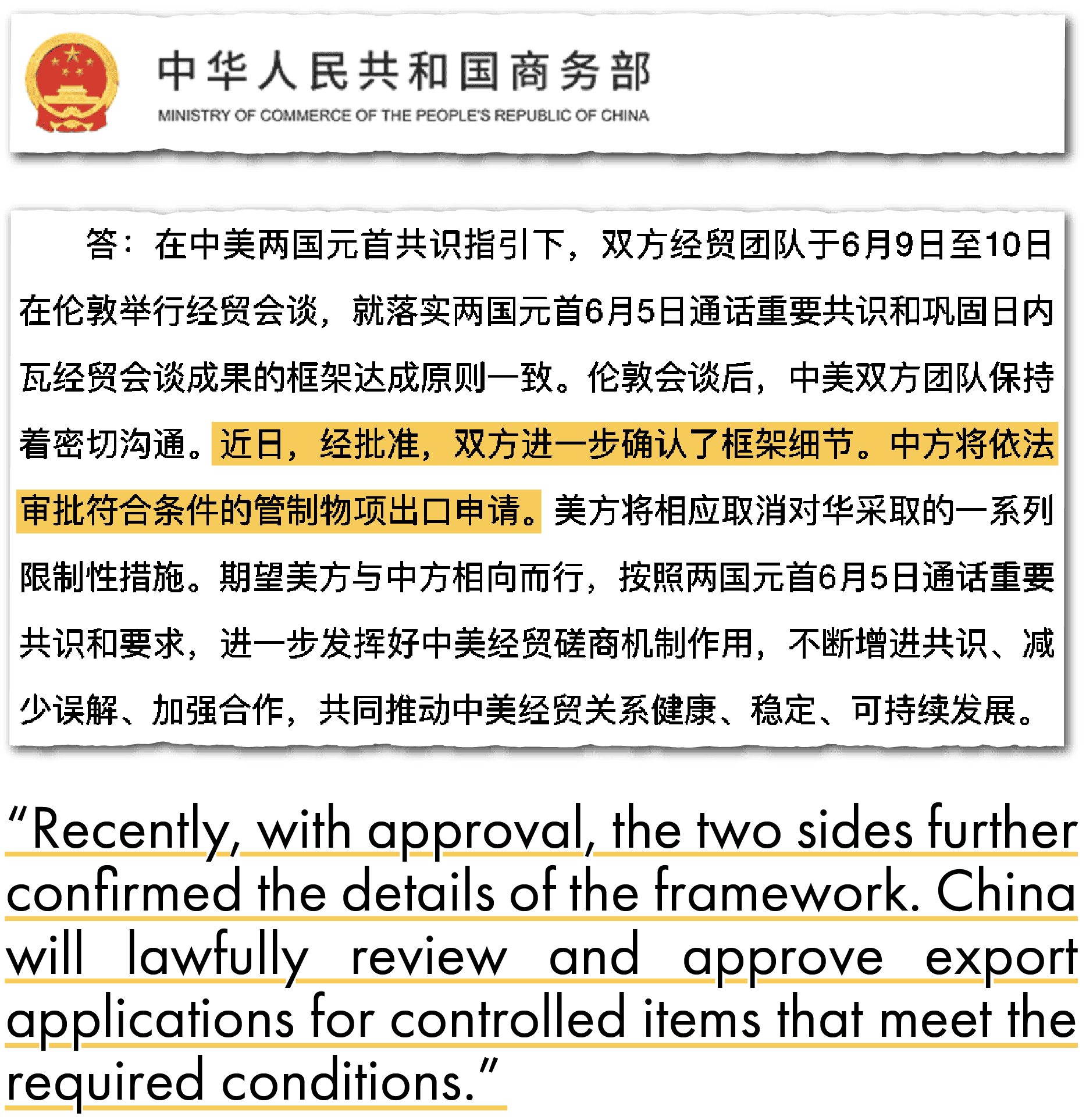
And yet, these seemingly law-based measures have been enforced in an opaque and ambiguous way. China has portrayed its recent rare earth export controls as unrelated to the trade war, describing them as routine restrictions to prevent dual use items from ending up in military equipment. Despite claims by U.S. officials that the issue has been resolved, China has slow-rolled export licensing approvals. On June 26, Trump said the United States had “just signed [a trade deal] with China yesterday”. The statement from the Chinese Ministry of Commerce the following day, however, remained vague, stating that China would approve applications “that meet the required conditions” and “in accordance with the law,” without specifying detailed criteria or procedures.
While some see this as deliberate coercion, others point to the lack of bureaucratic manpower that has constrained processing speeds. Since late April, Chinese companies have submitted a flood of export applications to the Ministry of Commerce’s Bureau of Industrial Security and Import and Export Control which has since then scaled up its capacity. The licensing application process has also included demands of sensitive commercial information, such as a company’s workforce, products, and even customer lists. At present, many firms seem prepared to adhere to the rules to keep their supply chains running despite the risks involved such as intellectual property theft. This could let Beijing build a picture of supply chain dependencies and potential chokeholds.

While China’s export controls are implemented through legal frameworks that outwardly resemble Western ones, imprecise language and vague enforcement grant Beijing the flexibility to calibrate pressure as conditions evolve. In its dealmaking with the Trump administration, the lack of any public commitment to lifting restrictions means that China can re-tighten controls under broad legal or national security justifications if tensions resurface. When doing so, the system gives Beijing the option to adjust pressure in strategic ways. It might, for instance, relax restrictions that lead to unforeseen economic costs or deploy differentiated pressure on firms, selectively rewarding sympathetic businesses while punishing others. Volkswagen, a vocal advocate of deeper cooperation with China, was among the first companies to receive rare earth related export licenses, while U.S. companies remain sidelined.
This is not only a risk for U.S. companies. The Ministry of Commerce has emphasized the global scope of its new export controls and said they are “not targeted at any particular country”. Europe has already been affected by the delays, with some automakers and medical equipment companies reportedly forced to halt production last month.
This ambiguous style of bargaining seems to provide China with a way to maintain coercive leverage without overt escalation that could spark a strong counterreaction from the Trump administration. Preserving some degree of uncertainty about its intentions and sanctions implementation keeps alive the perpetual hope of being able to gain access to raw materials and the broader Chinese market. This in turn seems to draw the U.S. government — as well as companies eager to preserve their bottom lines — to come back repeatedly to the negotiating table in hopes of a clearer resolution. China’s leverage is further amplified by Washington’s impatience to close deals and juggling of parallel negotiations with other countries.
Regardless of how these negotiations play out, Beijing has seen the power of its chokeholds in strategic sectors and is learning how to wield that leverage more effectively. The export control challenge from China is unlikely to go away.

Audrye Wong is an Assistant Professor of Political Science and International Relations at the University of Southern California, and Jeane Kirkpatrick Fellow at the American Enterprise Institute.

Viking Bohman is a Ph.D. Candidate at the Fletcher School of Tufts University and an associate analyst at the Swedish National China Centre at the Swedish Institute of International Affairs.

Victor Ferguson is a JSPS Postdoctoral Research Fellow at the University of Tokyo’s Research Center for Advanced Science and Technology.