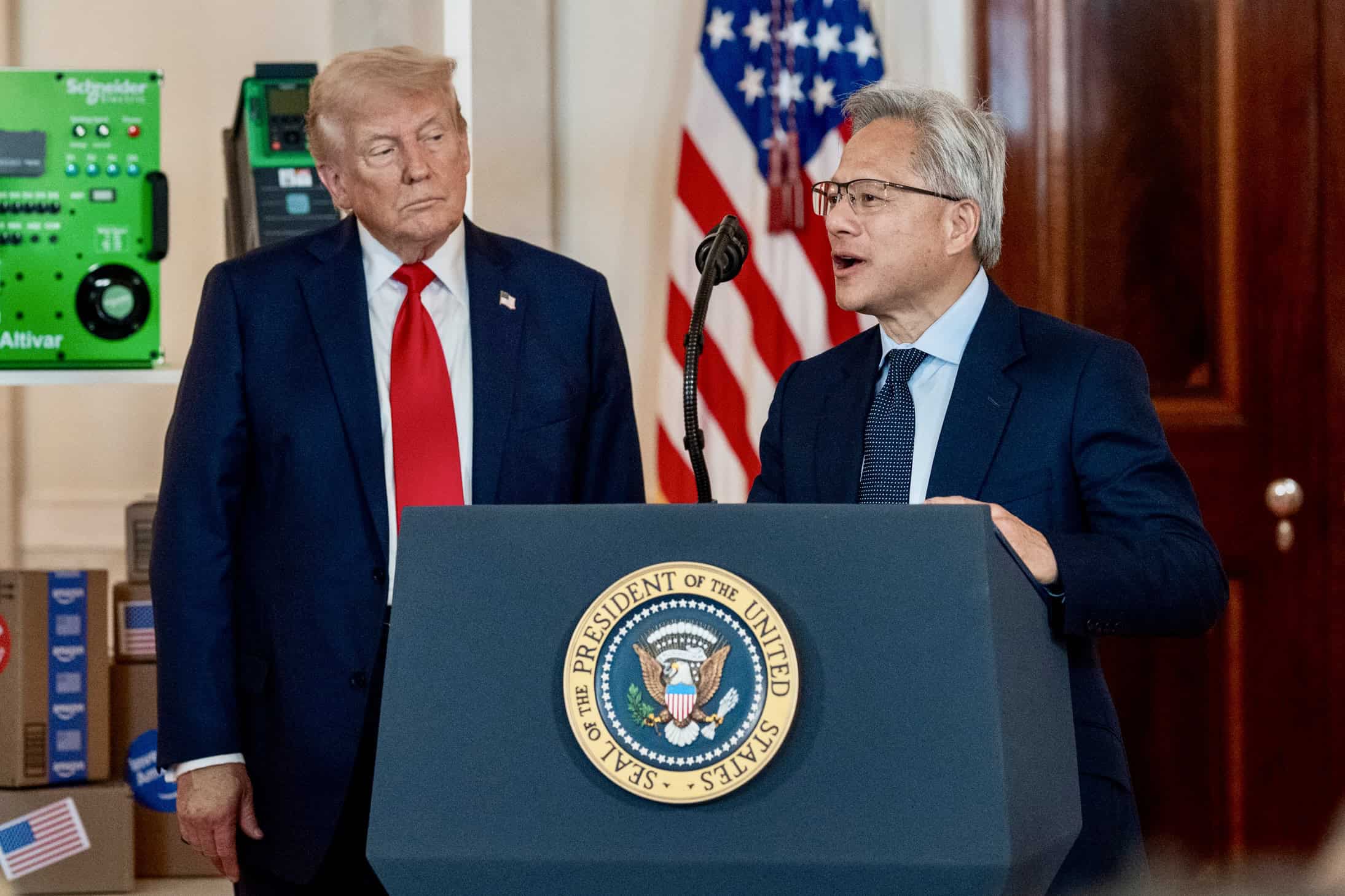
Last week, Nvidia’s chief executive Jensen Huang told reporters there is “no evidence” that his company’s highly sought-after chips for artificial intelligence (AI) are being smuggled to China. A new bill in the works in Congress says: Prove it.

The Chip Security Act, proposed by a bipartisan group of lawmakers this month, would compel chipmakers to outfit their hardware with “location verification” and require chipmakers to report any information about possible smuggling to the government.
The bill is the latest episode in a back-and-forth tussle between Nvidia, the world’s dominant producer of advanced chips for AI, and U.S. policymakers, who are increasingly frustrated that the export-controlled hardware keeps ending up in the hands of adversary countries.
For its part Nvidia, which is wary of increasingly burdensome regulations amid emerging competition from China’s Huawei, has already become more outspoken against U.S. controls on its chips business. Last week, Huang, in his most forceful comments to date, described the controls as a “failure” and called for the Trump administration to ease its restrictions.

Now, Congress is muscling into the fray. Its proposal to remotely track semiconductors is a simple idea, albeit one with little precedent. Past export controls, be they on nuclear materials or weapons, have largely depended on the sleuthing of U.S. Commerce Department officials for enforcement. Lawmakers want to put more of the onus on the chipmakers to check on where their products end up.
“Our national security is more important than one company’s profits,” Raja Krishnamoorthi (D-IL), ranking member on the House China Select Committee and a co-sponsor of the bill, said in a statement. “I’m proud to join my colleagues… in introducing this commonsense measure.”
A spokesperson for Nvidia declined to comment.
Since 2022, the U.S. has made blocking China from buying advanced semiconductors a hallmark of its strategy to keep ahead in the AI race. The chips are essential for the training and running of large language models, and between Nvidia and Austin-based AMD, U.S. firms have had a virtual monopoly over the market.

But Chinese AI companies have managed to keep up with leading U.S.-based developers like OpenAI and Anthropic, in part because it remains all too easy to obtain chips on the black market, thanks to a blooming cottage industry of chip smugglers operating in places from warehouses in Johor Bahru, Malaysia to electronics markets in Shenzhen.
Between ten thousand and several hundred thousand chips were smuggled into China last year alone, according to one estimate by researchers with the Center for A New American Security, a Washington think tank.
The sheer volume of smuggling has left the Commerce Department’s resource-strapped enforcement agency, the Bureau of Industry and Security (BIS) struggling to keep up. In parts of southeast Asia, where smuggling is widely suspected, American investigators operate only at the courtesy of local authorities. Smugglers can cover their tracks using a warren of shell companies, making enforcement a frustrating game of whack-a-mole. Chips that make it to China then all but disappear into an enforcement void.
There’s spy games and hardware exploitation that happens between nation states… but those sorts of activities are a separate world from what we’re talking about here. This technology would be open and pretty transparent.
Asher Brass, a researcher at the Institute for AI Policy and Strategy
Proponents of the Chip Security Act argue that “location verification” would beef up the export control regime in several ways. First, mapping the chips would help the government better gauge the extent of the smuggling problem. Second, it would provide honest customers a way to prove their chips are where they say they are, and for Huang to back up his claim that “chip diversion” isn’t a problem. Third, it would allow Commerce’s enforcement officials to concentrate its resources on suspected violators, making their probes more targeted.
Nvidia CEO Jensen Huang discusses AI infrastructure during Computex, May 18, 2025. Credit: NVIDIA
It’s also possible for this tracking to be implemented cheaply and quickly, using existing hardware. Because AI chips are almost always connected to the internet, a manufacturer like Nvidia could theoretically “ping” a chip with a signal and, by timing how long it takes to respond, estimate where it is in the world. The approach is akin to how bats navigate in the dark, or the sonars used by sailors to detect underwater objects.
“It isn’t particularly precise, because it’s based on certain assumptions of how fast a signal travels,” says Onni Aarne, an AI policy researcher who co-authored a paper on location verification. “So while you may not be able to say necessarily whether a chip is in [neighboring countries] Singapore or Malaysia, you could relatively easily say whether a chip is in Singapore or China.”

Such imprecision could preserve a modicum of privacy for customers while providing enough precision for sellers and the government to verify that chips are in the intended country. The solution could also be enabled with a simple software update.

“Just like how for chip vendors there’s a lot to like, for BIS there’s a lot to like,” says Asher Brass, a researcher at the Institute for AI Policy and Strategy, a think tank. “I don’t think BIS wants to mandate some really onerous regulation that will be poorly understood by vendors and catch a lot of flack.”
One open question is what the government should do with chips that they know have been smuggled. Here, even proponents of tracking are divided.
“You could certainly consider technical enforcement mechanisms,” says Aidan O’Gara, a doctoral student at Oxford University who has studied ways to use chip hardware to verify responsible AI development. “You could go with a geo-fencing solution, where a chip is licensed to operate only in approved countries. But if the chip ends up in China, then it slows down or turns off.“
Some companies have already embraced similar systems. Apple allows its products’ owners to ‘brick’ their devices if stolen, for example, while heavy equipment maker John Deere was able to remotely disable its tractors in Ukraine after Russian troops pilfered them.
Other researchers argue that remote disabling would be a bad idea. “It would be ripe for abuse because you can’t really predict how the mechanism will be used,” says Aarne. “From the point of view of U.S. export promotion, you don’t necessarily want to have the risk that your chips can be remotely disabled.”
Nvidia has frequently argued that heaping on additional regulations and features will ultimately make American chips less desirable, particularly as alternatives such as Huawei’s Ascend AI chips make their way onto the market with fewer strings attached. Analysts say that Huawei is still a long way from mass producing AI chips on the scale of U.S. chipmakers. Nonetheless, earlier this month, the Trump administration rescinded a separate “AI diffusion” rule that established a global licensing system for exporting AI chips, on the grounds that it saddled American companies with excessively onerous regulations, putting them at a disadvantage.

Another big question is how tracking would play with the Chinese authorities, which are unlikely to welcome the prospect of the U.S. government geolocating chips on their soil. Both Beijing and Washington have been incensed by past revelations that the other side could be employing tracking technology against it: just this week, lawmakers in Washington were alarmed to learn that undocumented communications devices were attached to Chinese-made solar panel components installed on U.S. soil.
IAPS’s Brass dismisses those concerns. “There’s spy games and hardware exploitation that happens between nation states… but those sorts of activities are a separate world from what we’re talking about here,” he says. “This technology would be open and pretty transparent. There’s so little information coming out of here, it’s literally just a ping. I think if China were to react in-kind, it would be with something more export control shaped.”

Eliot Chen is a Toronto-based staff writer at The Wire. Previously, he was a researcher at the Center for Strategic and International Studies’ Human Rights Initiative and MacroPolo. @eliotcxchen