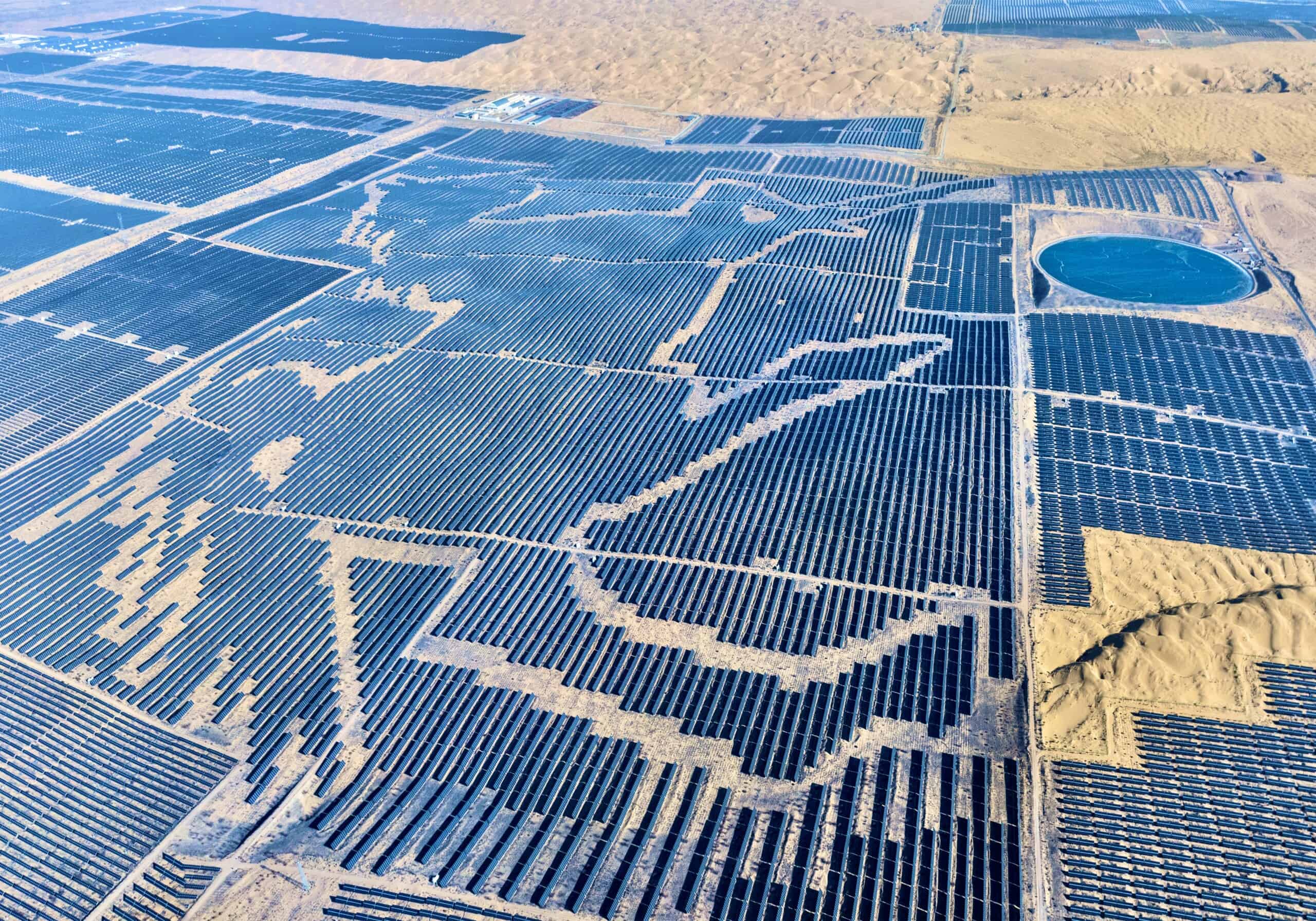
Drive north on G65 from the infamous ghostly Kangbashi new area of Ordos in Inner Mongolia, past the old city now Dongsheng Qu, until you come to the S24 (兴巴高速). Take it, heading west. As you look to your south, you’ll soon notice that the desert gives way to what at first appears to be a mirage but is in fact a blue ocean of solar panels, part of the Kubuqi Desert Ordos Central-North Renewable Energy Base (鄂尔多斯中北部新能源基地).
A section of the Kubuqi Energy Base. Credit: CTG
You have reached a portion of one of the most fascinating and important projects aimed at tackling climate change in the world: China’s energy megabases. A deep dive into these gargantuan projects can illuminate a surprising array of issues facing China — and the world — in 2025.
The concept of the first megabase project can be traced back to 2007, when the National Development and Reform Commission (NDRC) approved the 10-gigawatt (GW) Wind Power Base in Jiuquan, Gansu province. As with many enterprising Chinese projects, the idea was picked up in the CCP’s 12th five-year plan in 2010, in which the construction of further large-scale wind power bases in Hebei, Inner Mongolia, Jilin, Gansu, Xinjiang, Heilongjiang, as well as coastal regions in Shandong and Jiangsu were outlined. Together, these had a planned capacity of 79 GW by 2015, and over the five years the country added over 100 GW of wind power.

In October 2021, Xi announced the next phase for megabases. The National Energy Administration and NDRC issued a notice the following month, before detailing aspirational plans for these projects in the 14th Five Year Plan for a Modern Energy System in 2022. These documents lay out the impressive scale of the vision, scoping energy generation from China’s western deserts to the far seas of the east.
China’s energy megabases represent a major slice of China’s expansion of renewable capacity. The current plans for China’s wind and solar megabase projects see upwards of 600 GW of total capacity once all three phases are fully installed. To give a sense of scale, India’s entire installed electrical generating capacity is now about 460 GW. By the end of 2024, the first batch of China’s megabases had 91 GW in operation.

Construction for the first gigawatt of solar power at the Kubuqi desert base started in December 2022, and it was connected to the grid and started generating power a year later. It supplies 2 billion kWh of clean electricity annually, replacing around 600,000 tons of coal and reducing carbon dioxide emissions by 1.66 million tons per year. In the second phase, another gigawatt of solar power started construction in 2023 and was connected at the end of last year. The overall plan is for eight gigawatts of solar, four gigawatts of wind, four gigawatts of coal, plus some electricity storage facilities.
The co-location of these sources simplifies the grid connections to take this power to where it’s needed, with the thermal coal there to generate when the wind is calm and the sun isn’t shining. The major solar contractor is Three Gorges Inner Mongolia, a subsidiary of Three Gorges Group, named after the massive dam but now a major player across the energy sector. The company’s name is visible from space between rows of solar panels in what is perhaps the world’s largest corporate branding exercise.
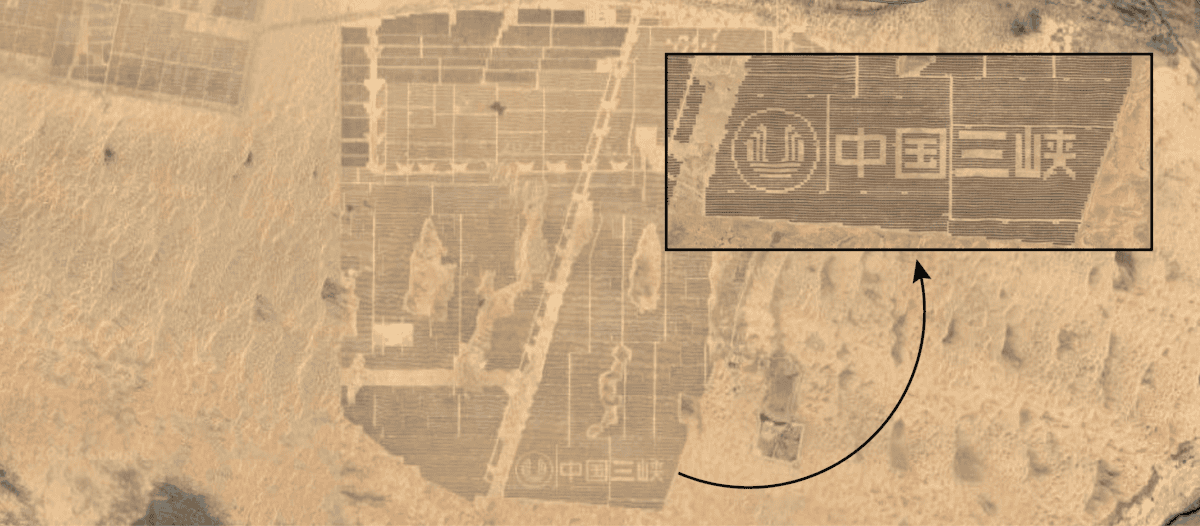
The construction continues apace. This NASA imagery shows the transformation of the deep desert to a sea of solar.
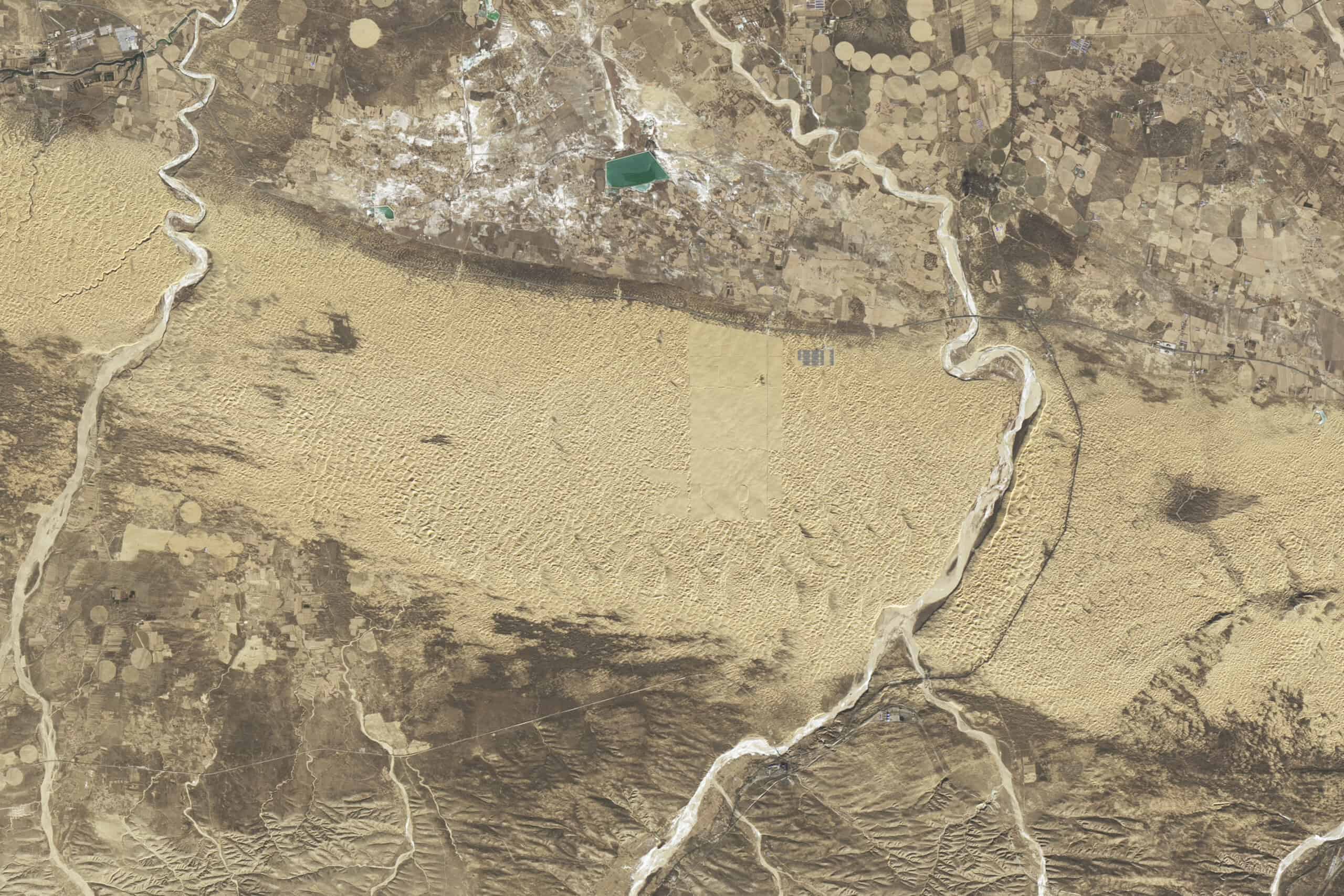
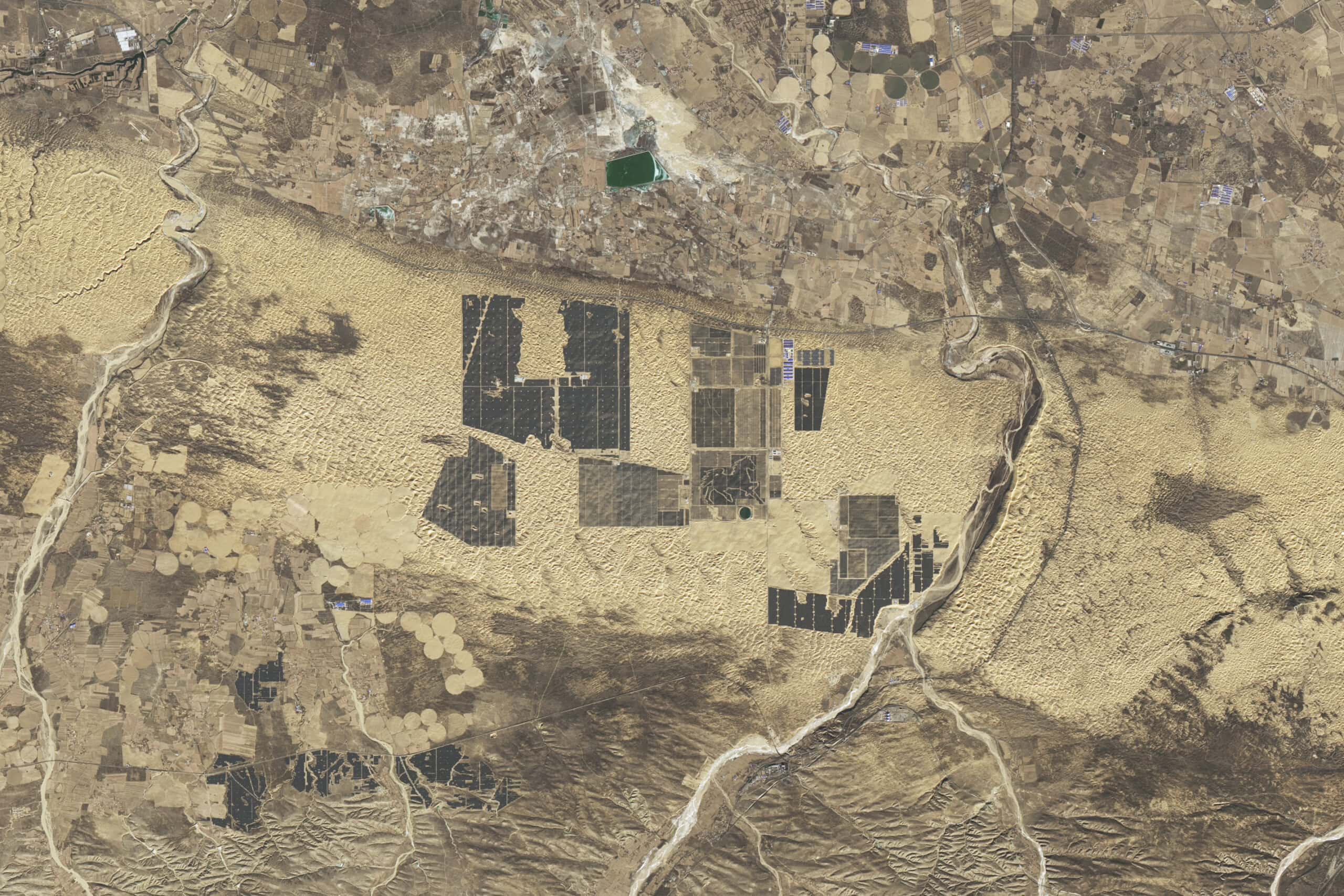
Panels at this site continue to grow, as this comparison image from Planet Labs below attests. The left half is September 2024, while the right is February 2025. Note the panels adjacent to the river on the right, but also the three groupings of new panels south of the main complex.


Beyond their material importance, megabases have symbolic resonance for key narratives shaping global understanding of the energy transition. Megabases fit with many contemporary conceptions of what China can do, and implicitly what the U.S. cannot do: namely, building things. In this case, building big and building fast.
Time will tell whether China can solve the challenges of transmission and storage to make these projects reach their full potential, but in the meantime, observers should pay as close attention to the structures rising in the Chinese desert as to the tariffs rising around the United States.
But closer examination of these megabases also helps expose the problems of this kind of building and what it fails to solve.
When you build big and fast, some inefficiency or waste is always present. At the megabases, two principal forms of waste are energy curtailment and the continued construction of coal power plants.
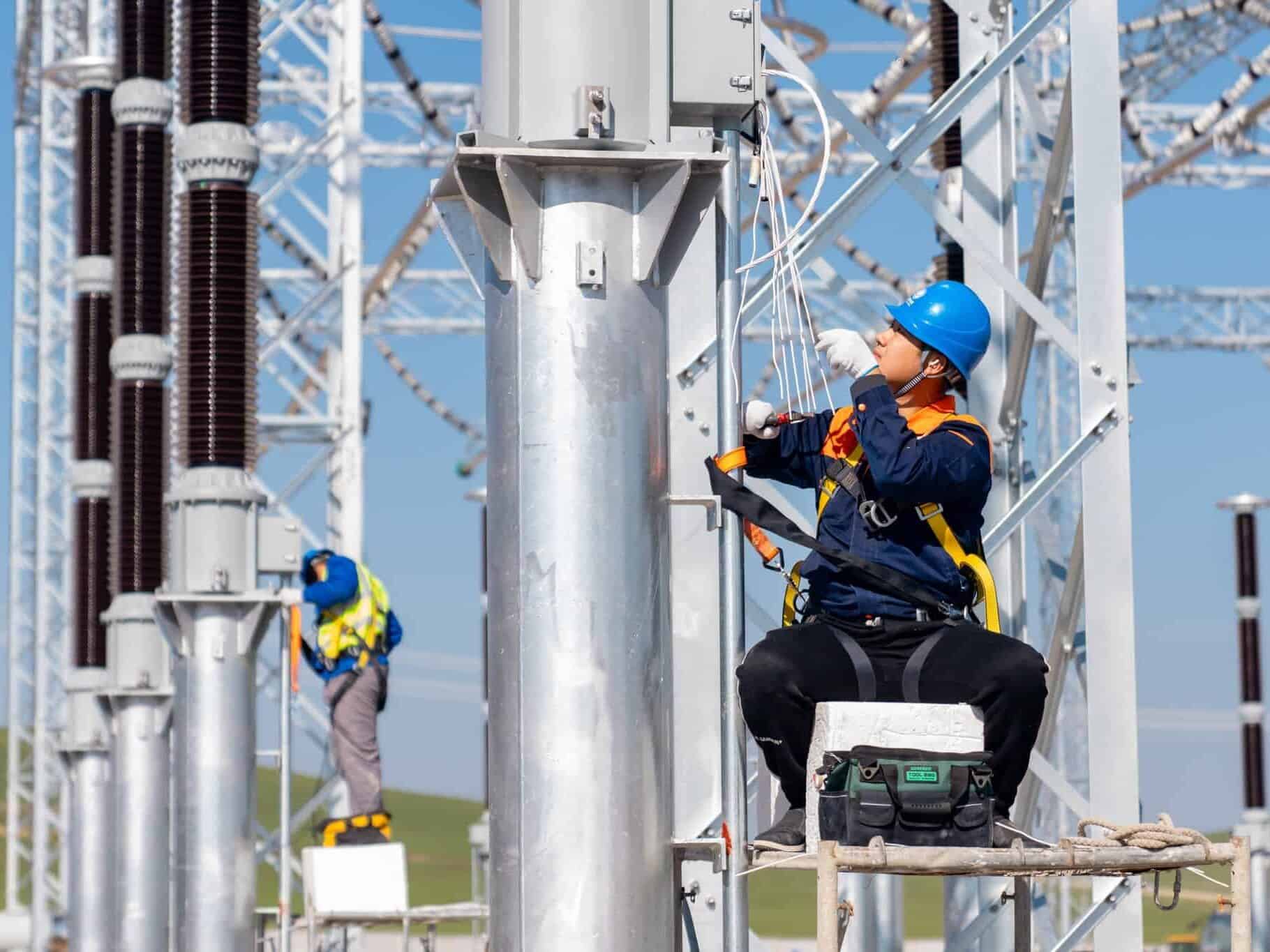
Curtailment refers to the non-use of generated electricity, in this case from solar and wind. Megabases suffer from multiple factors that make curtailment a problem. First, they represent extremely concentrated electricity generation. When the sun is shining on one of the panels, it’s probably shining on all of them. Unfortunately, the sun does not shine brighter or longer following demand signals from State Grid. We’re already beginning to see an increase in curtailment in official data, and some analysts think that even these patterns understate the real levels of curtailment.
On top of nature’s disregard for demand signals, Chinese power systems remain relatively balkanized at the provincial level with thin interprovincial linkages between electricity grids. This in turn pushes each province to make sure it has the ability to produce enough power without having to call upon the resources of its neighboring territories. Each province thus overbuilds generating capacity inside its own borders to maintain an adequate reserve, rather than more efficiently sharing these resources. This is one reason why ultra-high voltage (UHV) lines are under-utilized and why the planning processes tend to be segmented by region rather than deeply integrated.

The second major inefficiency in the megabase scheme is their incorporation of new coal plants. While Kubuqi Central-North describes itself as a “renewable energy base,” the name is only a half truth. Alongside sprawling solar fields and dozens of wind turbines are brand new coal power plants. Given that China’s existing coal fleet runs only about half of the time, the addition of these megaprojects is almost as surprising as it is disheartening. Kubuqi’s plans call for an ungodly large set of coal facilities — fully 4 GW of new capacity, to be built at the mouth of Selian No. 1 Coal Mine mine.
China, for its part, has continued to develop, innovate, and implement large-scale projects at home. While long standing issues in the Chinese state like waste, inefficiency, and decentralization now manifest in the modern renewable energy sector, its current approach echoes the past: build large, build fast, and go all in. Time will tell whether China can solve the challenges of transmission and storage to make these projects reach their full potential, but in the meantime, observers should pay as close attention to the structures rising in the Chinese desert as to the tariffs rising around the United States.

Jeremy Wallace is the A. Doak Barnett Professor of China Studies at Johns Hopkins School of Advanced International Studies.