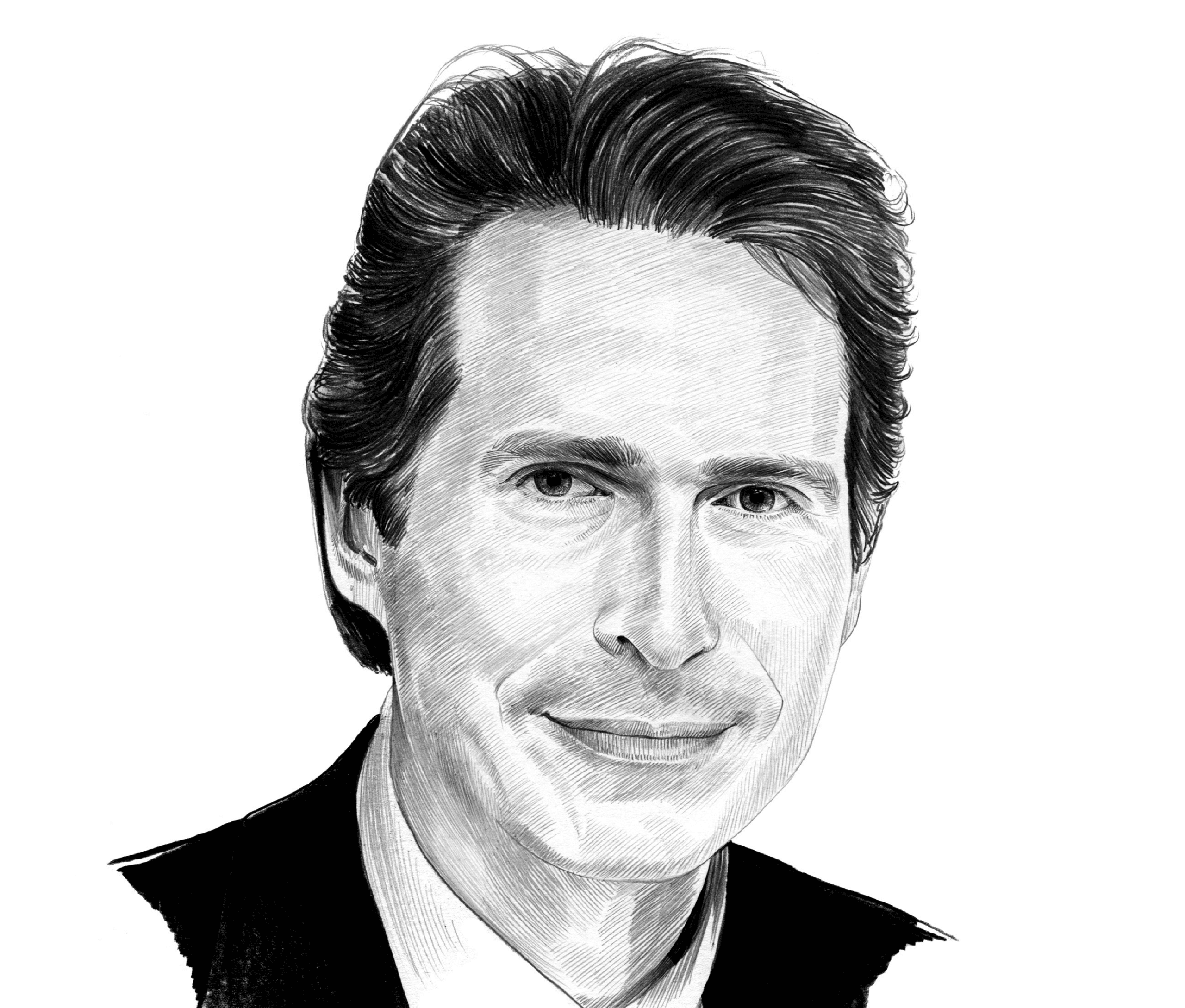
Tom Cotton is the junior United States senator from Arkansas and chair of the Senate Intelligence Committee. In recent years, he has become an increasingly outspoken China hawk and a prolific sponsor of legislation to get tough on the country, including a recent bill to revoke China’s permanent normal trade relations status. He is the author of a new book, Seven Things You Can’t Say About China, an “inside story on how deeply the Chinese Communist Party has infiltrated America.”
In this Q&A, we discuss what role, if any, Congress should play in holding the Trump administration to account on China policy, whether Cotton is concerned about Elon Musk’s Chinese business ties and the impact of DOGE’s audits on U.S. government initiatives to counter China, FBI director nominee Kash Patel’s Shein shareholdings, as well as why Cotton believes Chinese nationals in America should not be allowed to own land.

Illustration by Kate Copeland
Q: What’s the most important message about China that you want the American people to take away after reading your book?
A: A central theme of Seven Things You Can’t Say About China is, however bad and dangerous you think Communist China is, it’s actually much worse. Public opinion polls in America show that large majorities have a justly low opinion of China, but even still, they often don’t hear the full extent of China’s crimes and aggression against America and our interests. That’s in part because Communist China has infiltrated our society to such a degree and turned so many of our elites into a de facto new China lobby.
I wrote this book based on the work I’ve done in the Senate for 10 years, on the Armed Services Committee, on the Intelligence Committee — now as chairman — to sound the alarm for the American people even more loudly than it’s been sounded before. But this is not a country that has splittable differences or understandable grievances. It’s a communist dictatorship that wants to replace the United States as the world’s dominant superpower and ultimately see the eclipse of American prosperity and influence both at home and abroad.
| BIO AT A GLANCE | |
|---|---|
| AGE | 47 |
| BIRTHPLACE | Dardanelle, AR |
| CURRENT POSITIONS | U.S. Senator from Arkansas and Chair of the Senate Intelligence Committee |
What should Congress’ top priorities be vis-à-vis China?
There’s a lot of bills to introduce in Congress to counteract Communist China, because its crimes are so sweeping. One of the most fundamental bills I’ve introduced, though, first with Marco Rubio last year, when he was still in the Senate, now with Senator [Josh] Hawley (R-MO) and Senator [Jim] Banks (R-IN), is to repeal China’s permanent Most Favored Nation status.
I write in the book about how the two decisions that our leaders made in the 1990s, first to give China permanent Most Favored Nation status, second allowing it into the World Trade Organization, really supercharged China’s economic world war, and especially its economic war against the United States. It went from being a fairly poor and minimally industrialized nation with a backwards military to now the world’s second largest economy, with advanced manufacturing and a very large, menacing and growing military, and it did so by expanding its economy rapidly over the last 30 years. That’s a direct result of this extremely foolish decision. It was foolish at the time, but certainly in hindsight — by members of both parties, to be fair — to give China permanent Most Favored Nation status, as opposed to keeping the status quo in place in the mid-1990s, which was having annual votes on that to make sure that Congress had some check on Communist Chinese economic aggression against American prosperity.
Those two decisions led to what’s often known as the China shock, in which you saw the mass exportation of not just jobs or some factories, but in many cases, entire industries, to China. Of all the legislation I’ve introduced in the Congress, I think one of the most fundamental changes in our relationship with Communist China should be the revocation of permanent Most Favored Nation status.
Under the previous administration, Congress played an important role in holding the White House to account on various China issues, for example, getting tougher on export controls or on outbound investment. What role does Congress have to play in holding this White House to account on China? Should Congress push the administration to take tougher positions on issues like enforcing the TikTok divest-or-ban law?
The difference between the Congress and the Biden administration and Congress and the Trump administration is that Biden’s instincts were to placate and conciliate with China. He often was able to overcome those instincts because of the fear of political consequences, including opposition from the Congress and opposition from the American people.

That goes back to President Trump’s first term. President Trump deserves the credit for reorienting our relationship with China. Before him, every American president in the post Cold War period had bought into this myth that started with George H. W. Bush, looking the other way on Tiananmen Square and Bill Clinton going soft and abandoning his campaign promises. George W. Bush welcomed China into the World Trade Organization. Barack Obama constantly allowed Xi Jinping and Communist China to break its promises to America.
President Trump came into office and said: We need to hold China accountable. China is waging an economic world war against us. They are engaged in a military build up, militarizing islands in the South China Sea to threaten us. They’re openly threatening Taiwan. So in the first Trump administration, it was more a matter of Congress working in tandem with the President to counteract Chinese influence. President Biden kept a lot of those policies in place, I don’t think because of his instincts, but because he feared the political backlash from Congress and ultimately from the American people.
Then United States Attorney General Jeff Sessions announces the “China Initiative”, November 1, 2018. Credit: Department of Justice
I expect in the second Trump administration, we will once again be working in tandem with the President who, let’s remember, in his first term, did things like impose tariffs on China, declared the Uyghur genocide to be a genocide, shut down things like the Confucius Institutes on college campuses, shut down the Houston consulate — which was a den of spies — and launched the Department of Justice’s ‘China initiative’ to crack down on Chinese espionage — not just against the government, but against companies and universities.
I expect to see that continue in the second term, because Donald Trump is, at a minimum, the toughest president on China we’ve had in the post Cold War period, and maybe the toughest president we’ve ever had against Communist China. The only rival could be Eisenhower, and Eisenhower threatened to nuke China twice, which is tough competition. The difference is that Eisenhower was working at a time when Communist China was viewed as a threat and we recognized Taiwan, not Beijing. He also had a party that was strongly aligned with him on China, whereas in 2017 President Trump had to puncture a lot of conventional wisdom in both parties. There’s no question that he’s the strongest president on China in the post Cold War era, and maybe the strongest president ever on Communist China.

But on the TikTok ban extension, do you think Congress should be pressing harder for the administration to be enforcing the law? The app was put back on app stores by Google and Apple just this week after getting assurances that they wouldn’t be prosecuted for doing so.
I would prefer that the law was enforced today and that we didn’t have the enforcement pause. It’s now got about seven weeks left. I think that would be the best way to get leverage over Beijing to allow Bytedance to sell TikTok.
…just think about what happened when Congress was passing that law last April. TikTok sent push notifications to its users urging them to call their member of Congress… if they can do it in that setting, what might they do, say, if Donald Trump increases tariffs on China, or in a moment of tension around Taiwan?

Foreign Adversary Controlled Applications Act’, signed into law on April 24, 2024. Credit: U.S. Congress
Remember, the law does not ban TikTok. The law says that TikTok needs to be sold to a non-Chinese owner. If it was owned by a group of American investors or an American technology company, it would just be another social media app which had its problems, no doubt. But because it’s controlled by Communist China, it poses a unique threat to the privacy and data security of Americans. I know that a lot of users are kids, but even so-called kids in just a few years are going to be adults in law enforcement and the military and in intelligence.
And voters.
Yeah. And second, there’s no doubt that the content on TikTok is much worse than it is on social media. Is it all bad? No, of course not. There’s plenty of harmless content and cat videos and cooking instructions on TikTok are just fine. But there’s a lot of harmful content as well, much worse than what you get on other apps.
Senator Tom Cotton questions TikTok CEO Shou Zi Chew on TikTok’s practices and connections to the CCP during a hearing on protecting children online, January 31, 2024. Credit: C-SPAN
There’s also the issue of it being a Chinese Communist propaganda tool. Again, studies have shown conclusively that the content on TikTok is manipulated to serve Chinese Communist interests — whether you’re talking about the Uyghur genocide, the Tibetan genocide, the takeover of Hong Kong, Tiananmen Square — anything that’s negative about the Chinese Communist Party is suppressed on TikTok compared to other apps. Anything that’s pro-American or pro-Israel is suppressed. That’s why you get vile, disgusting anti-semitism on TikTok to a much greater degree than you do on any other app.
Finally, just think about what happened when Congress was passing that law last April. TikTok sent push notifications to its users urging them to call their member of Congress and lobby against the bill. This is not a spontaneous uprising of American citizens exercising their first amendment rights. This is TikTok manipulating its users, and if they can do it in that setting, what might they do, say, if Donald Trump increases tariffs on China, or in a moment of tension around Taiwan? So it’s not the social media app itself, it’s the fact that it’s controlled and manipulated by the Chinese Communists. All you really need to know is that China doesn’t allow that version of TikTok to be used in mainland China. They have their own version. It has strict controls over what can be seen, the amount of time a kid can spend on it each day. Chinese kids get a steady diet of videos saying to respect your elders and do your homework and eat your vegetables.

I want to stay on this topic of Chinese influence, and ask about Elon Musk. You’ve described him in your book as “chasing Chinese dollars” and, along with America’s tech titans, having “shamefully supplicated China’s Communist rulers”. Tesla, meanwhile, is deepening its investments in China. It just opened a Megapack factory there, its first outside of the U.S. We’ve reported that Tesla has sourced from a company in Xinjiang. At the same time, Musk has taken on an influential role within the Trump administration. Do you see that as a conflict of interest?

I think the exposure of Tesla in China is regrettable, but it’s not just Tesla. It’s a problem with all of corporate America. That’s all regrettable. It’s really the story of corporate America over the last 30 years. The same is true from blue chip American companies like Apple and Ford and Coke and Caterpillar and many others. And part of the point of the legislation we were discussing earlier about ending permanent Most Favored Nation status is to try to cut off that exposure and to bring those jobs and prosperity back, which also reduces the opportunities for China to try to influence American politics and society.
At the same time, I agree with Elon Musk that there’s a lot of waste and fraud and inefficiency in our government that I want to identify. They’re doing a good job of helping Congress spot it so we can adopt those reforms in the future. I would also observe that Elon Musk and his companies, especially SpaceX, have had the very highest security clearances for years because of their contracts with the Army and the Air Force and NASA and the intelligence community.

So I’m not concerned about the work that Elon Musk is doing right now. A lot of the work is very good, and Congress will need to act on it as we adopt spending reforms in the future. I do think it is a regrettable fact that over the last 30 years, corporate America, from all sectors, not just the tech sector, have grown increasingly exposed to China, and therefore Chinese influence, as I write about extensively in the book.
You sit on the board of the International Republican Institute, a sister organization of National Endowment for Democracy, which, [last] week, DOGE froze funding for. Beijing sees NED as a CIA front and would love to see it shut down. Many civil society groups that help inform us about what’s happening in China rely on NED money. What are your thoughts on what the administration is doing with NED right now and the fact that the freeze could hurt efforts to stand up to China?

I think it’s appropriate for the administration to pause this discretionary spending to take stock of it, and ascertain what spending is supporting the President’s priorities, putting American interests first, and what has essentially become feather nesting for liberals here and around the world. American taxpayers shouldn’t be underwriting that. We need to use that kind of funding to make sure that we’re standing up to Communist China, that we’re pushing back against North Korean and Iranian influence throughout the world, that we’re counteracting Russian propaganda as well.
But obviously a lot of spending that Elon Musk has exposed in the last three weeks has nothing to do with any of that. It is mostly granting international access to the ideological left. So it’s appropriate. We’ll have time to take stock of what spending is advancing America’s interest and what spending is wasteful. You might even see more spending in the areas that are advancing American interests because we’re freeing up the funds that are going towards trivial or wasteful or fraudulent purposes. Musk and his team are doing a good job of identifying all of these issues and teeing them up for Congress to act.

Groups like China Labor Watch, which has done a huge amount of work on a shoestring budget highlighting Chinese labor abuses on the Belt and Road Initiative, have one month of runway at a given time. The 90-day State Department and NED funding freeze means they can’t come back from this, which is going to damage our knowledge about what China is doing on the BRI. Are you not concerned about, if not the intent, then the way that these audits of government spending are being executed?
First, Secretary Rubio does have in place a waiver process in which any organizations that are recipients of such grants and face extreme hardship, or are providing life saving work around the world, can apply for a waiver. Second, it is important to know that these grants, much like private philanthropic grants, are not paychecks. These come periodically, and most organizations are not in a position where, just because their grant has been “frozen”, they’re going to close their doors the day after tomorrow. I also would say the pause is up to 90 days, and Secretary Rubio is working properly to go through all of the spending and to assess what he thinks supports America’s interests and where he thinks we can find savings.

Chinese companies are adept at hiring influential former politicians and government officials to lobby on their behalf. DJI, for example, hired former attorney general Loretta Lynch. In your book, you mention former Senate majority leader Trent Lott lobbying on behalf of TikTok. Defenders would argue this is part of the democratic process: lobbyists are there to ensure that every voice gets heard. Do you think Chinese companies should be allowed to hire lobbyists in America?
We should not have Communist Chinese money flowing through lobbying firms and think tanks and other influence peddlers in Washington, D.C.. You’re right that lobbying is an activity protected by the First Amendment. It’s there next to freedom of speech and to petition the government for redress and grievances. At a certain level, everyone has a lobbyist, not just the so-called special interests, but school teachers and nurses, firefighters and policemen, and they come in and advocate for those American interests and that’s part of our political process. The same is true from many foreign companies like Toyota or BMW that now have a large presence in the American southeast.
The difference is, none of them are communist dictatorships that are trying to replace America as the world’s dominant superpower. A simple rule of thumb I often apply is, would we have allowed communist Russia to do it? Of course, we never would have allowed communist Russia to have such an economically interdependent relationship with America, or to hire lobbyists to come in and advocate on behalf of Russian companies. We shouldn’t allow Chinese Communists to do it either.
Most Americans, for instance, might look at a road sign that announces that the city they’re entering is a sister city with a Chinese city and think nothing of it. I now know that it is a concerted program by Chinese Communist officials to try to curry favor with local American officials and turn them into de facto lobbyists for China.
You’re right that, unfortunately, it is a major and bipartisan scandal that so many people in Washington and around the country are on the Chinese Communist payroll. I, for one, would rather die penniless than take a check from Chinese communists. And there’s other people like that as well. I had occasion last year to speak to a very prominent lobbyist in Washington, DC, who’s he told me that Tiktok had offered him $100,000 a month — not a year, a month — to lobby against the legislation that required a TikTok sale, and he refused, because he’s a strong supporter of Israel and he’s appalled by the rising tide of anti-semitism most notably on TikTok. So there’s some people who won’t do it, but in too many cases, people see the money from Chinese communists and are willing to take it.
In your book, you described Shein as a threat to privacy and data security and encouraged families not to download its app. Given Kash Patel’s disclosure that he’s a shareholder in Shein, would you continue to support his confirmation as FBI Director on February 18?
I support Kash Patel’s confirmation, yes. I think he’s going to be an important reform and change agent inside the FBI. I would recommend that he and anyone else in the administration divest of any such stocks. But I’d also maybe say that most Americans should divest of it, because President Trump has signaled his desire to close the so called de minimis exception, which companies like Shein and Temu have exploited for so long to evade tens of billions of dollars of tariff revenue that should’ve gone to our Treasury. That exception was created so you can fly in from Toronto to Washington, D.C., for example, without having to declare the fact that you bought a new scarf or something.

I guess the concern, though, is what the fact that he has shares in this private company means about whether Patel has potentially done work lobbying or consulting for Shein. Do you think that is a concern?
I haven’t reviewed his disclosure in detail lately, but I’m not aware of any such thing, and I think such matters would be disclosed.
You emphasize in your book that getting tough on China is not about the Chinese people, but the CCP, and that the biggest victims of the CCP are actually the Chinese people. At the same time, a bill you’ve introduced, the Not One More Inch or Acre Act, some critics say unfairly blocks people who have done nothing wrong, may have no affiliation with the CCP, from home ownership. Why do you support banning Chinese people from owning land in America?
First off, you’re right, strong and vehement opposition to the Chinese Communist Party is not hostility to the Chinese people. It is standing up for the Chinese people, because going back 100 years since the founding of the Chinese Communist Party, and going back to 1949 since it took over China, the Chinese people have been the first and the worst victims of Chinese communism. In fact, the final recommendation I make to readers in the epilogue of the book is to pray for the Chinese people that one day they can live under a decent government that respects their basic rights.

At the same time, I think we have to recognize that most people who get visas out of China to come to America are able to because they’re in positions of influence, because they are family or friends or business associates of Communist Party officials or PLA personnel or other notable influentials. That’s especially true for all those thousands or hundreds of thousands of people who are coming here and undertaking work or visits to sensitive — sometimes exquisitely sensitive — sites like our national laboratories or advanced laboratories, or America’s leading research universities, or companies doing cutting edge work.
That’s the main concern I have about the volume of immigration that we have from China, not that we have anti-communist freedom seeking people [coming here]. There’s some of that, to be sure, but it’s pretty hard to get out of China, and it’s certainly hard to get an exit visa to come be in America for any period of time. And many, if not most, of the people who do are coming here because of their connections to Chinese communists and the power structure that supports Chinese communism.
Where does your own focus on China come from?

I’ve always been a strong anti communist. Soviet Russia collapsed when I was about 14, but even as a boy in the mid and late 1980s I understood what a monstrous place it was, and Ronald Reagan’s strong defense of freedom and opposition to communism certainly rang true to me. In college, I remember when Jiang Zemin took one of his big tours around America. He came to Boston when I was in school, and I was appalled that he was hosted at Harvard and joined some of my liberal friends in our college newspaper in denouncing it.
Once I got into the Congress, especially in the Senate, on the Armed Services Committee and Intelligence Committee, I began to realize the full extent of Chinese aggression and influence in America, and the threat that China posed and China’s ambitions, and how you can find it everywhere. Most Americans, for instance, might look at a road sign that announces that the city they’re entering is a sister city with a Chinese city and think nothing of it. I now know that it is a concerted program by Chinese Communist officials to try to curry favor with local American officials and turn them into de facto lobbyists for China. The same with things as innocuous as panda exchanges with zoos.
Or consider our media. Fox News is the only major American news network that is not owned by or affiliated with a major Hollywood studio — which are totally compromised by China and dependent on access to Chinese movie theaters.
As I entered the Congress and I began to study the issue more carefully and was exposed to some classified intelligence — although most of what I write about in the book is not based on classified intelligence, anyone who studied the issue carefully could learn it — I realized just how pervasive the threat from communist China is. Even though Americans instinctively oppose a communist dictatorship, they still are not presented with the full picture of the threat and the danger.
Who do you talk to/view as a major influence on your thinking about China policy?
People I’ve worked with in the government. Miles Yu, who was a State Department official in the first Trump administration and a very strong anti-China hawk. Matt Pottinger, who worked in the National Security Council, who himself was a former journalist and a Mandarin speaker, who runs an important newsletter for anyone who’s interested in China matters. Lots and lots of people in the government who I can’t discuss who are working undercover or in executive positions, who have helped me over the years to synthesize the views that I present in the book.

Eliot Chen is a Toronto-based staff writer at The Wire. Previously, he was a researcher at the Center for Strategic and International Studies’ Human Rights Initiative and MacroPolo. @eliotcxchen