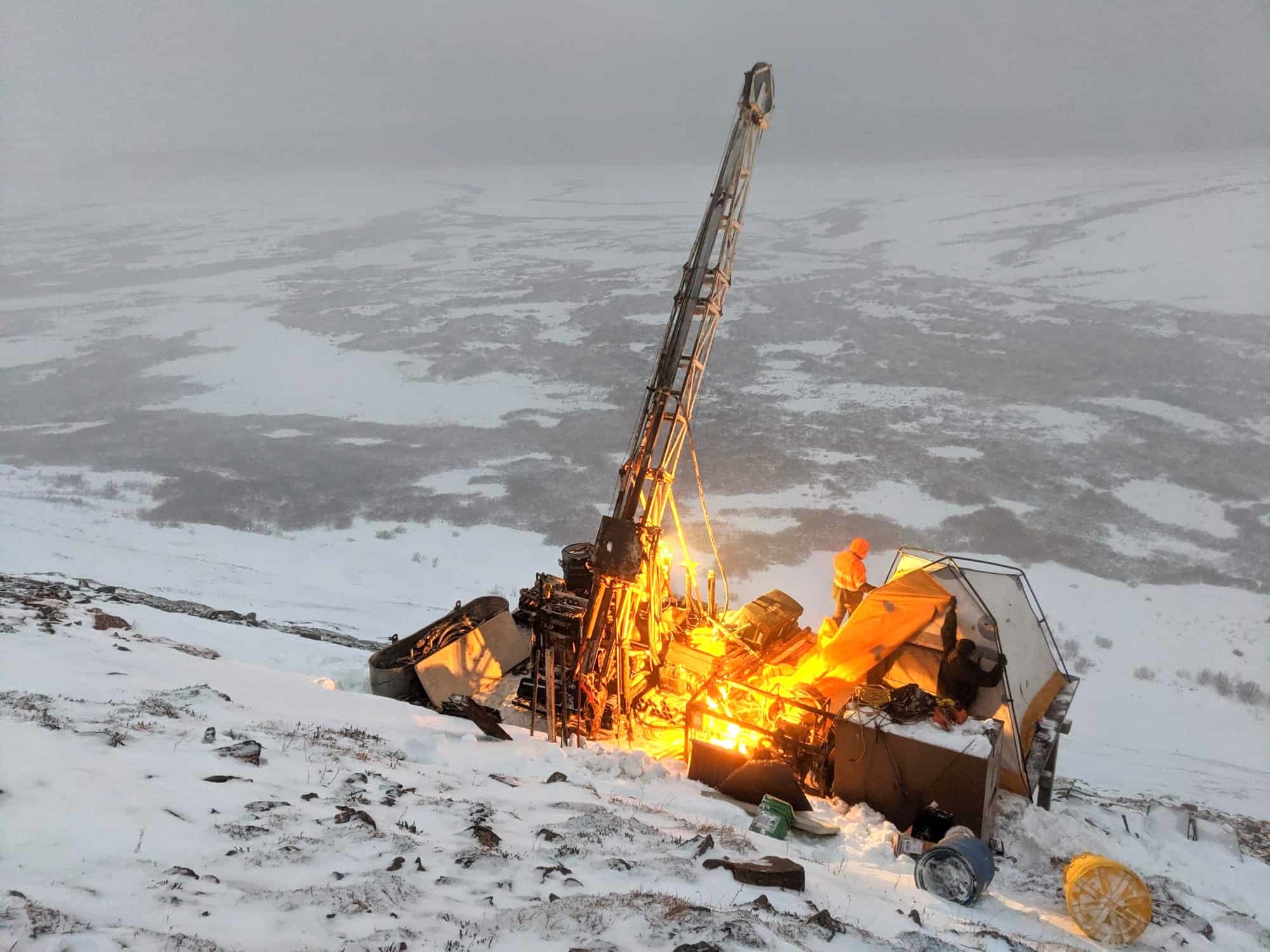
An American mining start-up gained the powerful endorsement of the U.S. Defense Department last month, when it received a $37.5 million grant to develop what could be the country’s largest graphite deposit, close to Nome, Alaska. The company, Graphite One (Alaska) Inc., aims to be America’s first domestic miner of graphite, a mineral that’s vital for producing electric vehicle batteries and is used widely in the defense sector.
But Graphite One’s fortunes will likely depend on the assistance of a familiar rival: China. That’s because a key advisor aiding the company’s plans to build a domestic battery anode factory is a Chinese firm founded by executives with deep ties to China’s battery industry.
In May 2022, Graphite One announced an agreement with Guizhou-based Sunrise New Energy Material Co. — also known as Sunrise Guizhou — that will see the Chinese firm share expertise and technology for the “design, construction and operation” of Graphite One’s proposed battery parts factory in Washington state.
As critical minerals increasingly become a geopolitical flashpoint between the U.S. and China, the apparent conflict of interest at Graphite One could raise uncomfortable questions for the firm and the policymakers who have thrown their weight behind it.
China dominates the mining and processing of graphite, accounting for 61 percent of global mine production and 98 percent of processing, according to Benchmark Mineral Intelligence, a research firm. Graphite One’s pitch — amplified by politicians including U.S. Senator Lisa Murkowski (R-AK) — is that it will help America break China’s grip over the industry.
“[Graphite One’s project] will be a secure supply of natural graphite from day one, without the political and the security risks associated with so many projects that are located abroad,” Murkowski said in a Senate speech last month.
Given China’s overwhelming dominance over the graphite industry, it is little surprise that an upstart American firm should require its help. “You have a burgeoning suite of battery anode companies emerging in North America,” says Ben Steinberg, executive vice president at Venn Strategies, a lobbying firm which represents companies in the critical mineral sector, not including Graphite One.
…most fully-formed companies in this industry are in China or touching China in some way, because that’s where the majority of the chemical processing and tech has been developed in the last 10 to 15 years.
Ben Steinberg, executive vice president at Venn Strategies
“But most fully-formed companies in this industry are in China or touching China in some way, because that’s where the majority of the chemical processing and tech has been developed in the last 10 to 15 years,” he says. “I do think there could be value gained in working with those companies if done carefully. The question is how the government will protect the U.S. graphite industry and investments given China’s dominance to date.”
Graphite One (Alaska) Inc. is a wholly owned subsidiary of Graphite One Inc., a listed company headquartered in Vancouver, Canada. The company plans to construct a vertically integrated supply chain, spanning from its Alaskan graphite mine to an anode factory and battery recycling facility to be built in Washington state. Graphite One calculates it will be able to churn out an average of 75 kilotonnes (kt) of anode material per year over the project’s 26 year lifespan. Global demand for anode material is surging alongside the adoption of EVs, reaching 300 kt in 2021, according to the International Energy Agency.

The unusual origins of Sunrise Guizhou add to the intrigue around its technology sharing agreement. While Graphite One has previously described Sunrise as “an experienced battery anode producer,” the Chinese company is in fact a nascent venture, incorporated just months before it landed the agreement.
Public filings and ownership records show how Sunrise’s operations were hastily formalized, beginning soon after an initial public offering in 2021. That February, a Beijing-headquartered company named Global Internet of People Inc. listed on the NASDAQ stock exchange, raising $26.9 million. The company is described in its prospectus as a “consulting company providing enterprise services to small and medium-sized enterprises,” with a “peer-to-peer knowledge sharing and enterprise service platform.”
Global Internet of People’s filings in the leadup to its IPO offer little indication of the company’s experience in the graphite business. But nine months later, in November 2021, it established Sunrise Guizhou as a joint venture via a wholly owned subsidiary, Zhuhai Zibo Investment Co., which held a controlling 51 percent stake in Sunrise. The other investors in the joint venture included a number of privately-owned funds and an investment firm controlled by the local government of Yilong district, in the southern province of Guizhou where the company’s facilities are located, according to data from WireScreen.

Global Internet of People’s directors approved Sunrise’s formation on April 1, 2022. Graphite One announced its technology sharing agreement with Sunrise five days later. Solidifying the parent company’s pivot to batteries, Global Internet of People’s shareholders then greenlit its renaming in August 2022, to Sunrise New Energy Co. Ltd.
Covid was a key driver behind the company’s pivot to graphite, the company’s chairman and CEO, Hu Haiping, said in an interview with The Wire. Prior to entering the consulting business, Hu was a longtime executive at Shanshan Group, parent company of Ningbo Shanshan Co., one of China’s largest manufacturers of battery anodes. The 20-year veteran of Shanshan struck out on his own in 2015, hoping to build an app-based platform that would provide advice to other entrepreneurs. But with small businesses hurting during the pandemic, Hu says interest in the platform fell, leading him back to graphite. In short order, Sunrise recruited a phalanx of veteran engineers and executives with experience in the battery sector.

From a technical standpoint, “having the participation of Hu Haiping is definitely a good sign for Graphite One,” says Albert Li, head of China analysis of Benchmark Mineral Intelligence. “Shanshan has been the leading anode producer in China for about a decade, and Hu was the founder and first general manager of Shanshan Technology. He likely already knows everyone in the supply chain.”
In the months after Sunrise signed its agreement with Graphite One, it also landed orders for its graphite anodes from major EV battery producers including Chinese industry leaders CATL and BYD. The company has rapidly scaled up production: Hu says that after just a year and a half of operations, his company is currently producing 3000 tonnes of anode material per month.
The Chinese government has also become a significant investor, after a fund controlled by Guizhou’s provincial government acquired a 23 percent stake in Sunrise Guizhou for 200 million renminbi ($27.8 million) in June 2022.
For officials in Washington, that could be a cause for concern. In response, Hu says that Sunrise’s management is completely independent, and that the provincial government has never intervened in his company’s daily activities.
There are other advantages for Graphite One in partnering with a relatively young Chinese company, such as Sunrise’s apparent distance from potentially troublesome connections to China’s military. Graphite has important applications in the defense sector, notably in the nozzles of rockets and the exterior coatings of drones, and a number of established Chinese graphite companies have military ties.
Records from WireScreen show that Shanshan Group, for example, controls a subsidiary located in a military civil fusion-focused industrial park. China has pursued the controversial strategy, promoted by President Xi Jinping, which involves fusing the country’s military and civil industrial and technological capabilities. The U.S. government has imposed sanctions in recent years on Chinese firms alleged to be involved in military-civil fusion.
Ownership records reviewed by The Wire found no financial ties linking Shanshan Group and Sunrise, nor ties between Sunrise and military-civil fusion.
As for Graphite One, the DoD’s grant will accelerate its planning process, enabling the company to move up the completion of its feasibility study by a full year.
Securing a domestic raw material supply is one thing — developing the expertise to manufacture complex battery anodes independently is another. Sophisticated factory equipment that China’s producers have spent years honing, notes Benchmark’s Li, are “not something you can copy and paste.”
The path to get there is already narrowing. According to Sunrise’s Hu, U.S.-China political tensions means he’s not sure whether his company will be permitted to export the advanced technology that Graphite One needs to develop its battery anodes. He says that Sunrise’s lawyers are still working out how to continue with the partnership in compliance with Chinese law.

Eliot Chen is a Toronto-based staff writer at The Wire. Previously, he was a researcher at the Center for Strategic and International Studies’ Human Rights Initiative and MacroPolo. @eliotcxchen