When Chinese Foreign Minister Wang Yi warned last month that Japan risks returning to the militarism of the 1930s, he might have paused to consider the historian John W. Dower’s observation that Imperial Japan justified its expansion through a toxic blend of racial hierarchy, national destiny, and the language of liberation. That combination bears a more than passing resemblance to Beijing’s own posture toward the Taiwanese, Hong Kongers, the Uyghurs, and Tibetans.
Wang Yi’s accusation was projection. Japan is rearming in response to a demonstrable and escalating threat. The PRC is the state that has militarized artificial islands in the South China Sea, crushed a free and legally autonomous city in Hong Kong, and which now openly threatens force against a democratic neighboring island it has never governed. If the ghost of the 1930s haunts this region, it is not wearing a Japanese uniform.
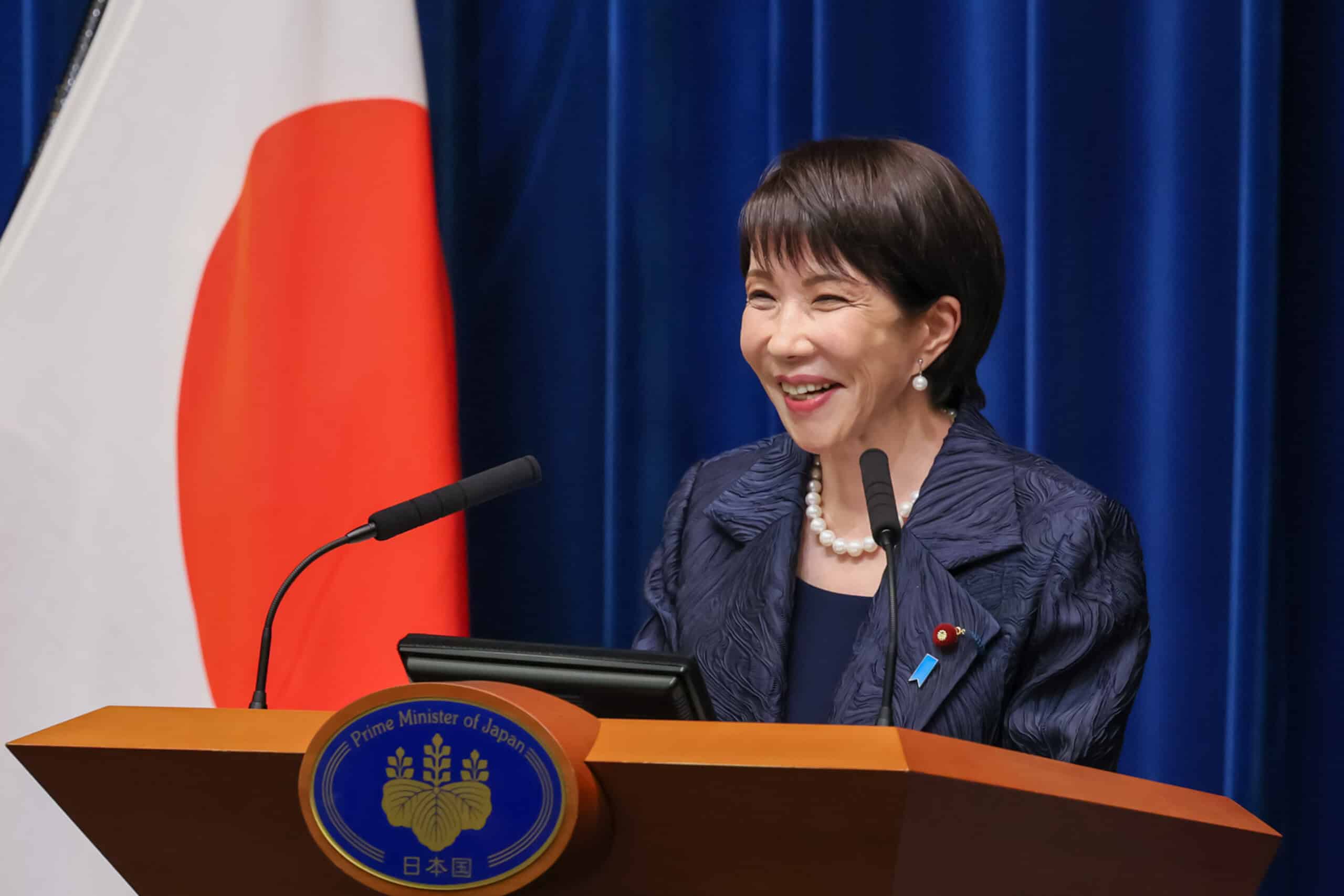
On February 24, China’s Ministry of Commerce banned dual-use exports to 40 Japanese entities — among them Mitsubishi Heavy Industries, Kawasaki Heavy Industries, the Japan Aerospace Exploration Agency (JAXA), and Fujitsu — in direct retaliation for Prime Minister Sanae Takaichi’s declaration that a Chinese military attack on Taiwan would constitute an existential threat to Japan. Beijing framed the move as punishment.

This is not the first time China has wielded economic coercion against Japan. In 2010, following a maritime dispute over the Senkaku Islands, Beijing restricted rare earth exports and sent an unmistakable message: your industrial base runs on our sufferance. Japan absorbed the blow, filed a WTO complaint, and for the most part moved on. Fifteen years later, Beijing is using the same playbook — but the geopolitical context has shifted so fundamentally that the calculus has reversed. China’s aggression now provides Japan with precisely the political and economic mandate it has lacked for a generation: the urgency to rebuild, reindustrialise, and rearm.

Beijing’s toolkit is well documented: rare earth restrictions, informal tourism bans, anti-dumping probes deployed as diplomatic instruments, and targeted sanctions designed to inflict political pain without triggering formal WTO dispute mechanisms. Applied to Australia over wine and barley, to South Korea over THAAD, to Lithuania over its decision to permit a Taiwanese representative office, and now to Japan over Prime Minister Takaichi’s Taiwan remarks, the pattern is consistent. The coercive intent is unmistakable. So, increasingly, is the self-defeating result.
The European Union offers a cautionary parallel. China’s weaponization of rare earth elements and its refusal to address excess industrial capacity flooding European markets has driven the bloc toward ‘Buy European’ industrial policies for the first time — doing more to align Paris, Berlin, and Brussels behind a common economic security doctrine than any number of Commission white papers. The lesson Beijing refuses to learn is that coercive statecraft, when applied against democracies with functioning institutions and credible strategic alternatives, tends to consolidate opposition rather than fracture it.

What Beijing has handed Prime Minister Takaichi is something no domestic political argument could easily achieve: a compelling external rationale for industrial policy on a scale Japan has not witnessed since the postwar reconstruction era. Japan’s defence budget is already on track to double to two percent of GDP by 2027. But the deeper transformation required — rebuilding domestic supply chain resilience, reviving the heavy industries hollowed out during decades of Japan Inc.’s slow retreat from manufacturing — has persistently lacked the political urgency needed to cut through fiscal conservatism and bureaucratic inertia. Beijing’s aggressive actions have now provided it.
Consider what is on that sanctions list. Mitsubishi Heavy Industries’ shipbuilding, aero-engine, and maritime systems divisions. Kawasaki Heavy’s aerospace arm. IHI Corporation. Japan Marine United. These are not peripheral companies. They are the physical spine of Japan’s industrial heritage — the firms that built the postwar economic miracle and that now represent the critical intersection between Japan’s civilian manufacturing capacity and its emerging defence production base. By targeting them, Beijing has inadvertently spotlighted their strategic value to every capital in the democratic world.
The investment case for Japan’s defence and heavy industrial sector was already compelling before this year. Japanese conglomerates in aerospace, shipbuilding, and precision manufacturing have been chronically undervalued by global investors, dismissed as old-economy dead weight in a world obsessed with software multiples. That framing is now collapsing. Defence rearmament cycles across NATO and the Indo-Pacific — a structural spending shift, not a cyclical blip — are creating sustained demand that favors the capital-intensive, technically complex manufacturing at which Japan excels.
The United States Department of Defense has elected to co-fund Japan’s development of hypersonic missile technology, in part because the American programme encountered serious technical and cost challenges — a meaningful reversal of the traditional dynamic in which the United States serves as the primary weapons developer for its allies. The deeper strategic shift is this: Japan is no longer simply the United States’ most important Asian ally. It is emerging as the leading regional security anchor in its own right — one that commands the alignment of South Korea, Taiwan, the Philippines, India, and Australia — while simultaneously burnishing its reputation as a reliable, rules-governed partner. That is a form of soft power that China, for all its economic scale, has consistently failed to cultivate.
Authoritarian states rarely appreciate that their most aggressive moves tend to accelerate the very outcomes they seek to prevent. China wanted to intimidate Japan into strategic passivity. Instead, it has galvanised a democratic nation into purposeful action.
China’s sanctions also accelerate Japan’s supply chain sovereignty agenda at the precise moment when the global conversation about critical dependencies has shifted from theoretical concern to operational urgency. China controls the overwhelming majority of heavy rare earth production, and those minerals flow directly into magnet systems used in F-35 fighters and precision-guided munitions. A recently signed Memorandum of Understanding between Malaysia and Japan on rare earths production represents a significant step toward breaking that chokehold. Japan, with its deep regional investment relationships and reputation for long-term partnership, is well positioned to capture alternative supply chains across Southeast Asia.

China’s sanctions do something else that is easy to overlook. This brand of nationalist coercion — the import restrictions, the targeted sanctions against institutions — is precisely the playbook China deployed against Hong Kong and Taiwan, and against Australia, Lithuania, and South Korea. In each case, the intent was to intimidate and divide. In each case, it consolidated public opinion against Beijing instead. Post-election, Japan is now debating a constitutional revision that would formally authorise offensive strike capabilities — a conversation that would have been politically inconceivable a decade ago. China’s coercion did not prevent these developments. It accelerated them.
Prime Minister Takaichi has been characterized by Beijing as recklessly hawkish. In fact, she has done something quite straightforward: she stated publicly what every serious strategic analyst in Tokyo, Washington, Canberra, and London already believes privately — that a Taiwan contingency is a Japan contingency. China’s furious overreaction reveals far more about Beijing’s anxieties than about any Japanese provocation. The most recent electoral results revealed a public that has decisively rallied behind her strategic direction. Beijing’s coercion did not fracture Japan’s political consensus. It forged one.
There is a final historical irony worth noting. The Sakurakai — the ultranationalist military faction that drove Japan toward catastrophe in the 1930s — believed that parliamentary democracy was incompatible with Japan’s civilizational destiny, that neighboring peoples must submit to their sphere of influence, and that internal dissent must be crushed. One searches in vain for this governing philosophy in contemporary Tokyo. One finds it, with remarkable fidelity, in Beijing. Japan’s growing soft power — its cultural influence, its reputation for quality and reliability, its demonstrated commitment to rules-based international order — is not in tension with its military renaissance. It is its foundation. China has purchased hard power at the cost of soft power, generating fear where it sought respect and resistance where it expected deference.
Authoritarian states rarely appreciate that their most aggressive moves tend to accelerate the very outcomes they seek to prevent. China wanted to intimidate Japan into strategic passivity. Instead, it has galvanised a democratic nation into purposeful action. That miscalculation may yet prove to be one of the most consequential strategic errors of this decade. Wang Yi would do well to recall another lesson from the 1930s: it was not the democracies that chose that era’s path of coercion, territorial expansion, and nationalist aggression. They merely had to respond to it. History has a long memory — and it is not fooled by who frames the accusation first.

Dennis Kwok is Co-Founder of the China Strategic Risks Institute (CSRI) and a faculty affiliate at Northeastern University. He previously served as a member of Hong Kong’s Legislative Council from 2012 to 2020.

Sam Goodman is the Senior Policy Director of the China Strategic Risks Institute.

Andrew Yeh is the Executive Director of the China Strategic Risks Institute.