International airlines have put themselves back in the black after taking a hefty blow from the Covid pandemic. The biggest carriers in China are still struggling to stop the bleeding, but their latest earnings offer some optimism that they will soon reverse years of losses.
China’s three largest airlines rode a summer travel boom to record a slim net profit in the third quarter. If they maintain their momentum for the rest of the year, each of the country’s major carriers — Air China, China Eastern Airlines, and China Southern Airlines — will record an annual net profit for the first time since 2019.

Major international airlines are far outpacing their Chinese peers. United, the biggest U.S. airline by fleet size, recorded a $2.3 billion net profit in the nine months through September, according to its financial filings. Air China, China Eastern, and China Southern have made less than 40 percent of that combined during the same period.
All these wide-body jets have to fly domestic and short distance international markets instead of intercontinental. That is definitely the dilemma.
Li Hanming, an aviation analyst
Chinese airlines are recording weak profits at best despite their far lower employee costs. United and Air China employ about the same amount of people: 107,300 and 104,909 respectively, according to their annual reports. Yet United spent $16.7 billion on salaries and related costs last year, while Air China spent $4.8 billion.

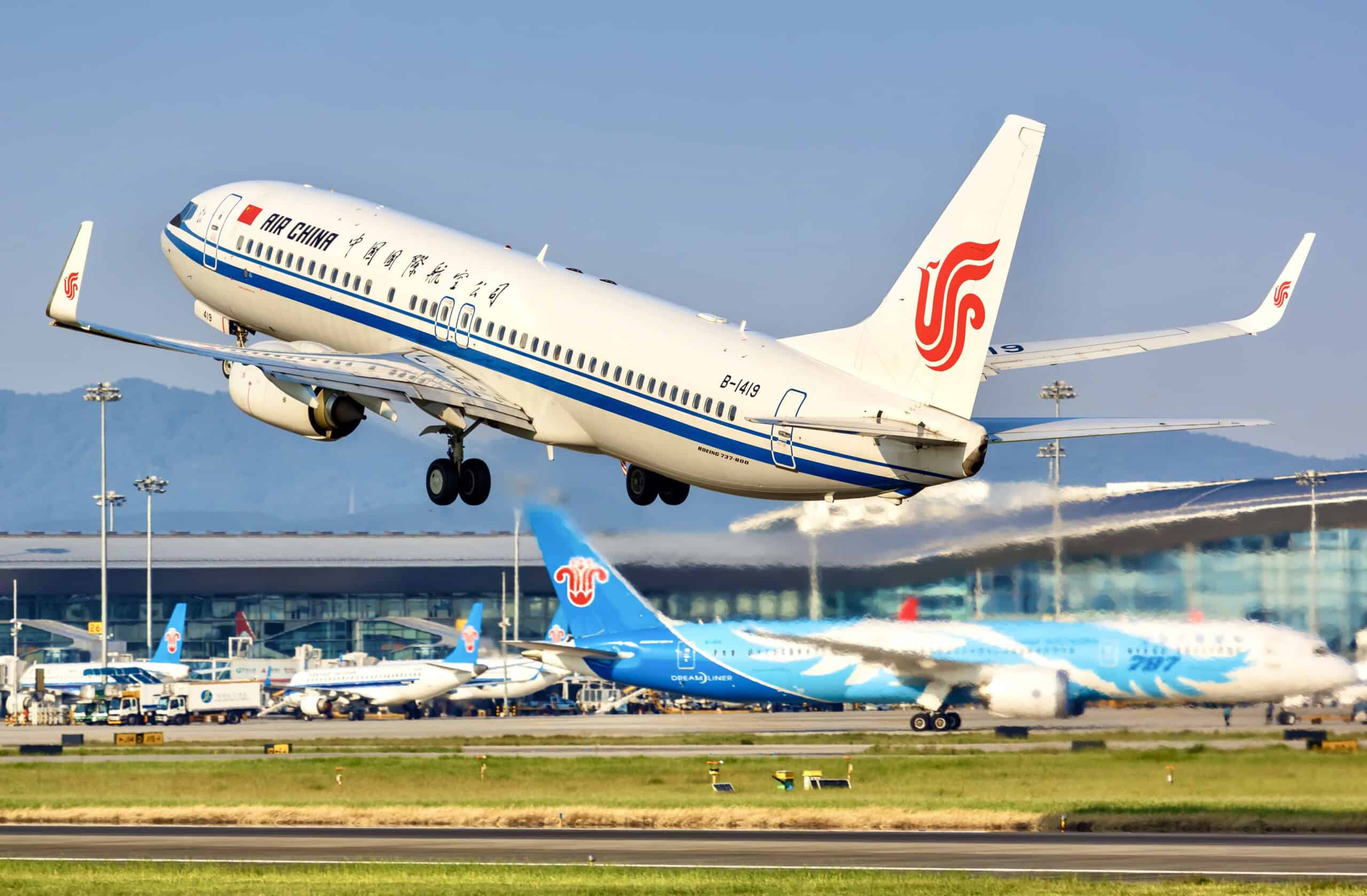
One factor slowing profit for China’s major airlines is the size of their planes. Each of the big three owns dozens of bigger jets known as wide-bodies. These can travel greater distances than narrow planes, but they are also more expensive to operate because they are heavier and use more fuel.

The big three Chinese carriers deployed wide-body planes for shorter flights during the pandemic, as popular long-haul routes like Shanghai to London stopped operating. Meanwhile, the price of jet fuel more than doubled.
“All these wide-body jets have to fly domestic and short distance international markets instead of intercontinental,” says Li Hanming, an aviation analyst. “That is definitely the dilemma.”

As recently as last year, Air China was warning that “some wide-body aircraft were [still being] used in the domestic market” because demand for international flights had not recovered from the pandemic.
But data from the Civil Aviation Administration of China shows that international air travel is on track to surpass prepandemic levels for the first time this year.

A more lasting headwind is China’s expanding network of high-speed trains, which generally cost less to travel on than planes, without the hassle of the airport. For example, a train from Beijing to Shanghai next week costs less than $100 for a commute as short as four and a half hours, according to travel platform trip.com; a flight on a big three carrier can cost more than twice as much for two hours in the sky, not including time at the airport.
There is significant overlap between flagship flight and high-speed rail routes, adding to pressure on the airlines, says Yu Zhanfu, a transportation consultant. China has the world’s largest network of high-speed trains, comprising some 30,000 miles, according to state media.
“That’s something that no other country will face,” Yu says.
Passengers took six times as many trips on high-speed trains as on domestic flights in China last year, official data shows.

China’s airlines are also no stranger to “involution,” the excess competition that is causing price wars across several Chinese industries. Each of the big three state-owned airlines mentioned intensifying competition as a risk to their businesses in their most recent annual reports.
None responded to requests for comment.
The fact that Air China, China Eastern and China Southern are all state-owned isn’t always helpful, as they end up creating routes based on policy priorities rather than market forces — such as a new China Eastern route from Shanghai to Ruijin, the historic capital of Mao Zedong’s Chinese Soviet Republic, where the Chinese Communist Party is now promoting “red tourism.”
Internationally, this means more flights are on offer to countries that are part of the Belt and Road Initiative, China’s landmark infrastructure investment program. In June, China Southern launched a twice-weekly direct route from Beijing to Dushanbe, Tajikistan — a country where only 30,000 Chinese have visited this year through September.

Noah Berman is a staff writer for The Wire based in New York. He previously wrote about economics and technology at the Council on Foreign Relations. His work has appeared in the Boston Globe and PBS News. He graduated from Georgetown University.