A single tweet by the general manager of a National Basketball Association team was all it took for China to sever ties with the world’s top basketball league six years ago. Now, the NBA has spent enough time sitting on the sidelines.

This week it will host two games in Macau, returning to Greater China for the first time since Daryl Morey, then the general manager of the Houston Rockets, tweeted support for pro-democracy protesters in Hong Kong in 2019. He later deleted the post, but the NBA refused to discipline Morey, leading China’s state broadcaster CCTV to stop showing games and Chinese sponsors to suspend partnerships with the league.
The dramatic fallout, along with the Covid-19 pandemic, slowed detente between the NBA and Beijing. But observers say the league has always been anxious to get back to a country that had seen rapid revenue growth through much of the 2010s.
“The question was never is the NBA abandoning China?” says Vince Gennaro, a sports business professor at New York University. “It was how quickly can you get back there?”
The league’s long-awaited return shows how international sports leagues still see the Chinese market as a valuable prize, as they compete in the global entertainment market — while underscoring the risks global brands are willing to accept to rake in revenue from China.
“The issue is not if you understand China’s red lines. If Beijing chooses to make an example of you, they will do so,” says Isaac Stone Fish, chief executive of Strategy Risks, a firm that consults on corporate exposure to China. “The NBA seems to have decided that China is integral to its growth, and that puts it in a difficult position.”
China’s appeal to the NBA lies in its vast population, many of whom love basketball. The league says that almost 500 million people — 50 percent more than the population of the United States — watched the NBA on platforms managed by its Chinese streaming partner Tencent in 2019.
“We are operating in China because there are hundreds of millions of passionate NBA fans there,” Deputy Commissioner Mark Tatum said in a statement.

An internal study the league conducted this year found that 37 percent of the online population in China watch live NBA games at least once a month, compared to 35 percent in the U.S. and 24 percent in Europe.
While the NBA and other major sports leagues are still continuing to grow in the U.S., the Chinese market has the potential to grow faster, says Mark Fischer, former managing director of the league’s operations there.
“China is a huge market with tremendous affinity for basketball and therefore for the NBA…It’s the biggest market outside North America, bar none,” he says. “It’s critical for the NBA’s international growth, which is a key pillar of the overall growth strategy.”
China is a market that you can’t ignore for a whole bunch of Western brands, the NBA as much as anyone. They’ve looked at the numbers, and they’ve looked at the potential growth, and they have weighed up the risk and decided that it is worth it.
Mark Dreyer, journalist and author of Sporting Superpower
Even so, the NBA does not publicly release its financials, making it difficult to assess China’s current importance to the league. One estimate in 2019 pegged NBA revenue from the country at $500 million annually, or about 6 percent of the $8 billion turnover Forbes approximated for the season prior.

A significant source of the league’s China revenue came from a streaming deal with Tencent, worth a reported $1.5 billion over five years. The two sides renewed it for an undisclosed sum before it expired last season, according to a league spokesperson.
The NBA’s streaming deal is likely the biggest signed by a global sports brand in China. Soccer’s English Premier League agreed in 2016 to a $700 million arrangement for the 2019-22 seasons with PPTV, a division of conglomerate Suning. However, the arrangement fell apart in 2020, and the EPL has not hosted a match in mainland China since before the pandemic.
China has also been a source of investment for NBA teams. Joe Tsai, a billionaire who is now chairman of Chinese tech giant Alibaba, agreed to buy a minority stake in the Brooklyn Nets in 2017 and fully acquired the team two years later for $2.3 billion.
Tsai has since played a crucial role in rebuilding the league’s relationship with Beijing, says Marc Ganis, a consultant. “He’s a human bridge between the NBA and China.”
After taking a hit that Silver said in 2020 was in the hundreds of millions of dollars, the league’s China revenue, including sponsorship, is back to prepandemic levels, according to an NBA spokesperson. But in the intervening years, the league’s total turnover has also risen, meaning income from China may now be a smaller part of its overall pie. CNBC estimated in February that the league’s teams currently make $11.4 billion in annual sales.
It is unclear how the NBA currently values its China business, although key Chinese companies that suspended their relationships with the NBA in 2019, including China Mobile subsidiary Migu and milk producer Mengniu Dairy, are now back as official partners, according to the NBA China website. They have been joined by the likes of Alibaba’s finance arm Ant Group — Tsai sits on the company’s board.
…both certain players and the NBA are actively working with a government [in China] that is perpetrating grave human rights violations against its own minorities. The hypocrisy is very disappointing.
Yaqiu Wang, a human rights researcher
“China is a market that you can’t ignore for a whole bunch of Western brands, the NBA as much as anyone,” says Mark Dreyer, who wrote a book about China’s sports industry. “They’ve looked at the numbers, and they’ve looked at the potential growth, and they have weighed up the risk and decided that it is worth it.”

“I don’t think they really have a choice,” he adds.
The question now is what steps the NBA will be willing to take to ward off another expulsion.
“Both the NBA and athletes like LeBron James are known for their support for social justice issues within the United States,” says Yaqiu Wang, a human rights researcher. “At the same time, both certain players and the NBA are actively working with a government [in China] that is perpetrating grave human rights violations against its own minorities. The hypocrisy is very disappointing.”
Other international sports leagues — and many global brands — have had to balance human rights and political concerns with their business in China. Mesut Özil, a former star for EPL club Arsenal, criticized China’s treatment of the minority Uyghur population in 2019, leading CCTV to temporarily halt broadcasts of his team’s games. Two years later, the Women’s Tennis Association suspended events in China when Peng Shuai, a former world no. 1 doubles player, disappeared after accusing a former Chinese official of sexually assaulting her. The WTA returned to the market in 2023.

The NBA’s rapprochement with Beijing conflicts with its proclaimed values, says Enes Kanter Freedom, who played for six NBA teams between 2011 and 2022. Kanter Freedom says that when he started wearing shoes with slogans like “Free Tibet” and “Free Uyghurs” in 2021, Ron Klempner, then senior counsel at the NBA players’ union, told him he would “cost your team and your owner millions of dollars.”
Klempner and the union did not respond to requests for comment, though the union has previously said it supported Kanter Freedom’s right to speak on important issues.
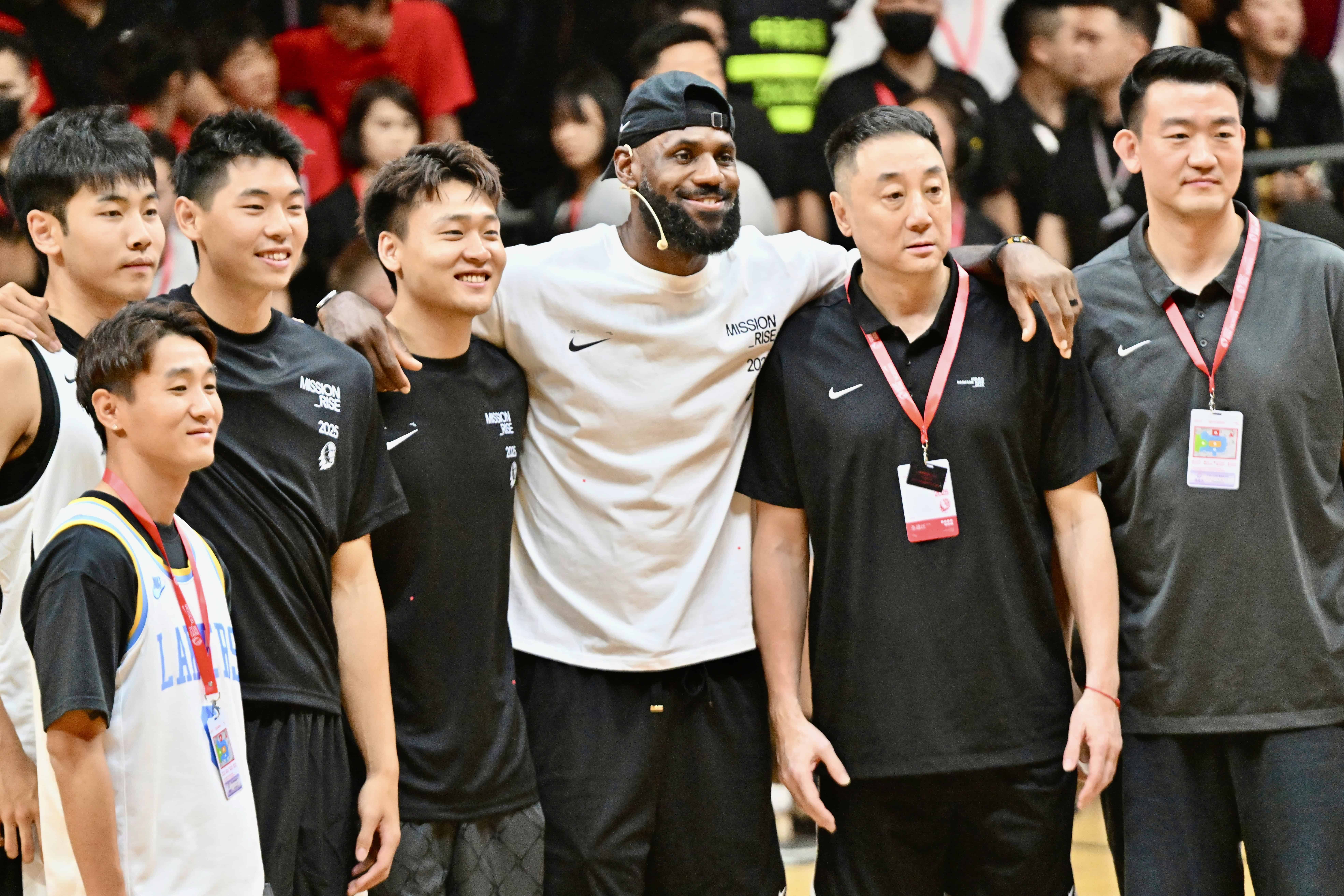
Teams and players alike are now looking to win the love of Chinese fans. This summer players including James, Stephen Curry, and James Harden drew big crowds on marketing tours there for sporting goods sponsors. Eight teams have meanwhile partnered with East Goes Global, a marketing and partnerships firm that manages Chinese social media accounts, according to founder Andrew Spalter.


Left: Stephen Curry visiting Chongqing, China, August, 2025. Right: James Harden visits a basketball court in Guangzhou with a custom mural of Harden, August, 2025. Credit: Stephen Curry via X, LA Clippers via X
The Morey tweet incident still looms large, however. When Spalter meets with team marketing officials, “one of the first questions is how do we avoid that situation?” he says.
“We have always supported members of the NBA family speaking out on issues that are important to them, and we’ll continue to rely on the U.S. State Department for guidance in the more than 200 countries and territories around the world where we engage fans,” Tatum, the league’s deputy commissioner, said in his statement.

Kanter Freedom is skeptical of the league’s support. After Morey sent his tweet in 2019, he says a Boston Celtics executive told players not to comment on China.
A spokesman for the Celtics said in a statement that Kanter Freedom’s claim was “untrue.”
“At no point has the team told players not to discuss any subject,” the statement said. “The Celtics have and will always support our players’ freedom of expression.”
The NBA did not provide details on how it is addressing potential reputational and political risk associated with operating in China.
Kanter Freedom doesn’t expect players to speak out when the season begins. “I’m sure they’re going to have a really strict training,” he says. The NBA has “been dying to go back to that market for a very long time.”

Noah Berman is a staff writer for The Wire based in New York. He previously wrote about economics and technology at the Council on Foreign Relations. His work has appeared in the Boston Globe and PBS News. He graduated from Georgetown University.