China’s political system is preoccupied with stability, particularly in the runup to a quinquennial Party Congress meeting. But there has been little understanding of how the Communist Party’s efforts to cultivate a perception of political stability have interacted with financial stability in China. Nor has there been a full appreciation of how the bargain between the Party and Chinese citizens, that has broadly sustained this financial stability in the recent past, has now fundamentally changed. Against that background, public messaging that Xi Jinping is set to further consolidate and centralize control at the 20th Party Congress is now more likely to generate risks within China’s financial system, rather than defusing them.
China has to date avoided a major financial crisis, despite its eye-watering debt levels — the result of the largest single-country credit expansion relative to global GDP in over a century. This is not because of commonly cited macroeconomic factors, such as the country’s high savings rate or its low levels of external debt, but because of market expectations that the government could be relied upon to intervene in response to the emergence of any financial risks. Given these expectations, financial market participants have not needed to reduce their exposure to such risk by selling assets in times of turbulence — they could simply wait on the sidelines for Beijing to intervene whenever problems occurred.
In 2022, Chinese depositors and investors can no longer be certain that Beijing prioritizes economic growth or stable employment ahead of all other objectives.
Over the past decade, China’s financial system has in this way served as a shock absorber for the economy and the CCP-led political system. Economic cycles that would typically create political risks in market economies, such as recessions, unemployment, or bankruptcies, were offset by new state-directed lending and investment from China’s banks. Under a market-driven financial system, credit expansion like that seen in China — much faster than the growth of the underlying economy — would normally have generated multiple defaults, bankruptcies, and financial losses for banks and investors. But until recently, Beijing could always be trusted to intervene to manage such losses, because it was understood that its priority was always to maintain the perception of political stability, which in turn required both high levels of economic growth and employment — and the avoidance of protests from angry investors facing financial losses.
Chinese households, companies and financial institutions gradually came to understand this bargain and took steps to benefit from it. If Beijing would always respond to potential losses that might generate political risks or protests, then investors could safely deploy capital into increasingly risky and high-return investments. The system as a whole became ever more unstable, but individual investors could benefit from higher rates of return on wealth management products or shadow banking instruments; or even, in 2015, from buying into an already-soaring stock market, knowing the government would eventually be forced to bail them out.
But that political bargain is changing — quickly. In 2022, Chinese depositors and investors can no longer be certain that Beijing prioritizes economic growth or stable employment ahead of all other objectives. Defaults and losses on financial products are increasingly probable given the inevitable risks exposed by an unprecedented, decade-long credit expansion. And the centralization of authority under Xi Jinping has made his words and actions more significant in investors’ calculations of risks. Beijing is less likely to intervene in response to financial stress, particularly if Chinese authorities under Xi are trying to change the structure of the economy in line with his objectives.

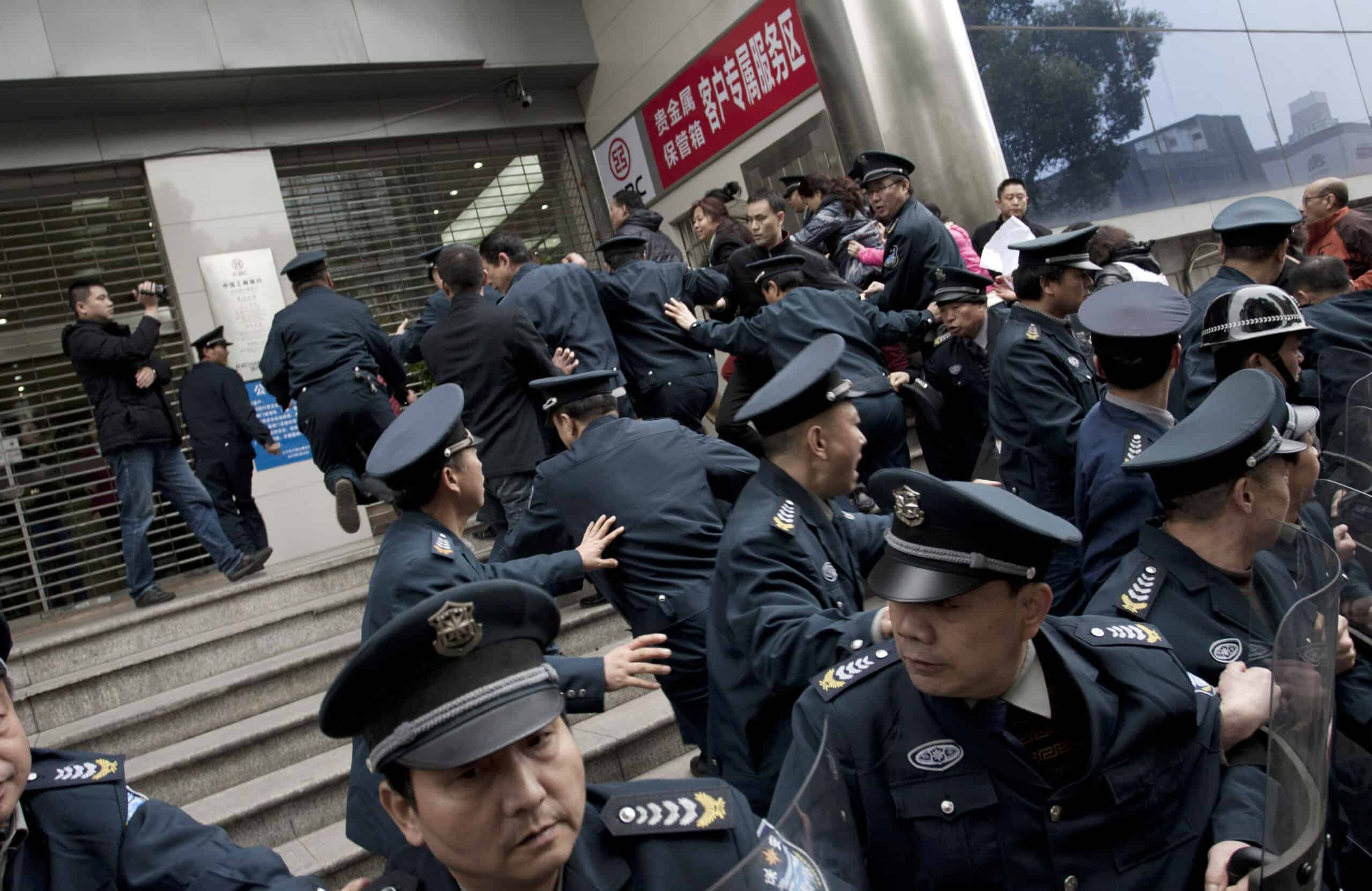
This fundamental change is evident in the way that Beijing has handled the increasingly common instances of default on financial products, since China’s deleveraging campaign began in 2016. Defaults started in peer-to-peer lending networks, and have extended to corporate bonds, smaller commercial banks, trust companies, local government state-owned companies, and most recently, property developers such as the country’s largest, Evergrande. After several peer-to-peer lenders defaulted in 2018, thousands of people gathered in Beijing to protest against their losses; however, they did not receive bailouts or compensation, but were simply placed on buses and sent home. Many investors in defaulted trust products showed up at these companies’ headquarters to protest last year, mostly to no avail. Defusing protests over financial losses does not appear to have been a political priority over the past five years, in part because Beijing never intended to actually bail out the riskiest parts of the shadow banking system. As a result, investors increasingly need to protect themselves, by selling assets, withdrawing investments in riskier firms, and contributing to a long-term slowdown in growth in credit and the overall economy.
The property market is a case in point. Xi Jinping’s widely quoted warning that “housing is for living in, not for speculation,” has deterred investors and speculators from returning to the now flagging housing market, despite new local government incentives to buy. In the past, stern warnings against speculation from Hu Jintao or Wen Jiabao did not generate the same response, because of a widespread belief that China had a collective leadership, with local governments — which depend on the property market as a key source of revenue — representing a powerful interest in Beijing’s decision-making.
Under Xi Jinping’s more centralized governance, it will be difficult to encourage speculators to come back to the market unless they believe that he has changed his mind about the risks of rising housing prices and the role of the property sector in the economy. Absent a public change of heart from Xi, investors are likely to face lingering concerns about new regulatory risks. So while China’s central bank has repeatedly encouraged Chinese commercial banks to extend new loans to the troubled sector, its efforts have met with little success: individual loan officers simply do not want to be held accountable for lending to riskier private developers during the current downturn.
…with the nature of Beijing’s credibility changing, and markets uncertain of how far various top-down policy changes might extend, risks of a crisis increase.
Proactive and unexpected political decisions under Xi’s administration have also generated significant financial risks in recent years. The regulatory scrutiny of Alibaba and other Internet platform companies caught shareholders in those firms off guard. Investors in education and tutoring firms saw almost their entire investments in the industry wiped out by new regulations last year. Property firms have cracked under the pressure of Beijing’s “three red lines” limiting developers’ leverage, although this adjustment was a long time coming.
It is far more probable that these sorts of reforms to China’s economy — unwinding government guarantees or sudden crackdowns on particular industries — will spark a financial crisis in China than external shocks such as the COVID pandemic, or the war in Ukraine. The government’s credibility — the belief that it would respond to financial stress — has previously prevented a crisis in China: But with the nature of Beijing’s credibility changing, and markets uncertain of how far various top-down policy changes might extend, risks of a crisis increase.
The perceived centralization of political power makes it more difficult for Beijing to reverse these actions and stabilize financial conditions. In a system of collective leadership in which technocrats weigh policy choices in the interests of the Party leadership as a whole, any individual leader’s choices may be important, but remain only one voice among many. In an increasingly centralized system, once a policy is identified with Xi Jinping himself, an investor would probably need to believe that Xi had changed his mind for that policy to be reversed. If the message emerging from the 20th Party Congress is that Xi Jinping has further consolidated control, China is likely to face rising risks to financial stability in the years ahead.

Logan Wright is a Partner at Rhodium Group and leads the firm’s China Markets Research work. He is also an Adjunct Fellow of the Trustee Chair in Chinese Business and Economics at the Center for Strategic and International Studies.