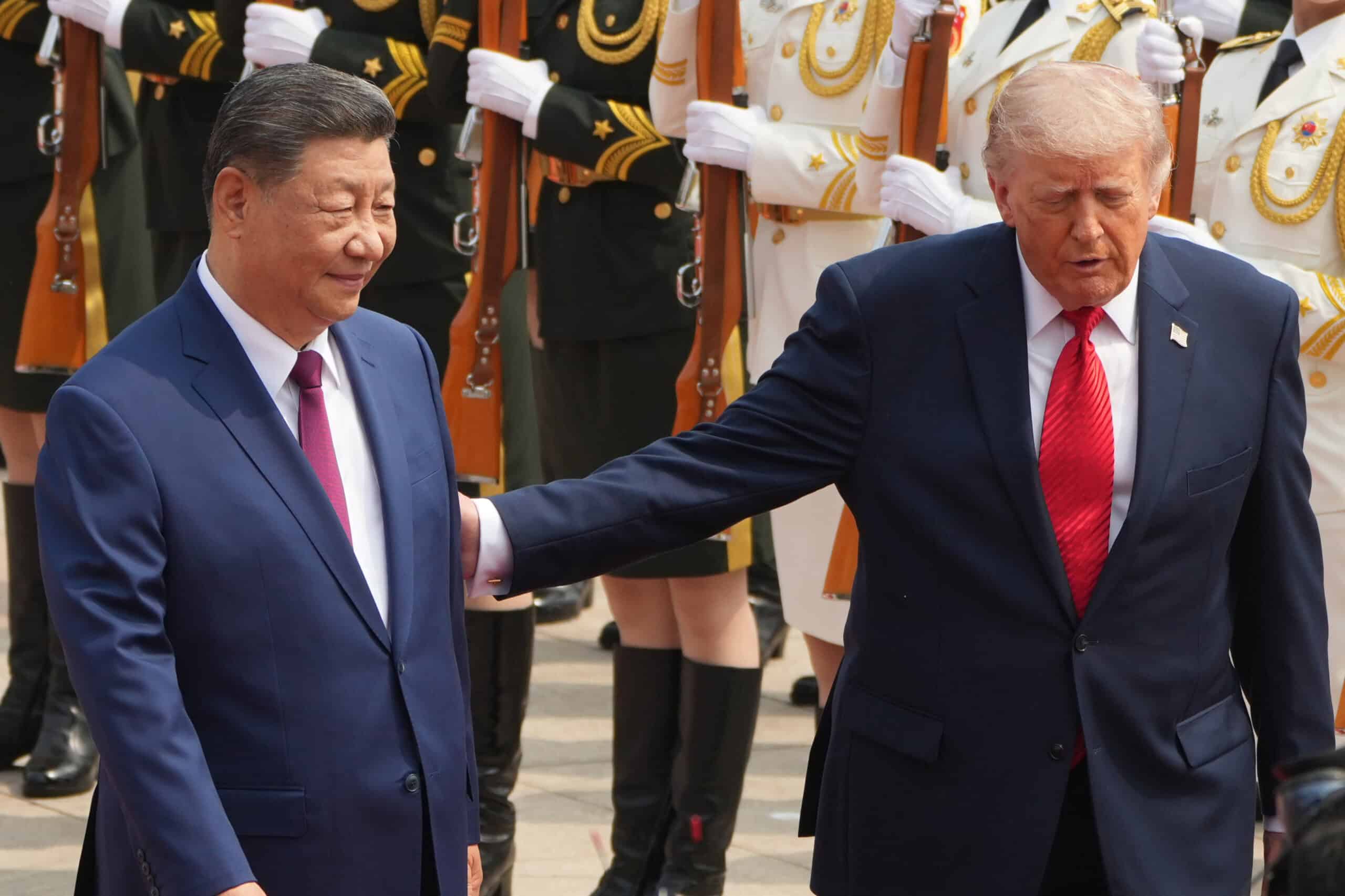
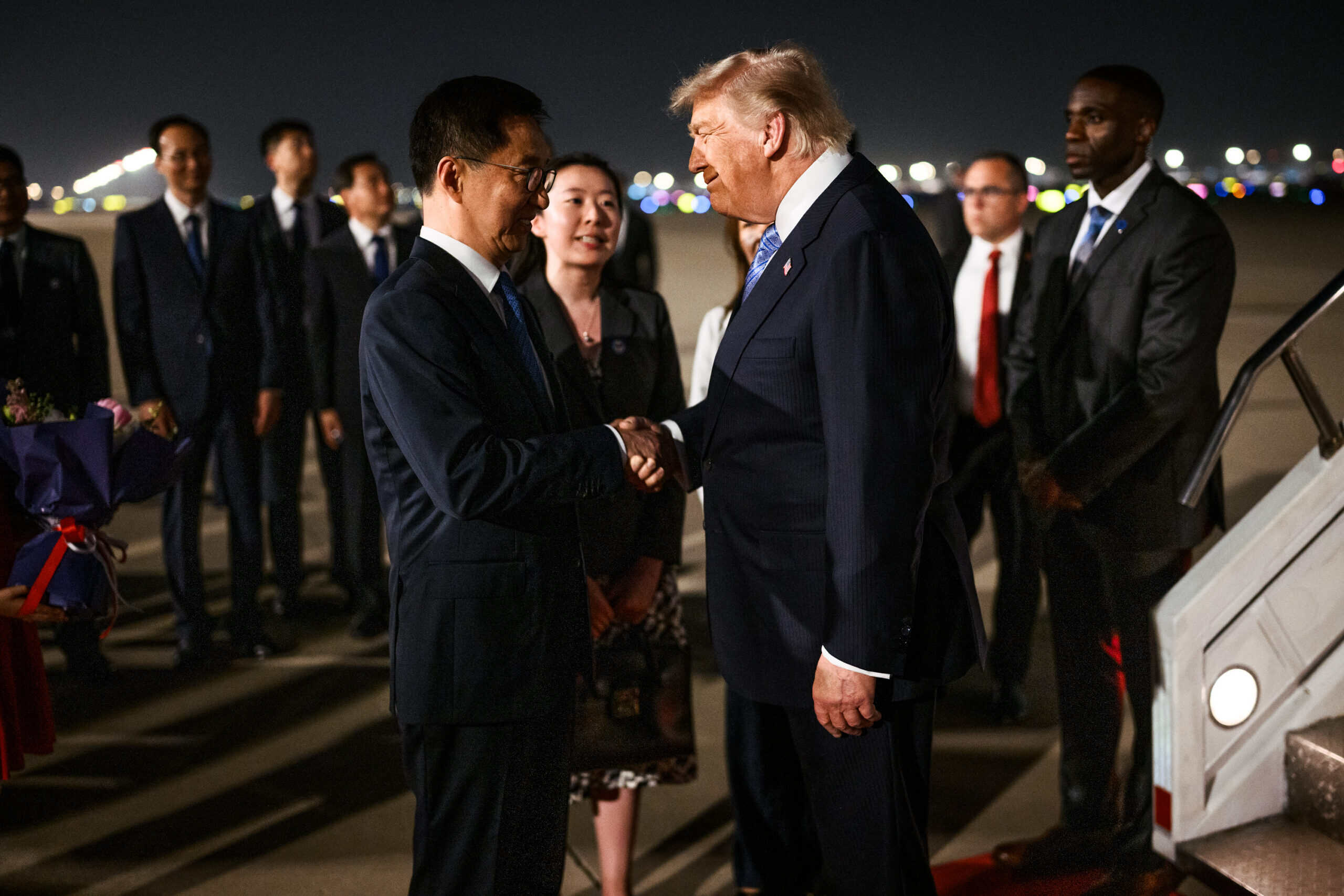
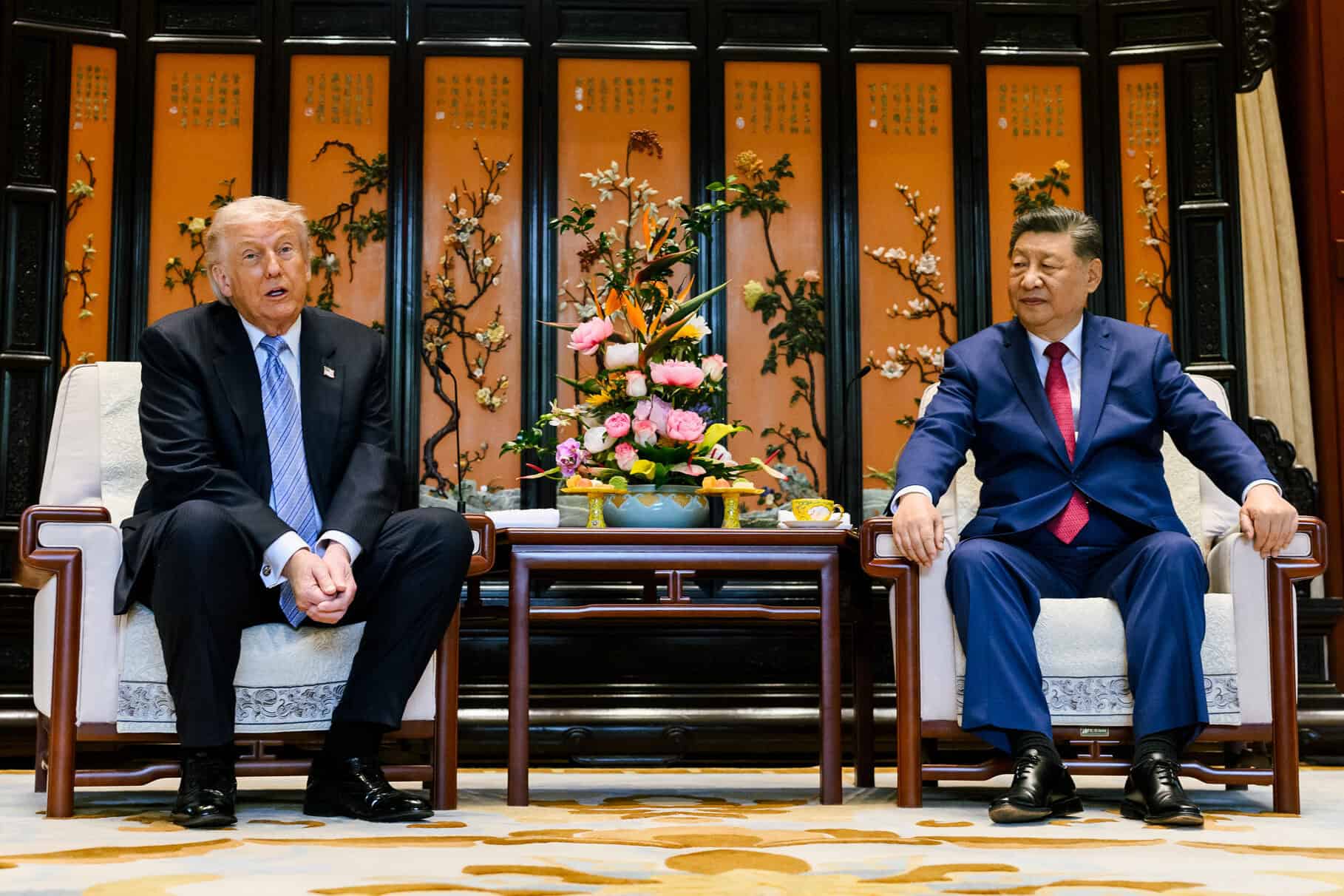
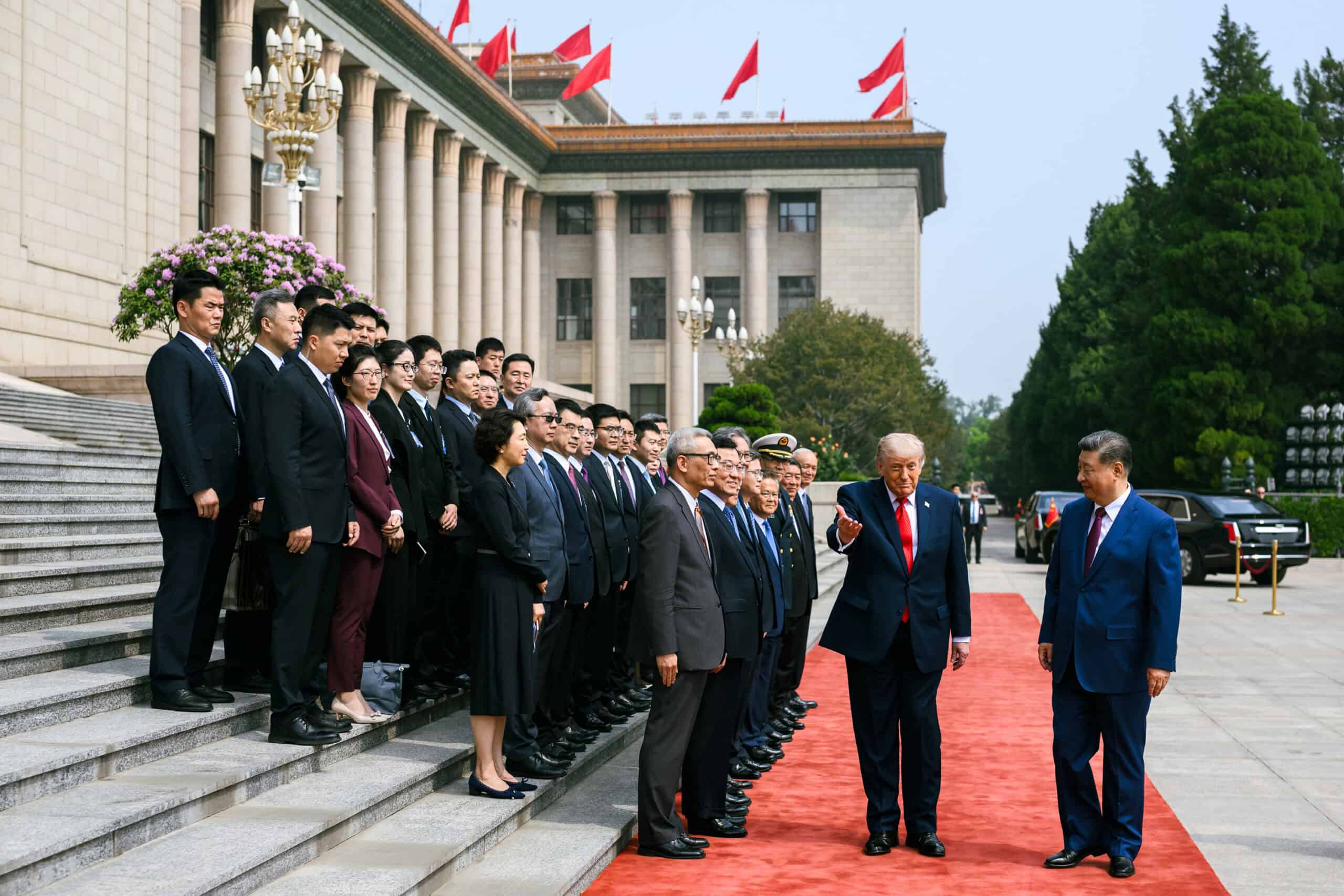
Meetings between the presidents of China and the U.S. generate much excitement, especially when those presidents are Xi Jinping and Donald Trump and it is the first time in almost a decade that an American president has visited China. Such a big event, the thinking goes, must surely generate big news.
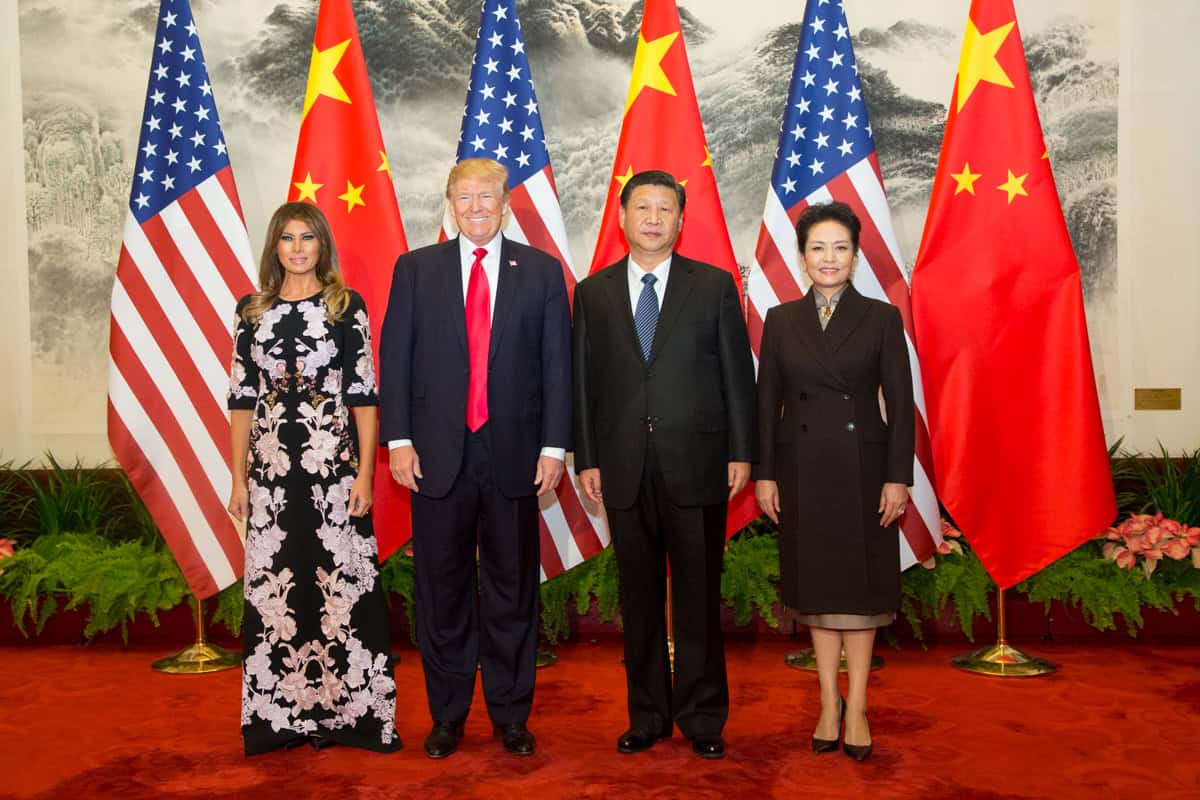
Such expectations are, however, a triumph of hope over experience, as illustrated by Trump and Xi’s May 13-15 summit in Beijing.
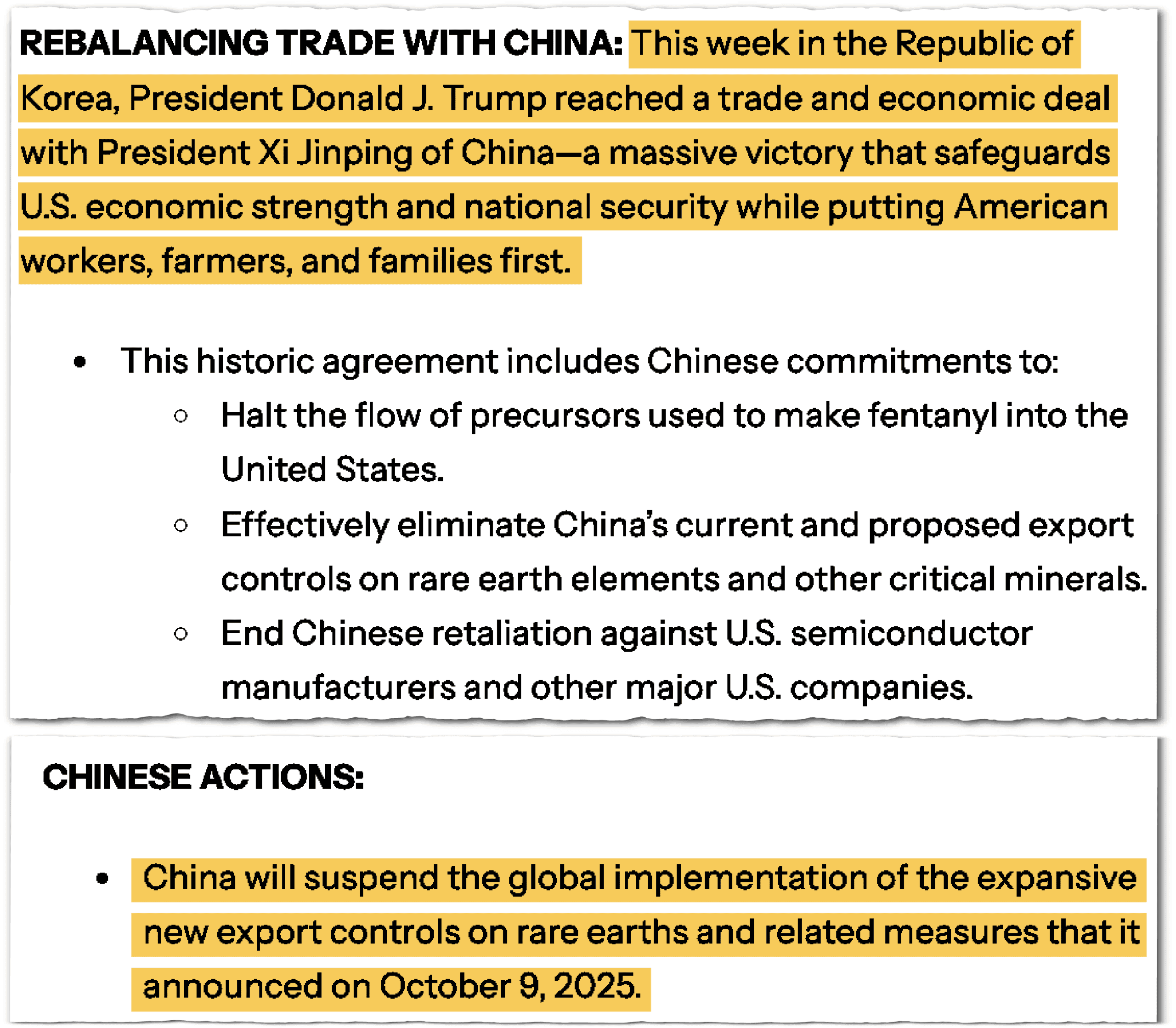
Major China-U.S. news stories (tariff hikes and counter-hikes, sanctions and counter-sanctions) happen between such meetings, not at them. A classic example of this pattern occurred in the run-up to Trump and Xi’s meeting last October in South Korea, when Washington was due to vastly expand the number of Chinese companies subject to American technology restrictions. Beijing countered with moves to restrict exports of vital rare earth elements. The end result was a stalemate, as the two presidents agreed to postpone each measure and also declare a truce in the trade war started by Trump shortly after he returned to the White House in January 2025.
Similarly, this month’s Beijing summit produced easy agreements on Chinese purchases of U.S. agricultural products and airplanes that China needed anyway, without any resolution of much more critical disagreements over technology, rare earths and Taiwan. (Trump’s first visit to Beijing in November 2017 was also heavy on pomp, light on substance and marked a lull in the storm. Eight months later, the president fired the opening salvo in his first-term trade war with China.)
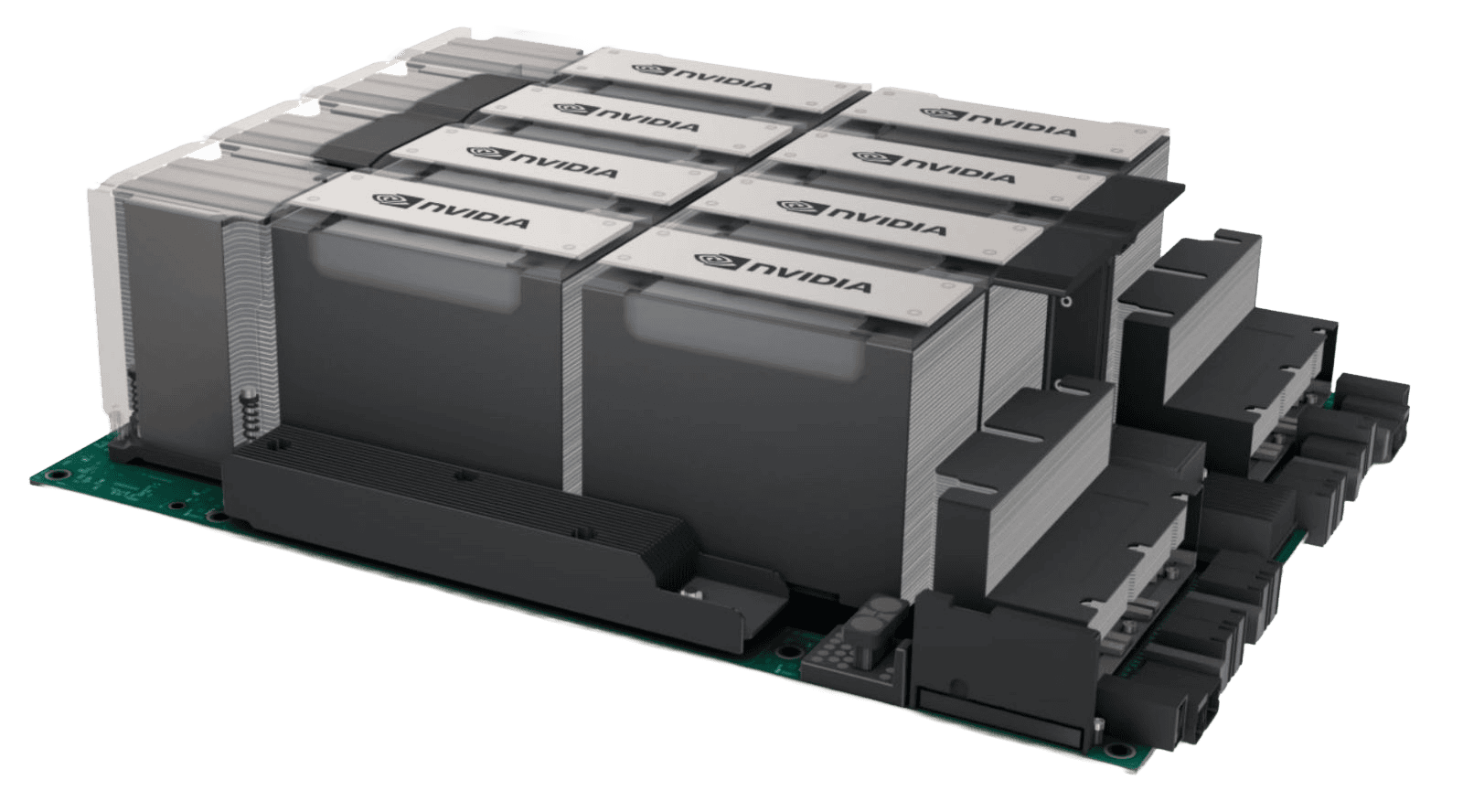
Trump said he and Xi had discussed Chinese purchases of Nvidia’s H200 semiconductor chips, which the U.S. has approved for sale to China over the objection of many China hawks. China, however, is reluctant to buy them. One person familiar with the discussions also told The Wire China that U.S. approval for Nvidia to sell its more advanced Blackwell chips was not on the agenda at the summit. (The White House did not respond to a request for comment.)
This week The Wire assesses the summit and its modest outcomes with seven Chinese and American experts and the relative of a Chinese prisoner of conscience.
THE VIEW FROM BEIJING AND SHANGHAI
* Wu Xinbo, Fudan University
* Xu Dingbo, China Europe International Business School
* Sun Chenghao, Tsinghua University
* David Daokui Li, Tsinghua University
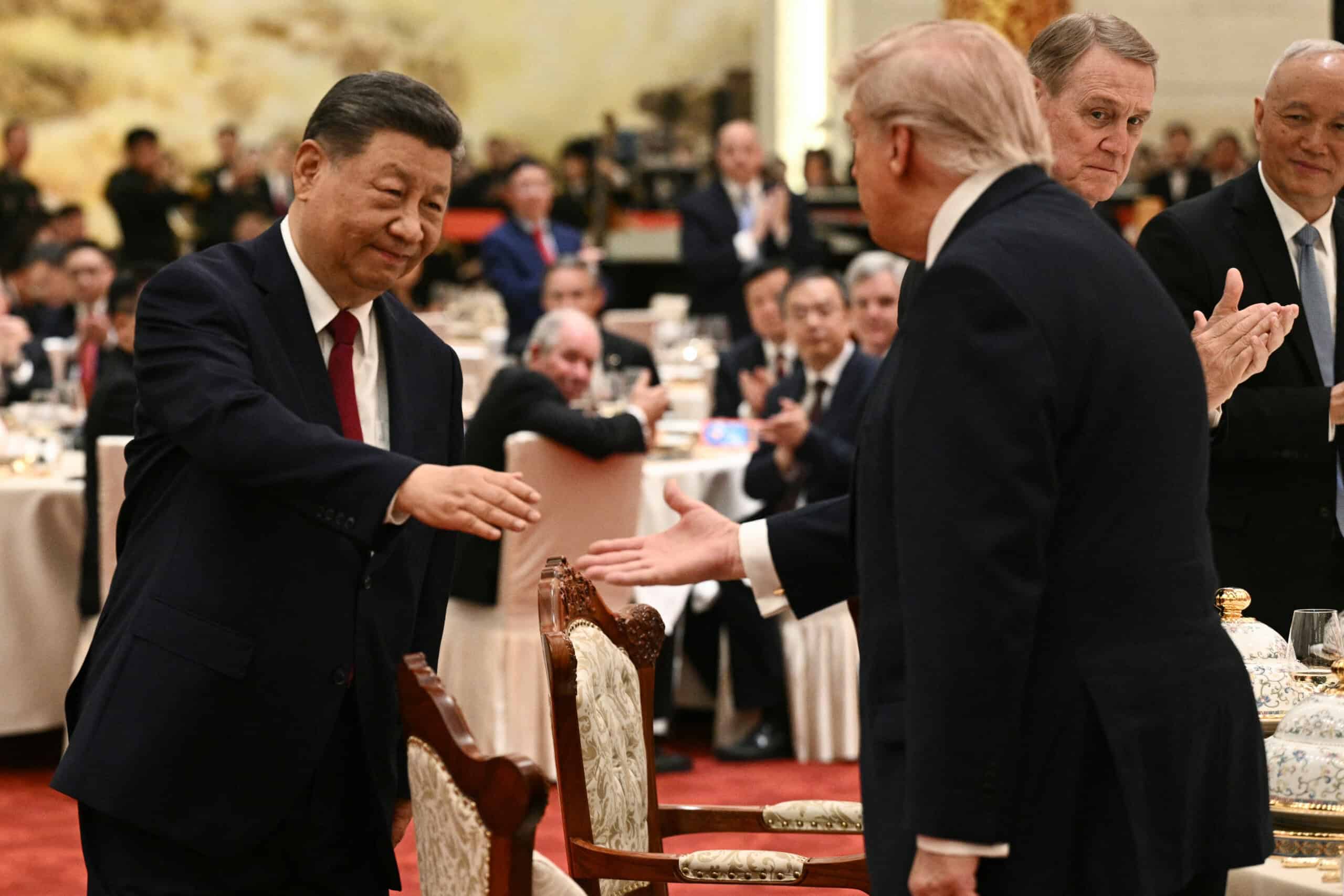
As he watched Xi Jinping’s official welcome banquet for Donald Trump unfold, Wu Xinbo reflected on what he sees as a fundamental shift in Sino-American relations since the U.S. president last visited Beijing in 2017.
“Trump has gone through a learning curve,” Wu, a dean and U.S. specialist at Fudan University in Shanghai, told The Wire. “Compared with his first term, he realizes that China is far more powerful than [it was] nine years ago — and also more determined in defending its national interests.”
He also believes Trump has shifted his approach to China even in the 18 months since he returned to the White House.
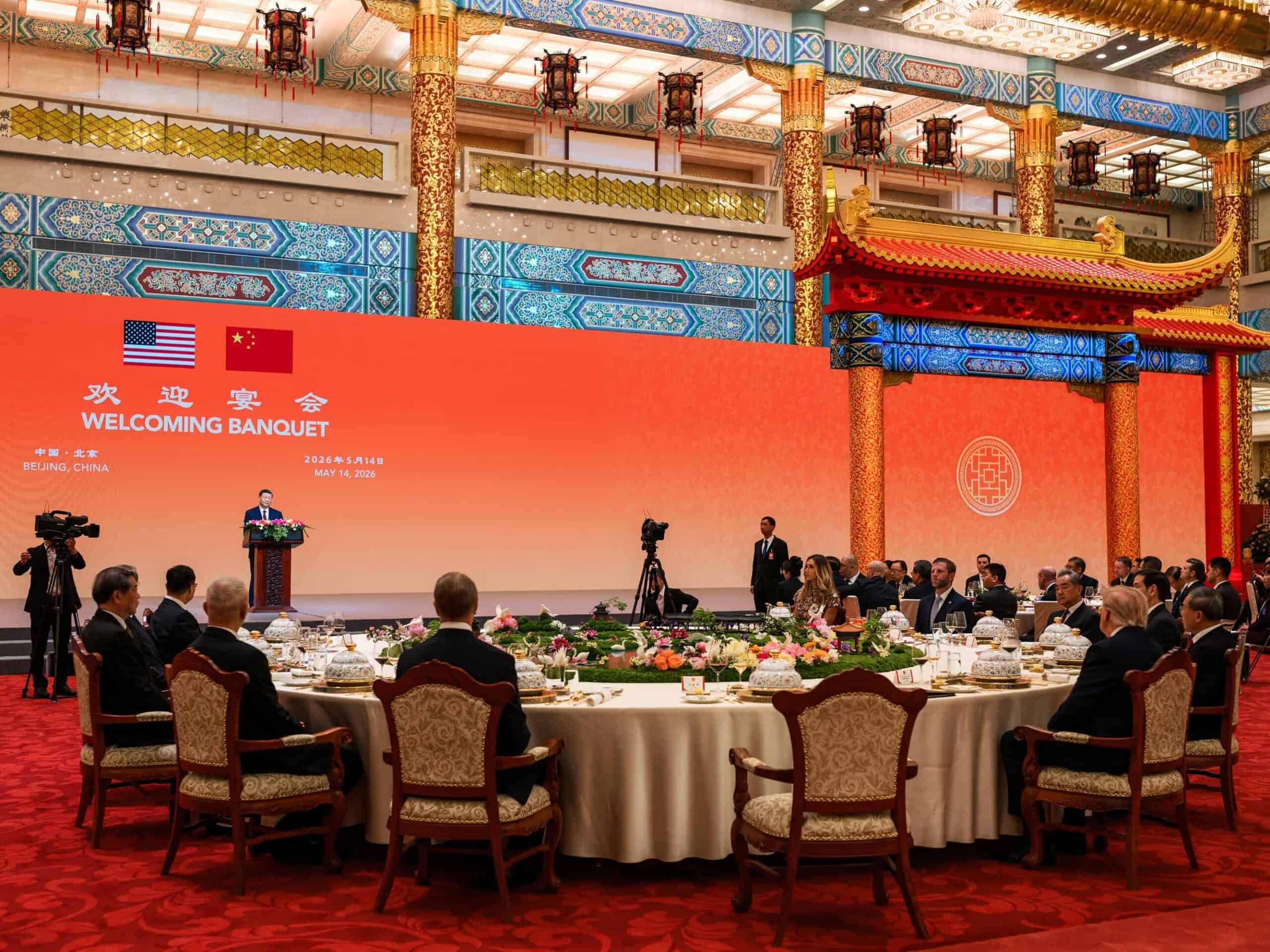
“[Last year] Trump was very much issue-specific in his China policy — focused on very narrow issues such as trade or fentanyl. He was not interested in exploring cooperation and coordination with China [more broadly],” said Wu, who was seated between John Hiller, head of Trump’s advance team, and Fox News anchor Bret Baier at the welcome dinner at the Great Hall of the People.
Wu, who sits on the Chinese foreign ministry’s policy advisory board, said that his two American dinner companions were surprised that a scholar had been invited to the event.
Xu Dingbo, a trade expert at the China Europe Business School in Shanghai, agrees with Wu that under Trump, the U.S. “treats every summit as a major deal-making event”.
In contrast, Xu adds, “China always takes a long-term perspective on this relationship — every summit is part of a process … As long as we are generating more positive dynamics [in] this relationship, then down the road we will benefit more and more.”
I would be cautious about using the word ‘détente’ because it may imply a fundamental reduction in strategic rivalry… I would say we are entering a period of managed competition. The relationship is not becoming warm, but it may become more predictable.
Sun Chenghao, a senior fellow at Tsinghua University’s Center for International Security and Strategy (CISS)
After the summit, the Chinese government claimed the two countries had entered a new era of “constructive strategic stability”. But Chinese academics said Beijing is under no illusion that its relations with Washington will improve rapidly.
“I would be cautious about using the word ‘détente’ because it may imply a fundamental reduction in strategic rivalry,” says Sun Chenghao, a senior fellow at Tsinghua University’s Center for International Security and Strategy (CISS). “That is not what we are seeing.
“I would say we are entering a period of managed competition,” he adds. “The relationship is not becoming warm, but it may become more predictable.”
Xu said Beijing had been emboldened by the success with which it has weathered the Trump administration’s tariff hikes on Chinese exports and its efforts to restrict Chinese companies’ access to advanced technologies.
“China’s trading system is far more resilient than most people predicted,” he adds. “Americans realize the limit of the impact of tariffs on China’s economy.”
Last year the world’s second-largest economy posted a record trade surplus of $1.2 trillion, and it did so while reducing its dependence on the U.S. market. At the beginning of the century, the U.S. absorbed 11 per cent of China’s exports. By last year that had fallen to 5.4 per cent. Xu says that “the question is, does the U.S. want to make itself irrelevant to China’s trade system?”
David Daokui Li, a Tsinghua economist who has advised China’s senior leaders and central bank, said that the most important item for Xi Jinping at the summit was Taiwan: “China would like the U.S. to make a statement saying that the U.S. opposes any action to support the secession of Taiwan from China.”
China appeared to make some progress on this front when, in an interview with Baier after the summit, Trump said he had no interest in fighting a distant war for Taiwan’s independence and urged the island’s government to “cool it”. But he also didn’t rule out defending Taiwan and told Beijing to tread more carefully as well.
China, Li said, knows all too well that “one can never” take Trump’s words at face-value because “he changes very quickly.”
TAIWAN
* Drew Thompson, a former director of the U.S. Defense Department’s China, Taiwan and Mongolia Office, is a senior fellow at Nanyang Technological University’s S. Rajaratnam School of International Studies in Singapore. In April, shortly after China’s highest ranking military official was purged by Xi Jinping, Thompson wrote a Substack post about his interactions with the disgraced general, Zhang Youxia, that went viral. In that post Thompson also shed new light on the case of missing South China Morning Post journalist Minnie Chan, a longtime friend and contact of his who is presumed to have been detained by Chinese state security officials.
In advance of his trip, Trump had told reporters he was prepared to discuss U.S. arms sales to Taiwan, raising fears on the island that he might change longstanding American policy by agreeing to stop such sales — or even formally oppose Taiwan independence — as part of a larger “grand bargain” with Xi. Thompson thought these fears were overblown, and disagreed with the perception that Trump would arrive in Beijing weakened by the unintended consequences of his politically unpopular war on Iran.
“I don’t think Trump is going to change rhetoric, or pledge not to sell arms or not run [Taiwan] Strait transits [by U.S. naval vessels] in exchange for a vague offer by Xi Jinping to address fentanyl,” Thompson said. “He’s not out of cards like a lot of the pundits are saying, and he’s self-confident.
“China has been really clear about what it wants or expects [from the U.S. on Taiwan],” Thompson added. “What they have not been upfront about is what they’re prepared to give for that concession from Trump. And President Trump is transactional, and he’s going to want something really valuable, particularly because the Chinese have made it abundantly clear that Taiwan is their number one issue.”
Many foreign policy analysts in Washington tut-tut that Trump’s willingness to talk glibly about sensitive issues that his predecessors would only address with extreme caution, or not at all. At the very least, they argue, this gives Beijing the impression that previously sacrosanct U.S. policy positions are now negotiable. Thompson thinks that Trump’s unpredictability instead causes fits for Beijing.
“All of these contradictions that President Trump throws out in advance of these meetings — there’s a pattern,” Thompson said. “He’s not telling you what his position is going into the meeting. He’s keeping it vague … He’s talking out of both sides of his mouth, which creates a bit of a dilemma for Xi Jinping’s staff. How do you prepare a boss who insists on preparation when this is what you’re facing?
“You don’t know how much Trump values things,” he added. “Essentially everything on the table is in a black market and what is [Trump’s] price for it?”
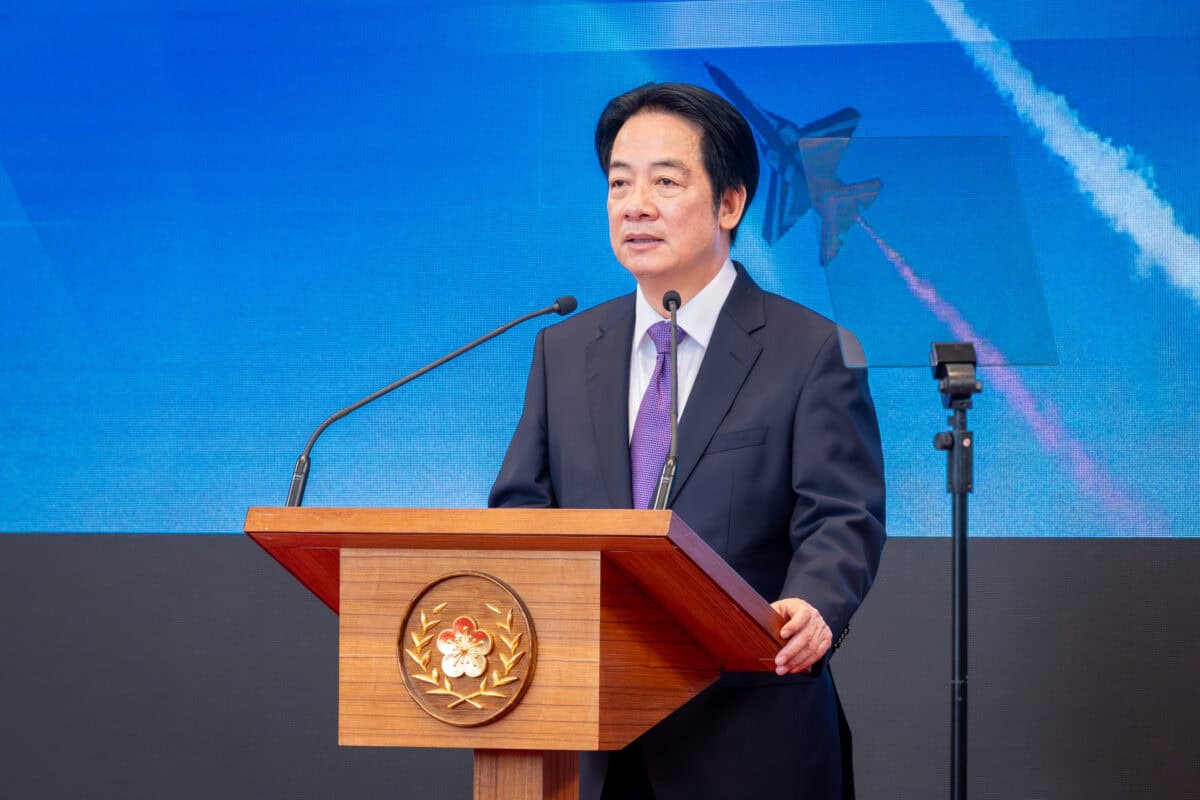
After leaving Beijing Trump continued to speak in ways that will both encourage and enrage Xi, implying that he may not approve a $14 billion arms sale to Taiwan but also saying he might have to speak to the island’s president, Lai Ching-te, before reaching a final decision. (A sitting American president has not spoken with his Taiwan counterpart since the 1970s; Washington re-established diplomatic relations with Beijing in 1979.) The arms sale, Trump added, was “a very good negotiating chip” to have in his pocket.
“The way Trump phrased many things was foolish and unhelpful but I think I understand why he’s doing it,” Thompson said. “He’s doing it to create uncertainty … He doesn’t want [Taiwan] President Lai [Ching-te] to be too confident either. Lai can declare [that Taiwan is already independent] all he wants but until somebody else does too it remains unrecognised.
[President Trump] is trying to buy time until we have more freedom of action to achieve the reindustrialization that he really really wants. We can’t do that right now, fully, given these continuing dependencies.
Nadia Schadlow, a former deputy national security advisor for strategy during the first Trump administration, and current senior fellow at the Hudson Institute
“In the [public] meetings with Xi Jinping, Trump was following his script and seemed to be quite disciplined,” Thompson added. “It was when he was meeting with the media [after the summit] and talking on the plane that he put things in his own voice. But I didn’t see huge inconsistencies or contradictions.”
TRADE AND THE BROADER RELATIONSHIP
* Nadia Schadlow, a former deputy national security advisor for strategy during the first Trump administration, is a senior fellow at the Hudson Institute. She was a lead author of the 2017 National Security Strategy, which described China as a “revisionist power” seeking to “shape a world antithetical to U.S. values and interests.”
* Piero Tozzi is senior director for China Policy at the America First Policy Institute, a think tank closely aligned with the Trump administration.
Trump went into the summit wanting the same thing from China he has always wanted, Nadia Schadlow says, which is to erode the “perpetual trade imbalance with China, which enrages him and has angered him, understandably, for ten years at least.”
It is a hard problem to solve, she notes, because China’s trade dominance is linked to its political system. “China can’t stop doing overcapacity. It’s who it fundamentally is,” she says. “It’s a tough problem.”
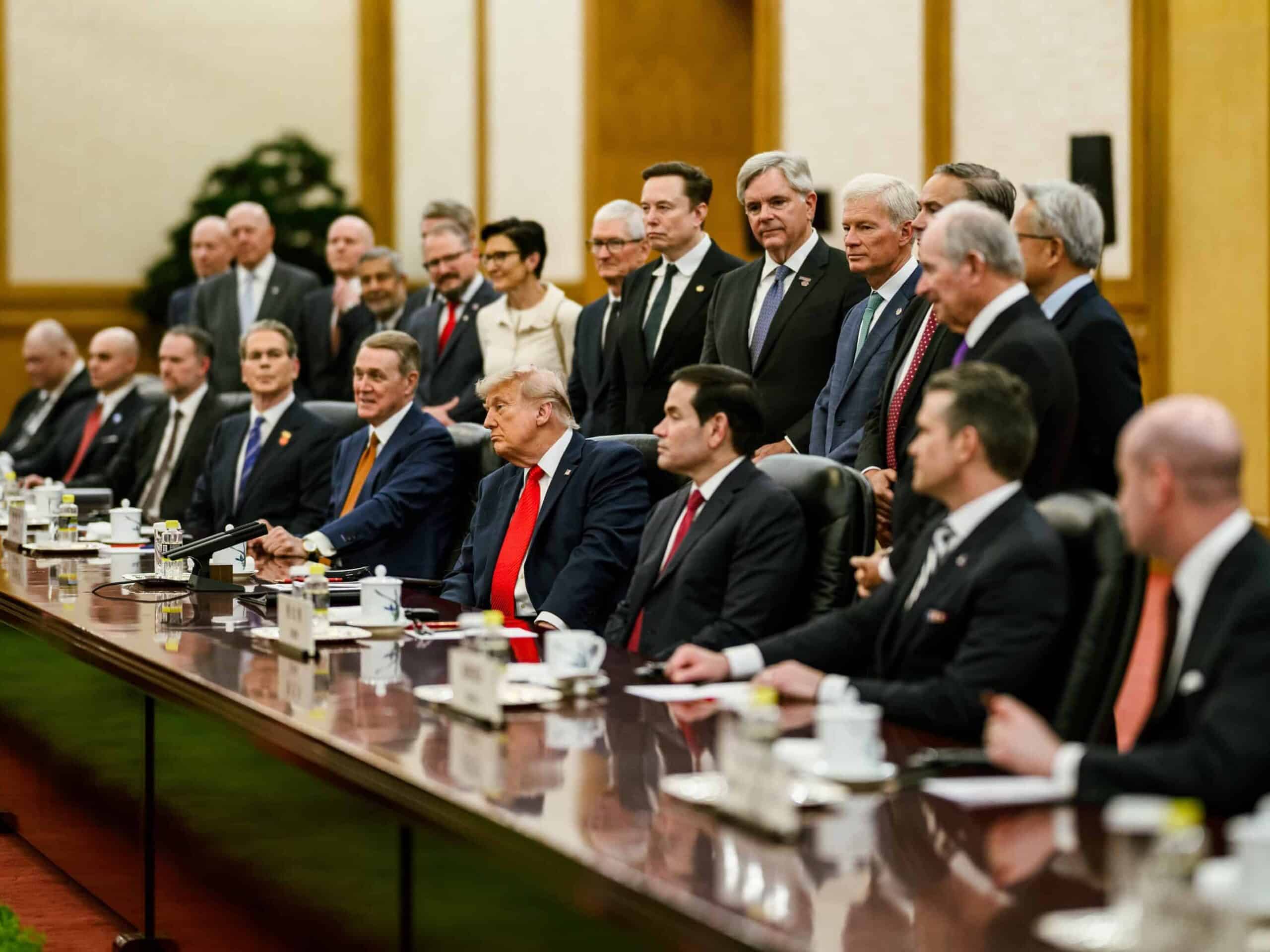
Rumors swirled ahead of the trip about whether Trump would accept a $1 trillion investment package from China. Trump has spoken several times about letting Chinese electric vehicle manufacturers build factories in the United States, and was joined in Beijing by 17 executives from some of the largest American companies.
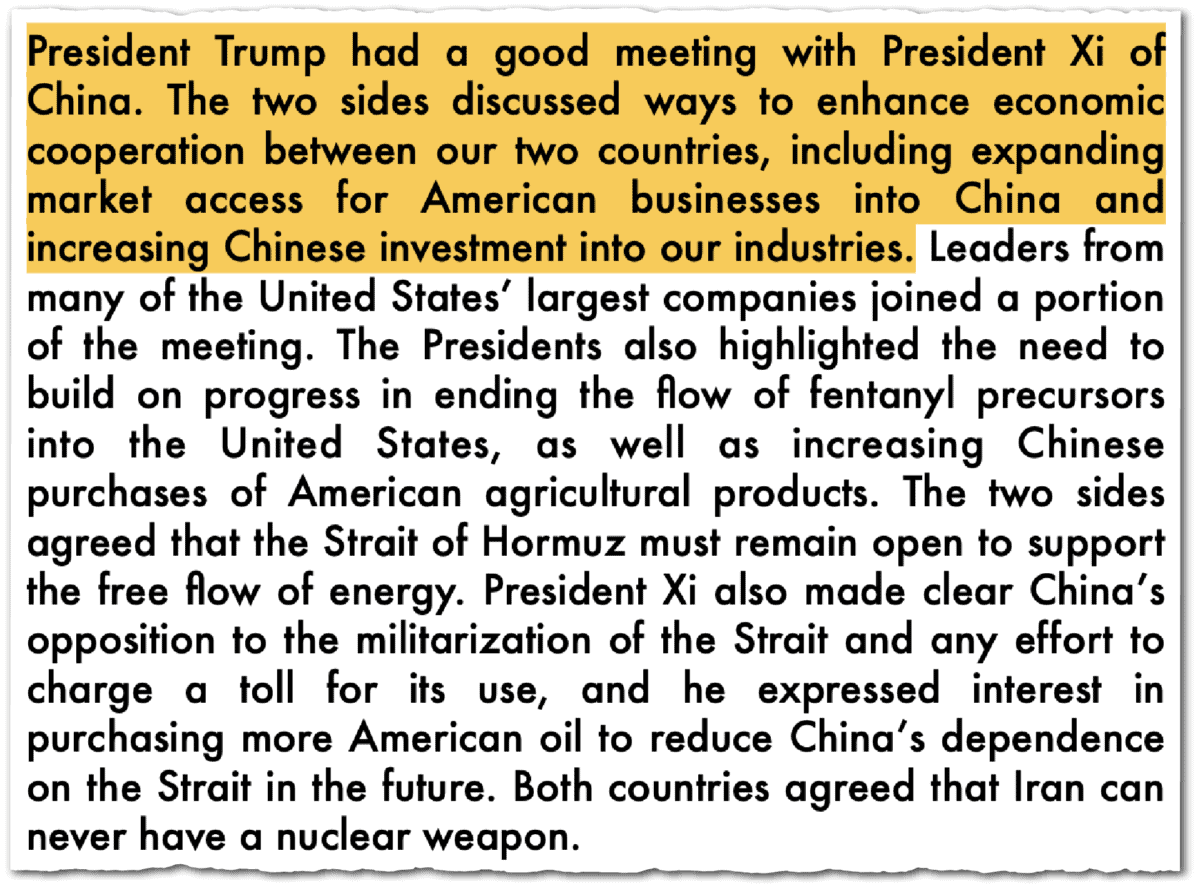
In a readout after the visit, the White House said the two sides had discussed “increasing Chinese investment into our industries,” without offering details. A Chinese Ministry of Commerce readout confirmed only that the countries had agreed to establish a board of investment.
Schadlow said that there are few sectors in which Chinese investment in the U.S. is risk-free, particularly given the relevance of AI and data to so many emerging sectors. “If he invited China in to reindustrialize American factories, for example, it would be [a] terrible mistake for national security reasons in particular.”
Trump could make concessions, she notes, if they give the administration the time to make supply chains more resilient, especially after China’s export controls on rare earths, imposed last year, threatened to grind several industries to a halt. “He is trying to buy time until we have more freedom of action to achieve the reindustrialization that he really really wants,” Schadlow says. “We can’t do that right now, fully, given these continuing dependencies.”
She cited areas including critical minerals and certain electronic components where Chinese companies control the market. “Sometimes you have to make some tactical concessions to get to a better end state.” What would that look like? “At the very least, an actual fundamental reduction of our dependencies on China.”
The U.S and China ultimately left the summit without clear progress on those sticking points, though the White House did say China would address its concerns about securing rare earths.
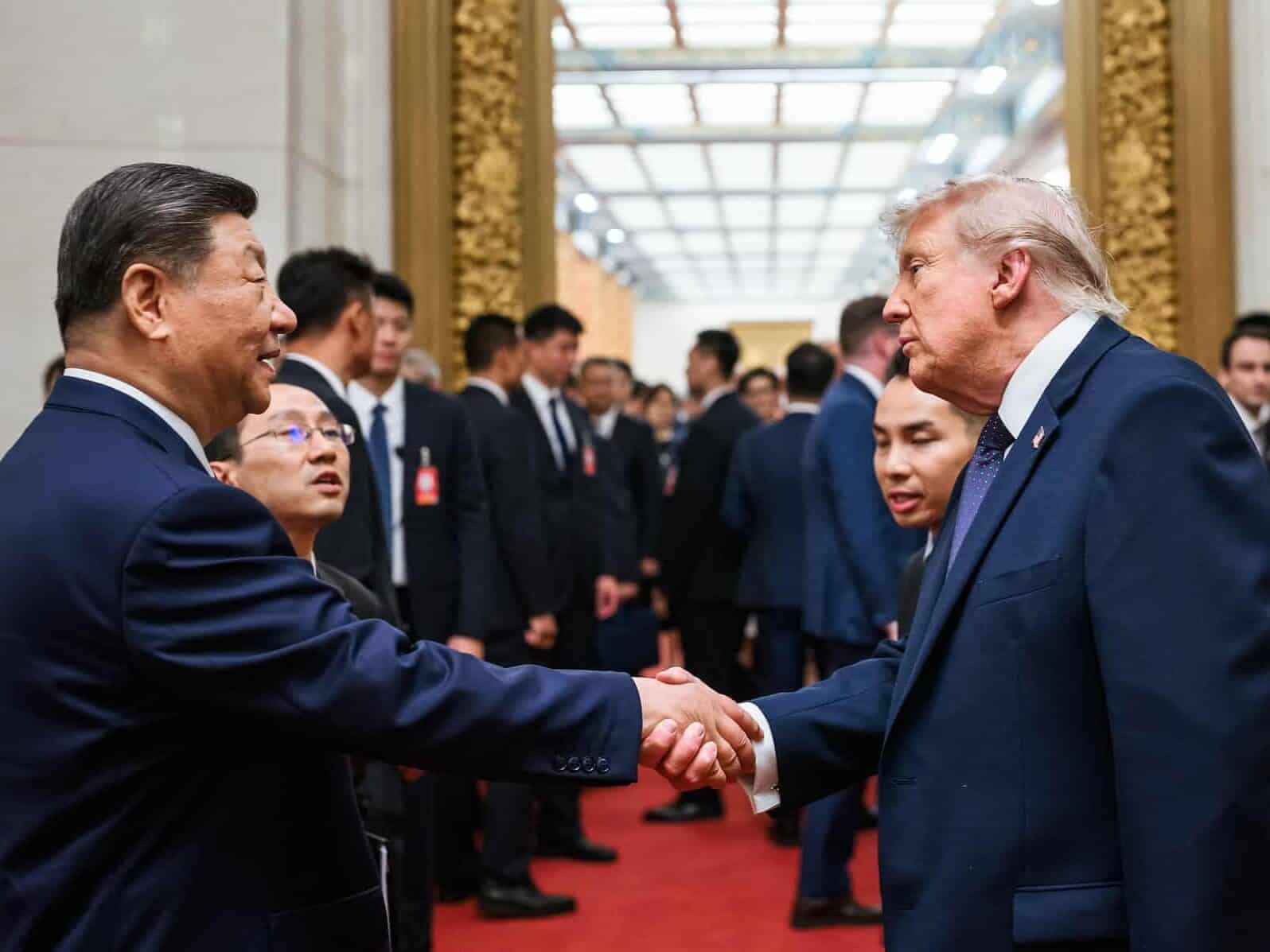
In the end, says Schadlow, the highly anticipated summit was mainly about “keeping lines of communication open with China and trying to buy time.”
Trump and Xi each wanted to stabilize ties for domestic political reasons, adds Piero Tozzi. “President Trump has an eye toward the midterms and doesn’t want a roiled economy.” Deals would help.
China agreed to purchase 200 Boeing airplanes, but the aircraft maker’s share price slumped because analysts expected the number to be higher. For his part, Tozzi says, Xi “doesn’t want to see reignition of tariffs and trade war.”
Even if Washington and Beijing have come to a truce, Tozzi doesn’t see a change in the nature of the U.S.-China relationship: “It’s more than just economic or strategic. It’s systemic.”
Despite fears that Trump will make concessions on the status of Taiwan, Tozzi says U.S. actions speak louder than Trump’s muddled statements about the island after the summit.
“If you want to sum it up in one word: Balikatan,” Tozzi says, referring to the name of the military exercises between the Philippines, the U.S., Japan and four additional American allies that concluded less than a week before Trump arrived in Beijing.
“China wants to supplant the United States as the preeminent global power. The president understands that.”
The week after Trump left, Xi hosted an ally of his own: Russian President Vladimir Putin, who he has described as an “old friend.” Over the winter, a procession of European heads of state made their own visits to China.
But for Xi, Trump will always be different from other foreign leaders and other U.S. presidents, Tozzi says. “Trump is in his own category. He’s sui generis [and] always unpredictable.”
POLITICAL PRISONERS
* Bill Drexel is the son-in-law of Ezra Jin, the pastor of one of the largest churches in China who was detained by Chinese authorities last October. Human rights groups denouncedthe arrest and urged foreign governments to put pressure on Beijing to release Jin, who is one of more than 1,000 political prisoners in China, according to U.S. government estimates.
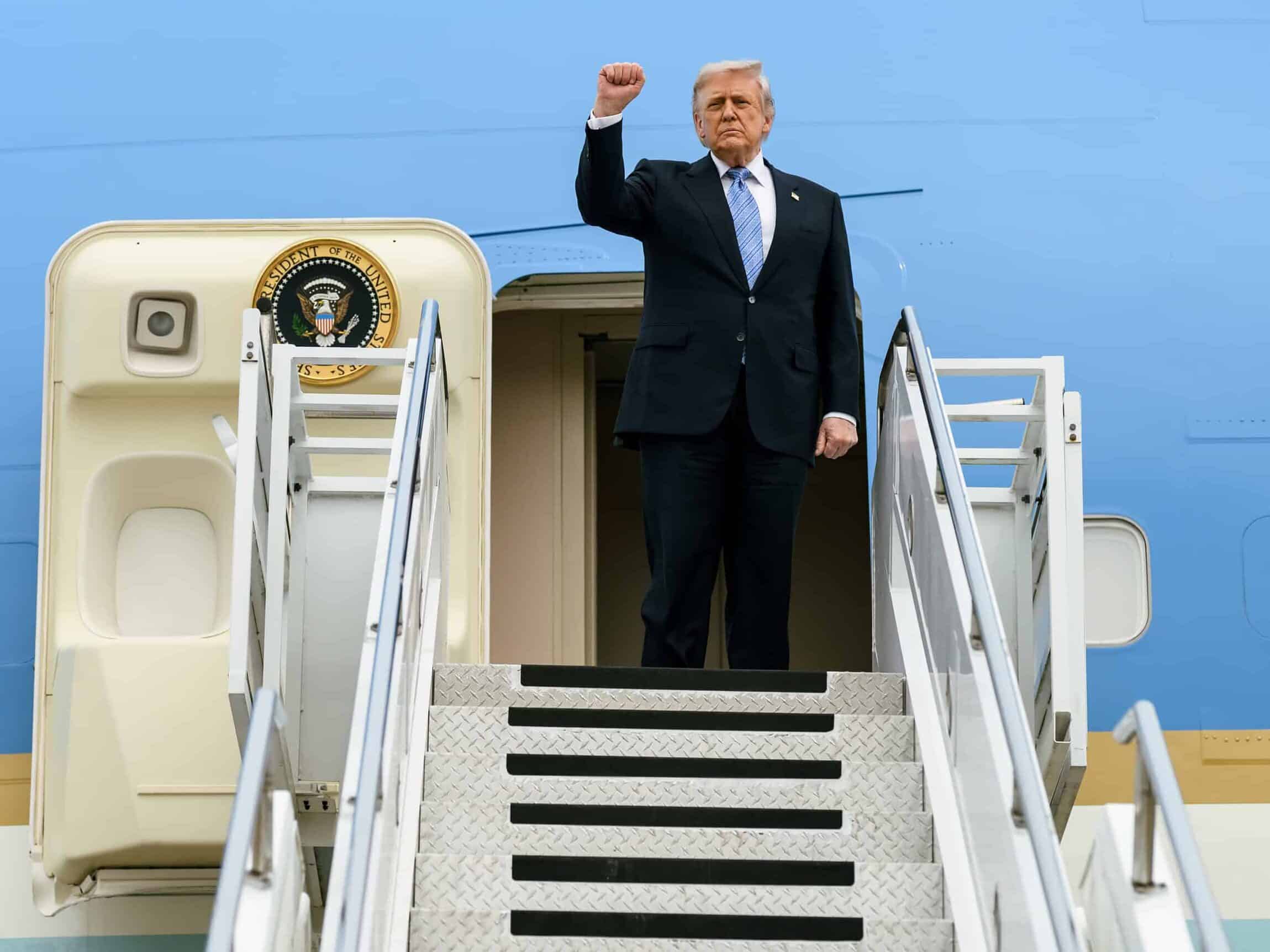
Speaking to reporters on Air Force One after the summit, Trump said that he had discussed Ezra Jin’s case with Xi and that Xi would “strongly consider the pastor.”
Human rights do not always make it on to the agenda in high-level meetings between the leaders of the U.S. and China. So the fact that Trump raised Jin’s case was a “huge breakthrough,” Drexel says, “particularly at a time when stabilizing the economic relationship seems to be such a priority.
“It’s not easy to bring up these sore spots,” he adds. “Raising it at this level is the first step to possible resolution, but we also want to be realistic that there’s a long road ahead. Getting any prisoner out of China is extremely difficult.”
Drexel notes that China may seek to extract unrelated concessions in exchange for the release of Jin and other prisoners of conscience Trump raised with Xi, including Jimmy Lai, Hong Kong’s most famous dissident. Lai is “a tougher one for [Xi],” Trump told Baier. “I would say the response to that was not positive.”
But Drexel sees cause for optimism, at least for his father-in-law, especially with another Trump-Xi summit scheduled for September in Washington.
“It would be nothing short of a miracle for him to get out,” Drexel says. “We believe in miracles.”
Rachel Cheung is a staff writer for The Wire China based in Hong Kong. She previously worked at VICE World News and South China Morning Post, where she won a SOPA Award for Excellence in Arts and Culture Reporting. Her work has appeared in The Washington Post, Los Angeles Times, Columbia Journalism Review and The Atlantic, among other outlets.

Noah Berman is a staff writer for The Wire based in New York. He previously wrote about economics and technology at the Council on Foreign Relations. His work has appeared in the Boston Globe and PBS News. He graduated from Georgetown University.

Savannah Billman is a Staff Writer for The Wire China based in NYC. She previously worked at the National Committee on U.S.-China Relations.

Tom Mitchell is features editor at The Wire. He previously worked at the Financial Times, where he was China bureau chief and deputy news editor, and also at the South China Morning Post as deputy business editor and Guangzhou correspondent.